

- POST-CLEARANCE AUDIT FOR FDI MANUFACTURERS IN VIETNAM: WHAT CUSTOMS FOCUSES ON AND HOW COMPANIES SHOULD PREPARE
- I. WHAT DOES CUSTOMS USUALLY FOCUS ON?
- 2. HS Code Classification and the Technical Nature of Goods
- 3. C/O and Preferential Tariff Treatment
- II. SMALL MISTAKES THAT MAY LEAD TO DUTY REASSESSMENT
- III. HOW SHOULD FDI COMPANIES PREPARE?
- IV. QUICK CHECKLIST FOR FDI IMPORT-EXPORT AND LOGISTICS TEAMS
- V. CONCLUSION: CUSTOMS COMPLIANCE IS PART OF SUPPLY CHAIN GOVERNANCE
- VI. WHAT SHOULD FDI COMPANIES DO NOW?
- Need support with customs compliance and post-clearance audit preparation?
POST-CLEARANCE AUDIT FOR FDI MANUFACTURERS IN VIETNAM: WHAT CUSTOMS FOCUSES ON AND HOW COMPANIES SHOULD PREPARE
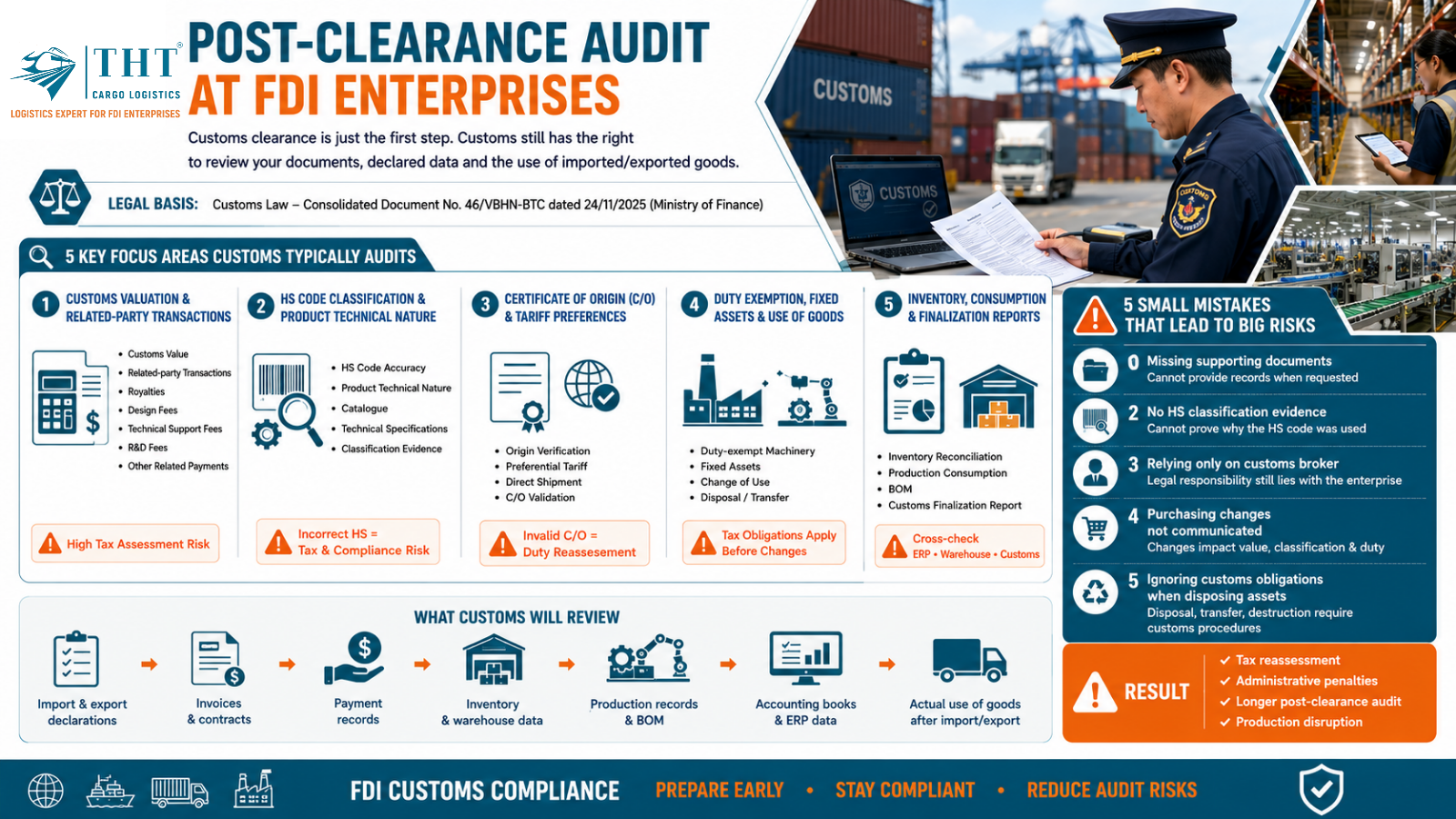
Many FDI manufacturers tend to think: “Once the shipment is customs-cleared, the matter is closed.” In reality, customs clearance is only the first step. After import or export procedures are completed, customs authorities may still review customs declarations, supporting documents, declared values, HS classification, preferential treatment, duty exemption status, inventory records and the actual use of imported goods.
Under Vietnam’s Customs Law, post-clearance audit is conducted to assess the accuracy and truthfulness of customs documents, declarations and the customs declarant’s compliance with customs regulations and other laws related to import-export management.
For FDI companies, especially export processing enterprises, export manufacturers, processing companies, or factories importing raw materials, components and machinery from parent companies or related parties, a post-clearance audit is not only about customs documents. It is also a test of the company’s internal control across purchasing, import-export, warehouse, accounting and production teams.
A small error, if repeated over several years, may lead to duty reassessment, late payment interest, administrative penalties and a higher risk profile in future customs procedures.
I. WHAT DOES CUSTOMS USUALLY FOCUS ON?
This is a key risk area for FDI factories importing raw materials, components or machinery from parent companies or companies within the same group.
Customs does not only look at the commercial invoice. Typical questions include:
- Is the declared price consistent with the actual transaction?
- Are there any additions to customs value that have not been declared?
- Are there royalties, mold fees, design fees, technical support fees, R&D charges or other payments to related parties connected to the imported goods?
- Are the Incoterms, payment terms and discounts commercially reasonable?
Practical example:
A factory imports components from its parent company at a price significantly lower than the price from independent suppliers. During a customs review, the company can provide invoices and contracts, but cannot explain the internal pricing policy, discount basis or commercial reason behind the lower price. As a result, the company may be requested to provide additional explanations and may face customs value reassessment.
Lesson for FDI companies:
An invoice alone is not enough. For related-party transactions, companies should keep internal pricing policies, framework agreements, price appendices, payment records, transfer pricing documentation if relevant, and a clear explanation of why the declared price is reasonable.
2. HS Code Classification and the Technical Nature of Goods
HS code classification is not only about tax rates. It determines customs duty, import-export policies, specialized inspection requirements and eligibility for preferential treatment.
Common mistakes at FDI factories include continuing to use the same HS code for years while:
- Product specifications have changed;
- Items have the same commercial name but different functions;
- New catalogues differ from old catalogues;
- The purchasing team changes suppliers without informing the import-export team;
- A forwarder or customs broker uses an HS code based on past experience, without proper verification by the importer.
Practical example:
A company imports “sensors” for its production line. Internally, all items are called sensors. However, when catalogues are reviewed, some are ordinary sensors, some are dedicated parts of machinery, and some have integrated control functions. If the company applies one HS code to all items, the risk of customs questioning is high.
Lesson for FDI companies:
Each key item should have an HS classification file, including product name, internal item code, current HS code, image, catalogue, function, material, working principle, reason for classification and history of changes. For high-risk items, companies should consider applying for advance ruling on HS classification where appropriate.
3. C/O and Preferential Tariff Treatment
C/O means Certificate of Origin. Companies often use C/O to enjoy preferential import duty rates under trade agreements such as ACFTA, ATIGA, AKFTA, VKFTA, CPTPP and EVFTA.
The risk is that preferential duty may be accepted at the time of import, but later rejected during a post-clearance audit if the C/O is found invalid or the goods do not satisfy the relevant rules of origin.
Common issues include:
- Incorrect product description, invoice number, quantity or delivery terms on the C/O;
- C/O issued retrospectively but not properly indicated;
- Goods transshipped through a third country without sufficient proof of direct consignment;
- Supplier provides C/O but does not fully understand the applicable rules of origin;
- Purchasing team focuses only on price and does not verify the supplier’s ability to provide valid C/O.
Practical example:
An import shipment from China uses Form E under ACFTA. The C/O describes the goods in very general terms, while the invoice contains many item codes. During a review, the company cannot demonstrate which invoice items correspond to which lines on the C/O. Customs may reject preferential treatment for all or part of the shipment.
Lesson for FDI companies:
C/O should be checked immediately upon receipt, not only when customs raises questions. For high-value items or items with significant duty differences, a C/O checking checklist should be used before claiming preferential tariff treatment.
4. Duty-exempt goods, fixed assets and actual use
This is a critical area for FDI companies importing machinery, equipment, molds, components and materials under duty exemption regimes or investment project incentives.
Customs may check whether:
- The machinery or equipment is still located at the factory;
- The assets match the registered duty-exempt list;
- The assets have been sold, transferred, leased, lent, liquidated or used for another purpose;
- The company has completed customs procedures and tax obligations when changing the purpose of use.
Practical example:
A factory imports machinery as duty-exempt fixed assets under its investment project. After several years, the machine is no longer used and is sold locally as liquidation. Accounting processes the fixed asset disposal internally, but the import-export team is not informed to handle the customs procedure. During a post-clearance audit, the company cannot prove that the change of use was properly declared.
Lesson for FDI companies:
Duty-exempt assets are not only an accounting issue. Any liquidation, sale, transfer, lease, destruction or change of use must be checked from a customs compliance perspective before implementation.
5. Annual finalization report, consumption norms and inventory
For processing enterprises, export manufacturers and export processing enterprises, the annual finalization report is one of the most common risk areas.
Customs may compare:
- Import declarations for raw materials;
- Export declarations for finished goods;
- Consumption norms;
- Physical inventory;
- Accounting records;
- Warehouse data;
- Inbound and outbound stock records;
- Scrap, defective goods and wastage ratios.
Practical example:
A factory uses an ERP system, but the import-export team prepares the customs finalization report separately in Excel. Inventory figures in ERP, accounting books and customs reports do not match. During an audit, the company spends significant time explaining differences because there is no clear internal process for locking and reconciling data between departments.
Lesson for FDI companies:
The annual finalization report should not be prepared only at year-end by collecting data manually. Companies should reconcile customs inventory, accounting records, warehouse data and production data monthly or quarterly to detect discrepancies early.
II. SMALL MISTAKES THAT MAY LEAD TO DUTY REASSESSMENT
The first mistake is insufficient document retention or slow retrieval. Many companies still keep documents separately by department: import-export keeps customs declarations, accounting keeps payment records, purchasing keeps contracts and warehouse keeps stock records. When customs requests documents within a short timeframe, the company may not be able to collect a complete file quickly enough.
The second mistake is not keeping the basis of declaration. A company may believe its HS code is correct, but cannot find the catalogue, technical documents, supplier confirmation emails or internal review records to prove why that HS code was selected.
The third mistake is relying entirely on the forwarder or customs broker. A broker can support customs declaration, but the legal responsibility for accuracy still belongs to the importer or exporter. This is a point many FDI manufacturers overlook.
The fourth mistake is changes in purchasing terms not being communicated to the import-export team. For example, changes in Incoterms, additional mold fees, design fees, royalties or technical support fees may affect customs value if related to imported goods.
The fifth mistake is handling assets, scrap or defective goods only from an internal accounting perspective and forgetting customs obligations. For export processing enterprises or export manufacturers, sale of scrap, destruction of defective goods, change of use of materials or assets must be carefully reviewed before execution.
III. HOW SHOULD FDI COMPANIES PREPARE?
Companies should not wait until receiving a post-clearance audit decision to start reviewing documents. A safer approach is to build regular internal control.
1. Monthly actions
- Reconcile import, export and inventory data among warehouse, accounting and import-export teams.
- Review shipments with high duty rates, high value or preferential C/O.
- Check payments or charges from parent companies or related parties.
- Store complete document sets by customs declaration number.
2. Quarterly actions
- Review newly created HS codes.
- Check shipments with new suppliers, changed specifications or changed use.
- Compare the duty-exempt machinery and equipment list with actual factory status.
- Review the validity of C/O used for preferential tariff treatment.
3. Annual actions
- Conduct an internal customs review before submitting annual finalization reports.
- Prepare a risk list by category: HS code, customs value, C/O, duty exemption, consumption norms and inventory.
- Identify errors that may need voluntary correction or supplementary declaration before customs inspection.
- Train purchasing, accounting, warehouse and production teams on matters that affect customs compliance.
IV. QUICK CHECKLIST FOR FDI IMPORT-EXPORT AND LOGISTICS TEAMS
1. Documents
- Each declaration should have invoice, packing list, bill of lading or airway bill, contract, payment records, C/O if any, and technical catalogue where required.
- Documents should be stored by customs declaration number, not only by month or supplier.
- Electronic documents should be backed up and retrievable within 24 hours.
- Old files should not be deleted simply because an internal audit cycle has ended.
2. HS code
- Maintain a standard HS code list for internal item codes.
- Keep classification basis for key items.
- Review HS codes when specifications, functions, materials or suppliers change.
- Consider advance ruling for sensitive or high-risk items.
3. Customs value
- Keep pricing policies, framework agreements, price appendices and payment records.
- Review payments made to parent companies or related parties.
- Assess royalties, mold fees, design fees, technical support fees and R&D charges if related to imported goods.
- Do not only keep the invoice; keep the pricing logic.
4. C/O
- Check C/O before claiming preferential treatment.
- Match C/O with invoice, packing list, bill of lading and transport route.
- Keep proof of direct consignment if goods transit through a third country.
- Assess the supplier’s ability to provide valid C/O before signing long-term contracts.
5. Duty-exempt goods and fixed assets
- Maintain a duty-exempt asset list by customs declaration.
- Conduct regular physical checks of asset status and location.
- Before liquidation, sale, transfer, destruction or relocation, check customs obligations.
- Do not allow accounting to dispose of duty-exempt assets without customs compliance review.
6. Finalization report and inventory
- Reconcile warehouse, accounting and import-export data regularly.
- Control consumption norms, wastage ratios, scrap and defective goods.
- Do not wait until year-end to resolve inventory differences.
- Keep internal explanation records for major discrepancies.
V. CONCLUSION: CUSTOMS COMPLIANCE IS PART OF SUPPLY CHAIN GOVERNANCE
A post-clearance audit does not only review “customs declaration documents.” For FDI manufacturers, customs may look across purchasing, import, production, warehouse, accounting and export operations.
A well-prepared company is not a company that never makes mistakes. A well-prepared company is one that can detect issues early, explain the basis of declaration and correct risks before they become significant duty exposure.
In 2026, as Vietnam Customs continues to strengthen risk management, compliance assessment and voluntary compliance programs, FDI manufacturers should treat customs internal control as part of supply chain competitiveness.
One incorrect shipment may create extra cost. But a weak control system may create accumulated customs risk for many years.
VI. WHAT SHOULD FDI COMPANIES DO NOW?
Instead of waiting until a post-clearance audit decision is issued, FDI companies should proactively review high-risk areas such as HS classification, customs value, preferential C/O, duty-exempt goods, annual finalization reports and inventory records.
An early review can help companies detect discrepancies, prepare proper explanations and reduce the risk of significant duty reassessment in the future.
THT Cargo Logistics supports FDI manufacturers in customs clearance, import-export documentation review, customs risk assessment and preparation for post-clearance audits.
If your company is preparing annual finalization reports, managing multiple imported item codes, frequently using preferential C/O, or importing duty-exempt machinery and equipment, this is the right time to review your customs records before risks become costly.
Contact THT Cargo Logistics for practical customs compliance support tailored to the operation of FDI manufacturers in Vietnam.
Need support with customs compliance and post-clearance audit preparation?
THT Cargo Logistics supports FDI manufacturers in customs clearance, HS classification review, customs valuation, C/O verification, duty exemption management and post-clearance audit preparation. Our team helps businesses identify customs risks early, improve document management and strengthen internal customs compliance before inspections take place.
With extensive experience supporting manufacturers in electronics, machinery, chemicals, industrial manufacturing and other FDI sectors, THT provides practical customs and logistics solutions that help reduce compliance risks and maintain a stable supply chain.
Visits: 29