

New Legal & Regulatory Updates Effective from July 1, 2026: 5 Key Changes Every Import–Export Business Should Know
Starting July 1, 2026, a series of new legal regulations officially take effect in Vietnam, directly impacting customs declaration, import-export taxation, logistics operations, warehousing, and customs compliance.
For importers, exporters, manufacturers, and FDI enterprises, these changes are more than regulatory updates—they affect customs clearance procedures, operational costs, compliance risks, and supply chain planning.
To help businesses quickly understand the most important changes, THT Cargo Logistics has summarized the five key updates that require immediate attention.
Download the Complete Regulatory Update (PDF)
THT Cargo Logistics has compiled the latest legal and regulatory changes effective from July 1, 2026, covering Customs, Import–Export Tax, Logistics, Product Traceability, Quality Management, E-commerce, Aviation, and other important regulations in a practical reference guide.
5 Key Regulatory Changes Every Business Should Review
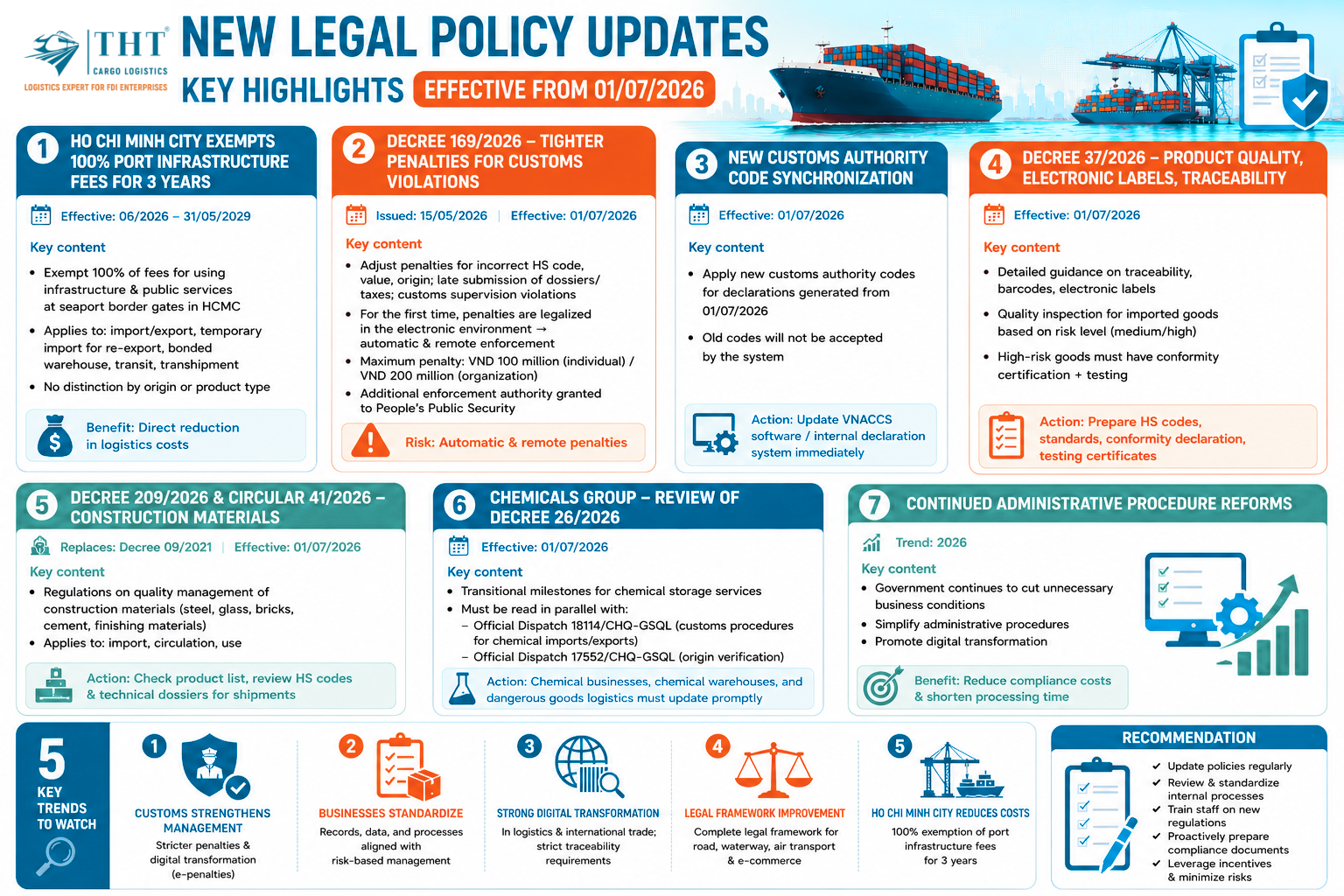
1. New Customs Authority Codes Become Mandatory
Effective July 1, 2026, the previous Customs authority codes are no longer accepted in Vietnam’s customs declaration system. Enterprises must update their customs declaration software to the latest version and ensure all customs office codes are synchronized before submitting declarations.
Recommended Action
- Update VNACCS and internal customs declaration software immediately.
- Verify customs office codes before transmitting new declarations.
- Review related tax payment, refund, guarantee, and customs information.
2. Customs Administrative Penalties Become Significantly Stricter
Decree No. 169/2026/ND-CP introduces stricter penalties for customs violations, including incorrect HS classification, customs valuation, origin declaration, delayed submissions, customs supervision violations, and electronic declaration errors.
The regulation also establishes administrative penalties for electronic customs violations, enabling automated monitoring and enforcement.
Recommended Action
- Review HS codes before customs declaration.
- Verify customs value and country of origin.
- Ensure supporting documents and Certificates of Origin (C/O) are complete and accurate.
- Strengthen internal review procedures before declaration submission.
3. The New Tax Administration Law Introduces Risk-Based Management
The 2025 Tax Administration Law shifts Vietnam’s tax management approach from traditional manual administration to a data-driven, risk-based model.
Businesses will increasingly be monitored based on compliance history, declaration quality, industry characteristics, and data consistency across customs and tax systems.
Recommended Action
- Review import-export tax records.
- Ensure accounting and customs data remain consistent.
- Standardize electronic invoice management.
- Prepare for more automated tax audits and inspections.
4. HCMC Waives Seaport Infrastructure Fees for Three Years
One of the most positive policy changes is Ho Chi Minh City’s decision to waive 100% of seaport infrastructure fees for three years.
The policy applies to import-export cargo, temporary import–re-export shipments, bonded warehouse cargo, transit cargo, and transshipment handled through HCMC’s seaport system.
The fee exemption is expected to benefit approximately 94,000 enterprises while reducing logistics costs by an estimated 0.5–0.8%.
Recommended Action
- No separate application is required.
- Update logistics cost forecasts for 2026–2029 to reflect the savings.
5. Product Traceability Requirements Become More Important
New regulations require businesses to strengthen product traceability management, particularly for goods under the Ministry of Industry and Trade.
Companies should prepare product identification information, manufacturer details, origin records, technical documentation, and traceability data before the full implementation period begins.
Recommended Action
- Prepare complete product traceability documentation.
- Maintain manufacturer, origin, batch, and product identification records.
- Register with the official traceability system where applicable.
Stay Ahead of Regulatory Changes
The legal updates taking effect on July 1, 2026 reflect Vietnam’s continued focus on digital transformation, risk-based customs management, product traceability, and stronger compliance enforcement.
Businesses that proactively review their customs procedures, documentation, tax records, and logistics operations will be better positioned to minimize compliance risks and maintain efficient supply chain performance.
Need Support in Complying with the New Import–Export Regulations?
THT Cargo Logistics helps businesses stay compliant with the latest Customs, Tax, and Logistics regulations by reviewing HS classification, customs documentation, import-export procedures, and operational workflows to minimize compliance risks.
With extensive experience supporting FDI manufacturers across electronics, machinery, chemicals, furniture, automotive components, and industrial production, THT provides practical logistics solutions that keep your supply chain compliant and efficient.
Visits: 42
This is a useful and informative update for import-export businesses. The five key regulatory changes are clearly explained and provide practical guidance for companies to stay compliant and reduce potential risks.