

- Specialized Inspection for Imported Electrical and Electronic Goods: Hidden Risks That Can Delay FDI Factory Production Plans
- 1. Why Electrical and Electronic Goods May Trigger Specialized Inspection
- 2. Three Common Blind Spots That Make FDI Factories Reactive
- 3. Impact on Production Planning
- 4. How FDI Factories Can Reduce Specialized Inspection Risks
- 5. Quick Checklist Before Importing Electrical and Electronic Goods
- 6. How THT Cargo Logistics Supports FDI Manufacturers
- Need Support Reviewing Specialized Inspection Requirements for Imported Electrical & Electronic Products?
Specialized Inspection for Imported Electrical and Electronic Goods: Hidden Risks That Can Delay FDI Factory Production Plans
For FDI manufacturers in electronics, semiconductors, precision engineering, and industrial production, imported electrical and electronic goods are often critical to production continuity. However, specialized inspection can become a major clearance risk if it is not reviewed early enough.
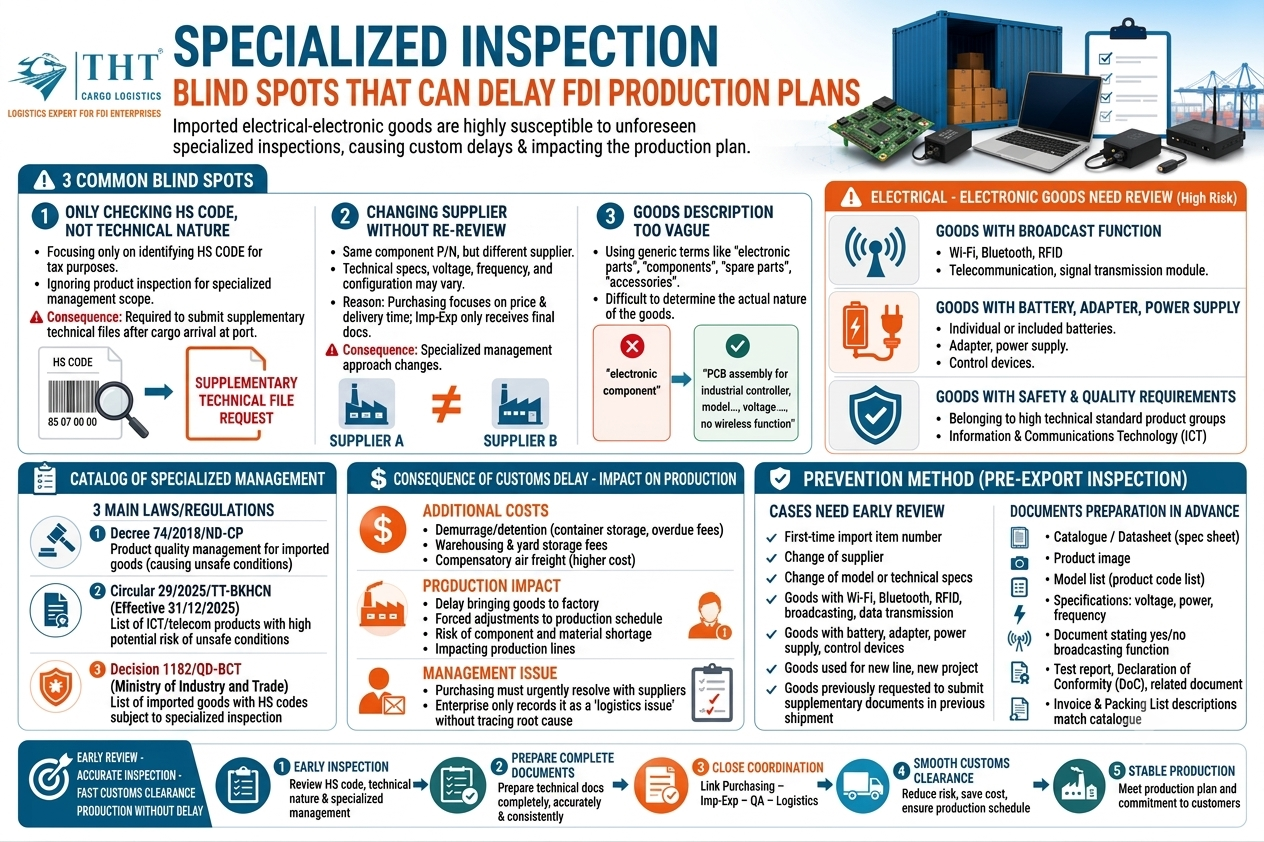
The issue is not that “all electronic components are subject to specialized inspection.” In reality, many components can be imported normally. The risk usually arises when the product has specific technical characteristics, such as wireless transmission, Wi-Fi, Bluetooth, RFID, telecommunication functions, power supplies, adapters, batteries, control devices, or when the product falls under safety, quality, or technical regulation requirements.
Under Decree No. 74/2018/ND-CP, certain imported goods that may pose safety risks are subject to quality management before being put into use or circulated in Vietnam. This is why specialized inspection should not be treated as a problem to solve only after the cargo has arrived at the port.
Reference:
Vietnam Government Portal – Decree No. 74/2018/ND-CP.
1. Why Electrical and Electronic Goods May Trigger Specialized Inspection
For electrical and electronic goods, the risk does not depend only on the HS code – Harmonized System code. Authorities may also review:
- Product name and actual use;
- Model and configuration;
- Technical functions;
- Voltage, power capacity, and frequency;
- Whether the product has wireless transmission functions;
- Whether it is a loose component, assembled module, or complete device;
- Whether it includes batteries, adapters, power supplies, or signal transmission modules.
For products in the ICT – Information and Communication Technology sector, Circular No. 29/2025/TT-BKHCN provides the list of products and goods that may pose safety risks under the management responsibility of the Ministry of Science and Technology, effective from December 31, 2025. Therefore, products involving data transmission, wireless functions, telecommunications, or ICT equipment should be carefully reviewed before import.
Reference:
Vietnam Government Portal – Circular No. 29/2025/TT-BKHCN.
In addition, certain goods under the management of the Ministry of Industry and Trade are listed for specialized inspection with HS codes under Decision No. 1182/QD-BCT. Importers should therefore review the relevant product list based on the actual product type, instead of relying only on previous import experience.
Reference:
Ministry of Industry and Trade – Decision No. 1182/QD-BCT.
2. Three Common Blind Spots That Make FDI Factories Reactive
Blind spot 1: Checking only the HS code, but not the technical nature of the product
Many companies focus on HS code classification for duty calculation, but do not check whether the product falls under specialized management.
For example, the invoice may describe the item as “electronic component”, while the actual product is a wireless data transmission module. If the company has not prepared the catalogue, datasheet, or technical documents in advance, customs may request additional clarification when the cargo has already arrived.
Blind spot 2: Changing suppliers without reviewing the technical documents again
The same part number may appear unchanged, but when the supplier changes, the technical specifications, production standards, voltage, frequency, or configuration may also change. These small changes can affect how the product is managed under specialized inspection regulations.
This is common in FDI factories because the purchasing team often focuses on price, quality, and delivery time, while the import-export team may only receive documents when the cargo is about to ship or has already shipped.
Blind spot 3: Using vague product descriptions on shipping documents
Descriptions such as “electronic parts,” “components,” “spare parts,” “machine parts,” or “accessories” can make it difficult to identify the actual nature of the goods.
A good description should clearly show the product name, model, function, and key technical specifications.
Example:
Unclear:
Clearer:
Unclear:
Clearer:
The clearer the product description, the faster the customs and technical clarification process can be.
3. Impact on Production Planning
When a shipment is unexpectedly subject to specialized inspection or additional document requests, the factory may face:
- Delayed customs clearance;
- Delayed delivery to the factory;
- Demurrage/detention charges;
- Additional storage and warehouse costs;
- Production planning adjustments;
- Urgent follow-up with overseas suppliers;
- Risk of component shortage or production disruption;
- Possible switch to air freight for urgent replenishment;
- Repeated issues in future shipments if there is no internal tracking system.
Key Takeaway:
The critical point is that many companies record these costs simply as “unexpected logistics costs,” but do not trace the root cause: unclear product descriptions, missing technical documents, late review of specialized inspection requirements, or weak coordination between purchasing, logistics, and planning teams.
4. How FDI Factories Can Reduce Specialized Inspection Risks
The most effective approach is to review specialized inspection requirements before purchase orders are confirmed or before shipments are arranged, rather than waiting until the cargo arrives at the port.
For products that are imported for the first time, involve new suppliers, or contain technical features such as wireless communication, telecommunications, batteries, power supplies, or control modules, companies should conduct an early compliance review covering both customs and specialized inspection requirements.
This review should include product specifications, technical catalogues, datasheets, applicable Vietnamese regulations, and the responsible management authority, instead of relying solely on previous shipment experience.
Equally important is communication between internal departments. Purchasing, engineering, production, import-export, logistics, and customs teams should share technical information early so that any regulatory requirements can be identified before shipping schedules are finalized.
Best Practice:
For FDI manufacturers with regular imports of electrical or electronic products, establishing an internal product compliance review process before shipment is often far less costly than dealing with customs delays after the cargo has arrived.
5. Quick Checklist Before Importing Electrical and Electronic Goods
Before arranging the shipment, companies should verify the following:
| Checklist | Status |
|---|---|
| Confirm the correct HS code based on the actual product characteristics | ☐ |
| Review whether the product falls under specialized inspection requirements | ☐ |
| Prepare catalogues, datasheets, and technical documents | ☐ |
| Verify product specifications after changing suppliers | ☐ |
| Use complete and accurate product descriptions on commercial documents | ☐ |
| Confirm whether testing, certification, or specialized inspection registration is required before import | ☐ |
| Coordinate information among engineering, purchasing, logistics, customs, and import-export departments before shipment | ☐ |
6. How THT Cargo Logistics Supports FDI Manufacturers
For FDI manufacturers, specialized inspection should not be viewed as a task handled only when cargo reaches the port. It should be part of the import planning process from the very beginning.
With extensive experience supporting FDI enterprises in electronics, semiconductors, precision engineering, industrial manufacturing, machinery, and high-tech industries, THT Cargo Logistics assists customers in identifying potential customs and specialized inspection risks before shipments are arranged.
Our support includes:
- Reviewing product information and import documentation before shipment;
- Supporting HS code assessment and customs compliance review;
- Identifying potential specialized inspection requirements based on product characteristics;
- Reviewing catalogues, technical documents, and supporting records;
- Coordinating customs clearance planning to minimize delays;
- Supporting import procedures for machinery, equipment, electrical and electronic products;
- Providing practical compliance guidance for FDI manufacturing operations in Vietnam.
In today’s regulatory environment, where product quality, safety, traceability, and technical compliance requirements continue to evolve, early preparation is often the most effective way to avoid unexpected delays, additional costs, and disruptions to production schedules.
Need Support Reviewing Specialized Inspection Requirements for Imported Electrical & Electronic Products?
THT Cargo Logistics supports FDI manufacturers in reviewing import compliance requirements, assessing potential specialized inspection risks, preparing customs documentation, and planning customs clearance processes before shipments arrive.
With experience supporting manufacturers in electronics, semiconductors, machinery, precision engineering, and industrial production, THT helps businesses reduce customs clearance risks, avoid unnecessary delays, and maintain stable production schedules.
Visits: 42