

- RED SEA CONFLICT CONTINUES TO PRESSURE GLOBAL LOGISTICS: WHAT SHOULD FDI ENTERPRISES PREPARE FOR IN 2026?
- 1. How Is The Red Sea Situation Affecting International Logistics?
- 2. How Are Freight Rates And Transit Times Changing?
- 3. The Biggest Risk For FDI Enterprises Is Not Only “Cost”
- 4. Which Industries And Trade Lanes Are Most Affected?
- 5. What Should Enterprises Prepare For In The Coming Period?
- 6. Conclusion
- Looking For A Reliable Logistics Solution?
RED SEA CONFLICT CONTINUES TO PRESSURE GLOBAL LOGISTICS: WHAT SHOULD FDI ENTERPRISES PREPARE FOR IN 2026?
For FDI enterprises in Vietnam, especially factories relying on imported raw materials from Europe or exporting goods to the EU and the United States, this is no longer simply “market news” — it is becoming a direct operational issue affecting production planning, inventory management, and logistics costs.
1. How Is The Red Sea Situation Affecting International Logistics?
The Red Sea and the Suez Canal have long been strategic shipping routes for global trade. According to international logistics organizations, approximately 12–15% of global maritime trade passed through this region before the crisis began.
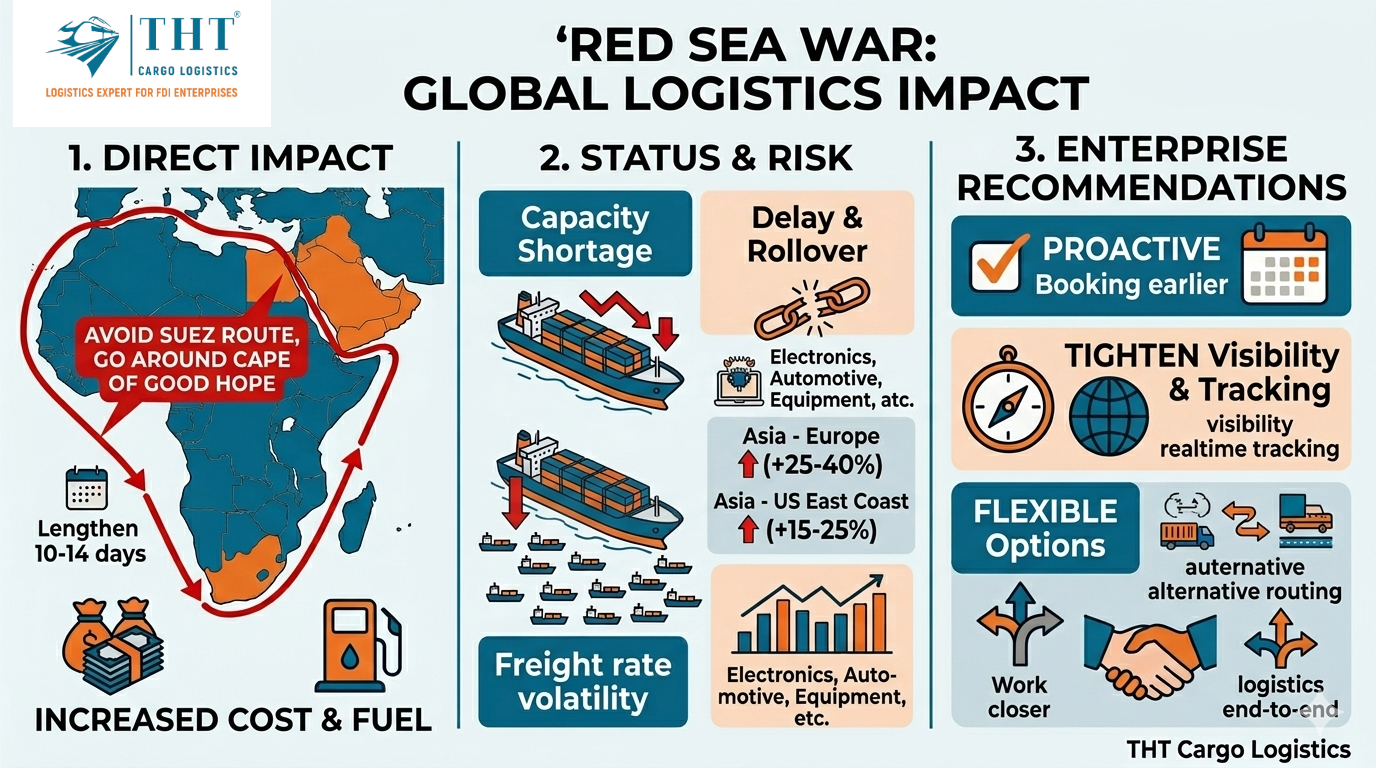
As shipping lines continue avoiding the Red Sea and rerouting around Africa, transit times on Asia–Europe routes are currently extended by approximately 10–14 days compared to pre-crisis conditions.
- Higher fuel costs due to longer sailing distances
- Localized vessel capacity shortages
- Increased risk of shipment delays and rollover
- Port congestion pressure at transshipment hubs
- Strong volatility in container freight rates
According to Reuters, major shipping lines such as Maersk and Hapag-Lloyd continue avoiding routes through the Red Sea and the Strait of Hormuz due to ongoing security risks.
2. How Are Freight Rates And Transit Times Changing?
One of the clearest impacts has been the prolonged volatility of international freight rates. Although rates are no longer at the peak levels seen during 2024, the market has still not returned to pre-crisis pricing levels.
- Asia–Europe freight rates remain approximately 25–40% higher than pre-crisis levels
- Asia–US East Coast rates have increased by around 15–25%
- Transit times on Asia–Europe routes are extended by an average of 10–14 days
Reuters also reported that prolonged rerouting continues to keep freight rates above normal levels while increasing both fuel expenses and carrier operating costs.
Notably, even trade lanes that do not directly pass through the Red Sea are being indirectly affected due to reduced global shipping capacity. As vessels travel longer distances, the number of annual vessel rotations decreases, effectively reducing available market capacity worldwide.
3. The Biggest Risk For FDI Enterprises Is Not Only “Cost”
In real-world supply chain operations, the biggest concern is not simply increasing freight costs.
FDI enterprises are more concerned about:
- Unpredictable shipment delays
- Lack of supply chain visibility
- Risks impacting production planning
This is particularly critical for enterprises operating under:
- Just-In-Time manufacturing models
- Lean manufacturing systems
- Low inventory strategies
An additional 10–14 days in lead time can create major pressure on safety stock levels and raw material planning.
Many enterprises have already begun to:
- Increase safety stock levels
- Book shipments earlier
- Split shipments into smaller lots
- Shift urgent cargo to air freight to avoid production line stoppages
According to analysis from multiple global logistics firms, the market is shifting from “cost optimization” toward “supply chain risk management.” Visibility and disruption forecasting are becoming just as important as freight pricing.
4. Which Industries And Trade Lanes Are Most Affected?
Industries currently experiencing the strongest impact include:
- Electronics
- Automotive
- Industrial equipment
- Fashion & retail
- Machinery parts
These industries rely heavily on international ocean freight and require stable lead times to maintain production continuity.
The most heavily affected trade lanes include:
- Asia – Europe
- Asia – Mediterranean
- Asia – US East Coast via Suez
Meanwhile, the US West Coast trade lane is currently less directly impacted as it primarily uses Pacific routes rather than the Suez Canal.
5. What Should Enterprises Prepare For In The Coming Period?
Many logistics experts believe that international transportation markets in 2026 will continue operating under highly volatile conditions. Even if geopolitical tensions ease, the market will still require additional time to stabilize as global supply chains have fundamentally changed after the prolonged crisis period.
For FDI enterprises, this is a period to focus more heavily on supply chain resilience rather than only optimizing short-term logistics costs.
- Booking cargo space earlier to reduce rollover and space shortage risks
- Enhancing supply chain visibility through real-time tracking and predictive ETA systems
- Reviewing safety stock policies based on longer transit times
- Preparing alternative transportation solutions including ocean freight, sea-air combinations, and alternative routing
- Working more closely with forwarders and carriers to monitor congestion and vessel schedules
6. Conclusion
The Red Sea crisis demonstrates that today’s global supply chains no longer operate in the stable environment businesses once relied on. Geopolitical disruptions can rapidly create chain reactions affecting lead times, freight costs, and global transportation capacity.
For FDI enterprises, logistics strategy is no longer simply about finding the lowest freight rate — it is about building a supply chain capable of adapting and responding quickly to disruptions.
In the coming period, enterprises with stronger visibility, more flexible planning, and closer collaboration with logistics partners will have a significant advantage in maintaining stable production and import-export operations.
Looking For A Reliable Logistics Solution?
With extensive hands-on experience in international transportation and logistics solutions for FDI enterprises, THT Cargo Logistics supports businesses in optimizing supply chains, proactively managing market volatility, and maintaining stable import-export operations.
Visits: 67