

- 1. Applicable Legal Basis
- 2. Enterprise Responsibilities in Customs Declaration
- 3. Regulations on Confidentiality of Chemical Composition Information
- 4. Obligation to Provide Technical Documents for Inspection
- 5. Recommendations from THT Cargo Logistics
- 6. Conclusion
- Having Difficulties with Chemical Declaration Procedures?
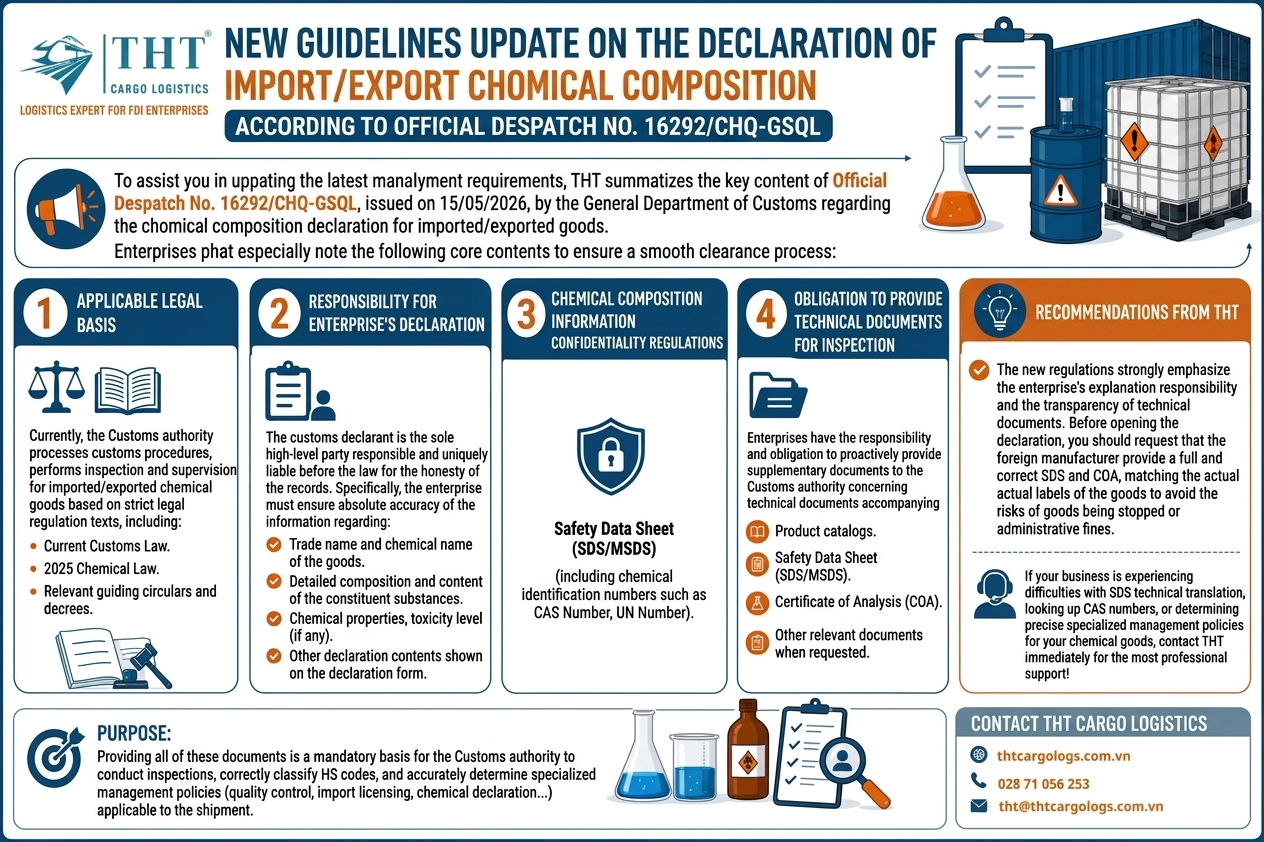
UPDATED GUIDELINES ON DECLARING CHEMICAL COMPONENTS FOR IMPORT & EXPORT GOODS UNDER OFFICIAL LETTER 16292/CHQ-GSQL
Enterprises should pay close attention to the following key points to ensure smooth customs clearance and minimize the risk of cargo delays or administrative penalties.
1. Applicable Legal Basis
Currently, Customs authorities conduct customs procedures, inspections, and supervision for imported and exported chemicals based on a strict legal framework, including:
- Current Customs Law
- Chemicals Law 2025
- Relevant decrees, circulars, and implementation guidelines
This shows that chemical declaration is no longer merely an administrative procedure but is now being managed under stricter requirements for transparency and enterprise accountability.
2. Enterprise Responsibilities in Customs Declaration
Under the new guidelines, the customs declarant is the party fully and solely responsible before the law for the truthfulness and accuracy of all declaration documents.
Enterprises must ensure absolute accuracy of the following information:
- Commercial name and chemical name of the goods
- Detailed composition and concentration of chemical substances
- Chemical properties and toxicity level (if any)
- Other declared contents shown on the customs declaration form
Even minor discrepancies in chemical names, concentrations, or technical descriptions may result in additional explanations, intensive inspections, or reclassification of HS codes by Customs authorities.
3. Regulations on Confidentiality of Chemical Composition Information
Many enterprises often encounter difficulties in providing detailed chemical composition information due to concerns about protecting proprietary technology or commercial formulas.
However, according to Official Letter 16292/CHQ-GSQL, certain technical information is NOT considered confidential information.
Information not classified as confidential includes:
- Material Safety Data Sheet (MSDS/SDS)
- Including chemical identifiers such as CAS Number and UN Number
This means enterprises cannot refuse to provide MSDS or SDS documents on the grounds of protecting product formulas or technology confidentiality.
4. Obligation to Provide Technical Documents for Inspection
Since the above information is not considered confidential, enterprises are obligated to proactively provide all relevant technical documents to Customs authorities during customs procedures.
Required technical documents may include:
- Product catalogues
- Material Safety Data Sheets (MSDS/SDS)
- Certificate of Analysis (COA)
- Other related technical documents upon request by Customs authorities
Providing these documents is mandatory for Customs authorities to:
- Inspect and accurately determine HS codes
- Apply the correct specialized management policies for the shipment
- Determine requirements related to quality inspection, import permits, or chemical declaration procedures
5. Recommendations from THT Cargo Logistics
The new regulations strongly emphasize enterprise accountability and the transparency of technical documentation in chemical import and export activities.
THT recommends that enterprises should:
- Request complete MSDS/SDS and COA documents from overseas manufacturers before shipment departure
- Ensure the information on MSDS/SDS matches the actual labels and specifications of the goods
- Verify CAS Numbers, UN Numbers, and chemical compositions before customs declaration
- Standardize technical documents to minimize risks of cargo suspension or prolonged explanations
Proper preparation from the beginning will help enterprises:
- Reduce customs clearance delays
- Minimize warehouse and container storage costs
- Avoid risks of administrative penalties
- Improve stability in chemical import and export operations
6. Conclusion
Official Letter 16292/CHQ-GSQL demonstrates that chemical import and export management in Vietnam is becoming increasingly stricter, particularly regarding chemical composition declarations and transparency of technical documentation.
In this context, enterprises should proactively:
- Standardize chemical documentation
- Carefully review MSDS/SDS and COA documents
- Verify chemical compositions and HS codes accurately
- Coordinate closely with logistics providers and customs brokers
Comprehensive preparation from the beginning will significantly reduce risks arising during chemical customs clearance procedures.
Having Difficulties with Chemical Declaration Procedures?
If your business needs support with MSDS translation, CAS Number verification, specialized management policy consultation, or chemical import-export procedures, THT Cargo Logistics is ready to support your business with practical and professional solutions.
Visits: 42