

Exporting Controlled Chemicals: Legal Risks & How Businesses Can Avoid Compliance Mistakes in 2026
Currently, chemical products classified under controlled chemical categories are being more strictly monitored by regulatory authorities during import and export activities.
Therefore, businesses must proactively ensure full compliance with all relevant legal requirements, including:
- Business eligibility requirements for chemicals
- Import licenses for regulated chemicals
- Accurate and complete customs documentation
Failure to comply may result in:
- Customs clearance disruptions
- Administrative penalties under applicable regulations
- Additional warehousing, detention, and compliance costs
Businesses should carefully review product classifications and prepare appropriate documentation before carrying out import-export procedures to ensure smooth and compliant operations.
As import-export activities continue to face stricter regulatory oversight, exporting controlled chemicals has become one of the highest legal risk areas for businesses.
Recent actions from regulatory authorities indicate that compliance enforcement is no longer limited to licensing procedures but is now expanding into retrospective reviews and traceability assessments of past export activities.
A recent case in Ho Chi Minh City clearly reflected this trend when authorities reviewed an FDI company’s chemical export license application while cross-checking compliance with Vietnam’s Chemical Law, related decrees, and implementing circulars.
Notably, the review process focused not only on current documentation but also required the company to provide historical export shipment data.
This highlights an important issue: many businesses still approach chemical exports as a simple administrative procedure, while in reality this sector requires end-to-end compliance covering business conditions, production management, technical documentation, and declared end-use purposes.
1. Increasingly Strict Licensing Reviews for Chemical Exports
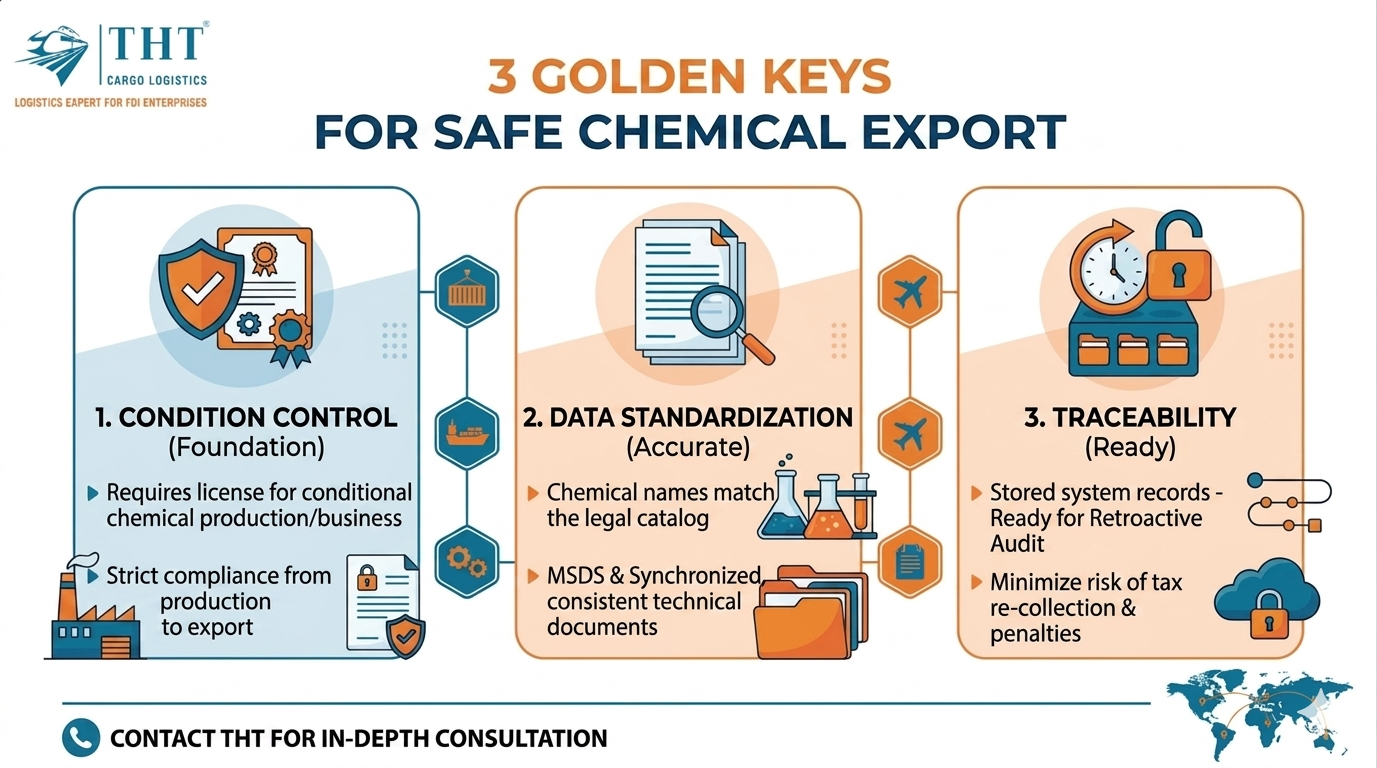
During licensing reviews, authorities identified cases where businesses had not yet obtained the required licenses for producing or trading conditional chemicals but were still conducting export activities.
This is one of the most common compliance risks, especially among companies operating under combined manufacturing and processing models.
Common issues identified during compliance reviews include:
- Chemical names not standardized according to legal classifications
- Inconsistent technical information
- Missing MSDS (Material Safety Data Sheet)
- Discrepancies between invoices, packing lists, and product descriptions
- Incomplete traceability data for previous shipments
These issues may appear minor but can result in rejected applications or lengthy clarification requests.
More importantly, authorities are now requesting businesses to provide complete historical export records to assess overall compliance performance.
This means past compliance mistakes may be re-examined, potentially leading to tax reassessments and administrative penalties.
2. Legal Risks Go Beyond Licensing
Failure to fully comply with import-export regulations for controlled chemicals may not only delay customs clearance but can also expose businesses to administrative penalties and mandatory re-export requirements under applicable regulations.
The biggest risk today is not simply delayed licensing.
Businesses may also face retrospective compliance reviews if documentation and compliance data were not consistently managed from the beginning.
Another frequently overlooked risk is the loss of document transparency and traceability.
When compliance data is not centrally managed, businesses may struggle significantly during audits or inspections, especially for shipments completed several years earlier.
3. What Should Businesses Do to Reduce Compliance Risks?
Given the tightening regulatory environment, businesses can no longer approach chemical import-export operations reactively.
Instead, companies should proactively establish a structured compliance management system from the outset.
3.1. For Businesses Importing Chemicals for Manufacturing Use
If the chemical mixture contains substances classified as specially controlled chemicals, businesses must:
- Declare the intended usage purpose
- Apply for the required import license for controlled chemicals
3.2. For Businesses Importing Chemicals for Commercial Trading
Businesses must comply with the following legal requirements:
- Obtain a conditional chemical trading certificate if the chemical mixture contains substances listed under Appendix II
- Apply for a controlled chemical import license if the mixture contains substances under Appendix III
- In cases where the mixture falls under both Appendix II and III categories, authorities will review licensing requirements based on controlled chemical regulations
Businesses should prioritize the following:
- Ensuring all legal conditions are fulfilled before import-export operations
- Carefully reviewing HS codes and controlled chemical classifications
- Standardizing technical documents and logistics paperwork
- Maintaining centralized compliance records for future traceability
These compliance requirements are increasingly being enforced through real-world inspections and audits conducted by authorities.
4. Insights from THT Cargo Logistics
Based on practical customs and logistics experience, THT Cargo Logistics believes that stricter regulatory oversight for controlled chemicals will continue in the coming years.
This trend is driven not only by domestic regulatory requirements but also by international commitments regarding chemical safety and control standards.
Businesses that standardize compliance processes early will gain significant advantages in:
- Maintaining stable import-export operations
- Reducing unexpected operational costs
- Minimizing legal and customs risks
- Improving document transparency and traceability
- Reducing supply chain disruptions
In contrast, reactive problem-solving after issues arise often results in significantly higher costs in both time and operations.
5. Conclusion
Exporting controlled chemicals is no longer just a standalone licensing procedure. It has become a continuous compliance process covering production, technical documentation, customs declarations, and logistics operations.
As regulatory authorities continue strengthening inspections and traceability reviews, businesses must proactively standardize their entire compliance process to ensure safe, stable, and legally compliant export operations.
Early preparation not only helps reduce operational risks but also creates a sustainable competitive advantage in import-export and supply chain management activities.
Looking for Support with Chemical Export Compliance?
THT Cargo Logistics supports businesses with legal document reviews, chemical licensing consultation, customs compliance, and practical logistics solutions for specialized import-export operations.
Visits: 23