

- 1. New Trend: Preparing Customs Documentation Earlier Than Before
- 2. Key Electronic Documents Businesses Should Prepare
- 3. Business Sectors Most Affected by the New Regulation
- 4. Common Risks Businesses Face During Electronic Customs Declaration
- 5. Checklist Businesses Should Prepare Before Cargo Arrival
- 6. How Digital Customs Will Impact Businesses In The Future
- 7. Conclusion
- Looking For An Optimized Logistics Solution?
CIRCULAR 121/2025/TT-BTC: WHAT IMPORT-EXPORT BUSINESSES SHOULD PREPARE FOR VIETNAM’S DIGITAL CUSTOMS TREND FROM 2026
The new Circular focuses on:
- Increasing the use of electronic customs documentation
- Standardizing customs declaration data
- Enhancing system connectivity between businesses and customs authorities
- Reducing dependency on traditional paper-based documentation
This is considered an inevitable trend to improve customs clearance efficiency, optimize supply chains, and strengthen the competitiveness of import-export businesses.
In particular, FDI enterprises, manufacturing factories, and businesses operating with strict delivery timelines are expected to experience significant impacts during this transition period.
1. New Trend: Preparing Customs Documentation Earlier Than Before
For many years, numerous businesses have continued handling customs documentation only after cargo arrival at port.
However, with the rise of digital customs systems and electronic data processing, early document preparation is becoming almost mandatory to ensure smooth customs clearance timelines.
Businesses that prepare documents early often gain significant advantages:
- Shorter customs processing time
- Reduced container storage and detention costs
- Lower risk of production delays
- Greater flexibility when customs authorities request document verification
For industries with highly sensitive supply chains such as electronics, semiconductors, automotive, machinery, and pharmaceuticals, document delays can directly affect production schedules and delivery commitments.
2. Key Electronic Documents Businesses Should Prepare
To ensure smooth customs declaration and processing, businesses should standardize the following electronic documentation in advance:
- Electronic customs declarations
- Bill of Lading (B/L)
- Commercial Invoice
- Packing List
- Certificate of Origin (C/O) for FTA preferential treatment if applicable
- Specialized import permits where required
- Technical catalogues or product specifications
- Digital signatures
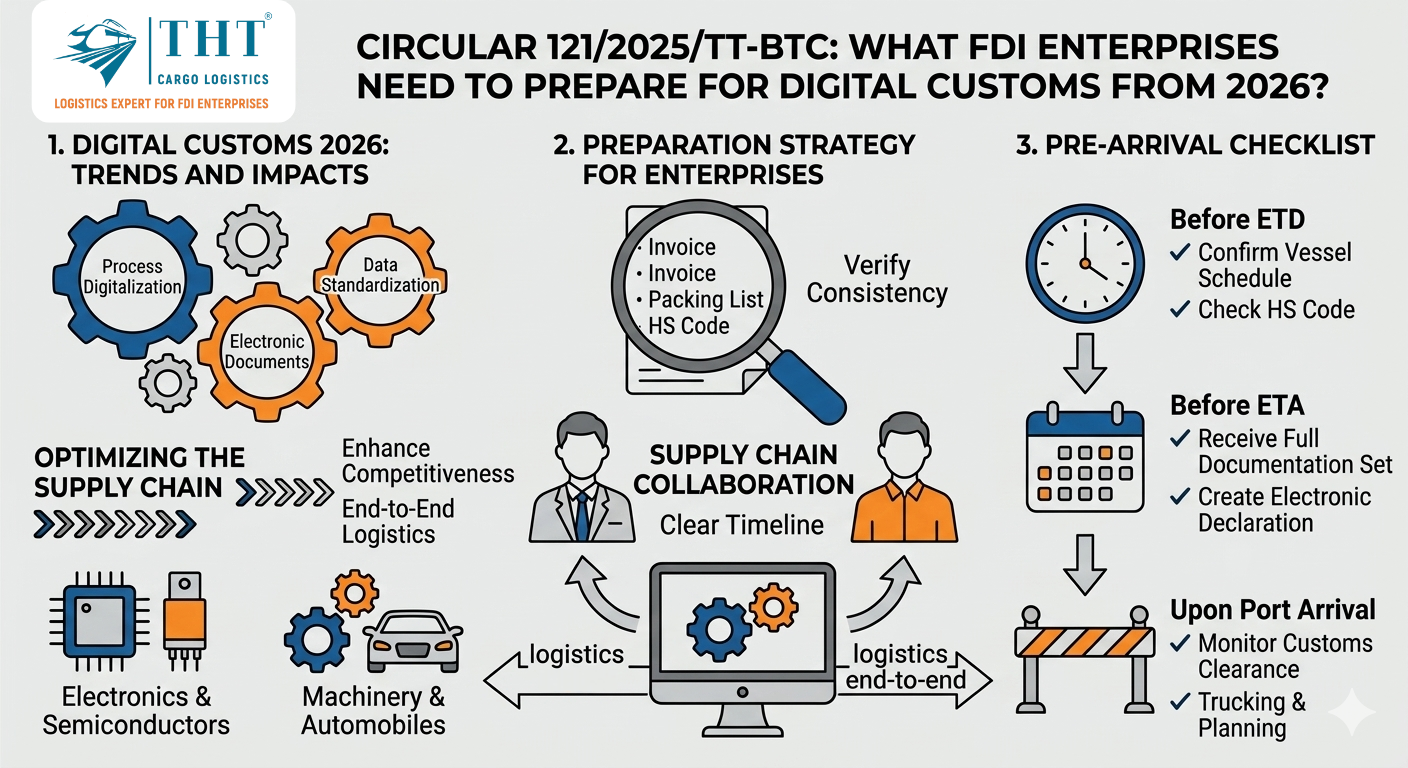
Verifying consistency between invoices, packing lists, and HS codes before submission is especially important to minimize inspection risks and amendment requests.
3. Business Sectors Most Affected by the New Regulation
3.1 Electronics And Semiconductor Industry
This sector requires extremely high standards regarding:
- Customs clearance speed
- Document accuracy
- International compliance standards
- Supply chain traceability
Any delay in importing components may directly impact factory production schedules.
3.2 Machinery And Automotive Industry
Machinery shipments often involve:
- Complex technical documentation
- Specialized inspections
- Complicated HS code verification
As a result, early document preparation allows businesses to proactively handle potential customs or regulatory requirements.
3.3 Pharmaceutical And Chemical Industry
These industries are heavily regulated and require:
- Import permits
- Inspection certifications
- Quality certificates
- Chemical safety documentation
Missing or inaccurate documentation can significantly prolong customs clearance timelines.
4. Common Risks Businesses Face During Electronic Customs Declaration
4.1 Suppliers Sending Documents Late
This remains one of the most common reasons businesses struggle with import customs processing.
Common situations include:
- Invoices adjusted close to vessel departure date
- Packing list quantity changes
- Missing original C/O documents
- Incorrect Bill of Lading information
These issues can delay the entire customs declaration and cargo delivery process.
4.2 Inconsistencies Between HS Codes And Supporting Documents
Inconsistencies between:
- Invoice
- Packing List
- HS code
- Product description
may lead to:
- Customs inspection channel assignment
- Requests for additional documents
- Customs clearance delays
- Additional storage and warehouse costs
This is one of the most common risks during the transition toward digital customs systems.
As customs data becomes more standardized and integrated, even small inconsistencies in electronic documentation can be identified much faster than before.
4.3 Lack Of Coordination Across The Logistics Chain
In many cases, delays are caused more by poor coordination between:
- Shippers
- Forwarders
- Customs declaration providers
- Importing businesses
than by transportation itself.
Businesses should establish clear document coordination processes and aligned operational timelines from the beginning.
5. Checklist Businesses Should Prepare Before Cargo Arrival
Before ETD
- ✅ Confirm vessel schedule and booking
- ✅ Verify HS codes
- ✅ Check specialized import permit requirements
- ✅ Confirm Incoterms conditions
Before ETA
- ✅ Receive complete Invoice and Packing List
- ✅ Verify data consistency
- ✅ Prepare electronic customs declaration documents
- ✅ Verify C/O and tax preferential documents
Upon Vessel Arrival
- ✅ Monitor customs clearance status
- ✅ Respond proactively to additional document requests
- ✅ Coordinate trucking and delivery planning
6. How Digital Customs Will Impact Businesses In The Future
The customs digitalization trend is not limited to Vietnam — it is becoming a global standard across international supply chains.
In the coming years, import-export businesses will need to:
- Standardize logistics data
- Strengthen electronic document management
- Improve coordination between suppliers and forwarders
- Invest more in compliance and risk management
Businesses that prepare early will gain significant advantages in:
- Faster customs clearance
- Optimized logistics costs
- Reduced operational risks
- Improved supply chain stability
7. Conclusion
Circular 121/2025/TT-BTC clearly demonstrates Vietnam’s direction toward digital customs and modernization of import-export procedures.
As supply chains increasingly require higher speed and transparency, businesses need to proactively:
- Standardize documentation
- Coordinate documents earlier
- Upgrade logistics processes
- Work closely with forwarders and customs declaration partners
Early preparation not only helps reduce operational risks but also creates sustainable competitive advantages in import-export and manufacturing operations.
Looking For An Optimized Logistics Solution?
If your business is preparing for Vietnam’s digital customs trend from 2026 and looking to optimize logistics operations, the THT Cargo Logistics team is ready to support you.
Visits: 28