

- Red Sea Route Disruptions 2026: When Suez Reopens But Global Supply Chains Continue To Shake
- 1. The Core Issue: The “Test And Pause” Status Of The Red Sea Route
- 2. Three Common Mistakes Creating Major Risks For FDI Enterprises
- 3. Europe – Vietnam Supply Chain Checklist During Red Sea Disruptions
- 4. Recommendations From THT Cargo Logistics
- 5. Conclusion
- Looking For An Optimized Logistics Solution?
Red Sea Route Disruptions 2026: When Suez Reopens But Global Supply Chains Continue To Shake
However, in reality, global supply chain operations are still operating under a “new normal” condition with extremely high volatility. Red Sea routes remain unstable, while global vessel networks continue to adjust in response to ongoing regional security risks.
1. The Core Issue: The “Test And Pause” Status Of The Red Sea Route
The reopening of the Suez route does not mean the market has fully stabilized.
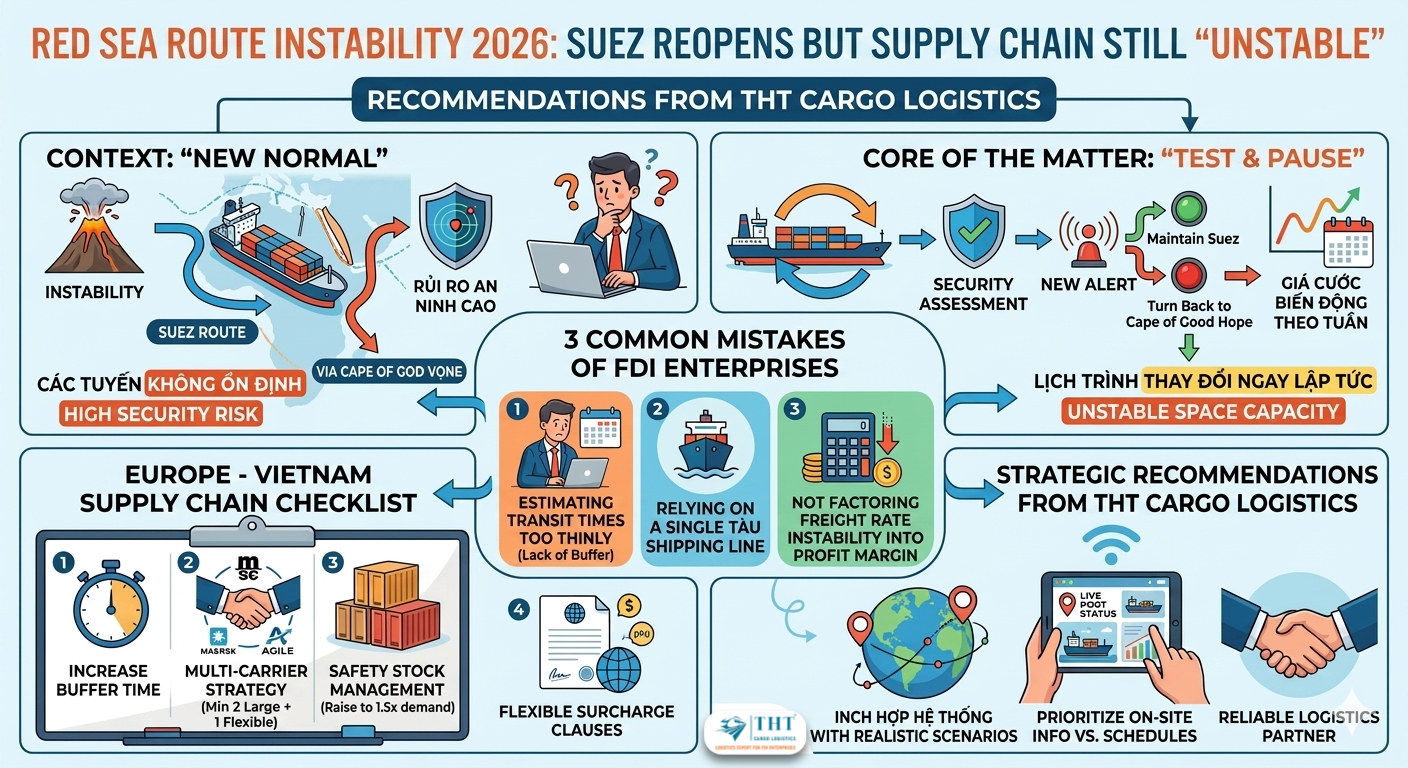
Currently, most carriers are operating under a “test and pause” model — continuously evaluating security conditions before deciding whether to maintain Red Sea routing or divert vessels around the Cape of Good Hope.
Any new security alert could immediately disrupt vessel schedules.
The biggest issue today is not only the longer transit distance.
The more critical challenge is the disruption of the global shipping network structure itself. When some vessels return to Suez while others continue rerouting around Africa, overall slot capacity across the network becomes unstable.
This situation leads to:
- Constantly changing vessel space availability
- Unstable transit times
- Higher rollover rates
- Congestion at transshipment ports
- Freight rates fluctuating weekly instead of quarterly
2. Three Common Mistakes Creating Major Risks For FDI Enterprises
2.1 Assuming The Red Sea Is “Stable” Again And Planning Transit Time Too Tightly
This is one of the most common mistakes THT Cargo Logistics has observed in machinery and raw material import projects from Europe.
Many companies are currently planning supply chains based on “normal route” transit times of approximately 35–40 days.
However, if the Red Sea suddenly becomes inaccessible again:
- Vessels will reroute around the Cape of Good Hope
- Transit times may increase by another 10–15 days
- Delivery schedules can collapse entirely
- Production lines may stop due to material shortages
Critical concern:
Many factories only maintain safety stock sufficient for 7–10 production days. If shipments are delayed beyond that threshold, companies may have virtually no buffer left to manage disruptions.
2.2 Relying On A Single Shipping Line
To optimize transportation costs, many businesses allocate all cargo volume to a single carrier.
Under stable market conditions, this may reduce costs.
But under current Red Sea conditions, this strategy carries extremely high risk.
When a carrier:
- Changes routing
- Reduces vessel capacity
- Or faces security-related disruptions
the company’s entire supply plan may be immediately impacted without backup options.
2.3 Ignoring Freight Volatility In Profit Margin Planning
Another common mistake is continuing to plan logistics costs based on the assumption of stable freight rates.
In reality, current market volatility remains extremely high.
Freight rate differences within a single month can equal the value of an entire 40-foot container shipment.
This is particularly dangerous for:
- FOB shipment models
- Long-term EXW contracts
- Low-margin industrial projects
3. Europe – Vietnam Supply Chain Checklist During Red Sea Disruptions
To maintain supply chain continuity and control, THT Cargo Logistics recommends that businesses implement the following principles:
3.1 Increase Buffer Time
- Add at least 10–15 extra buffer days for all shipments affected by Red Sea routing
- Avoid production planning based on “best-case” vessel schedules
- Build delay scenarios into procurement planning from the beginning
3.2 Multi-Carrier Strategy
- Avoid depending on a single carrier
- Distribute cargo across at least:
- 2 major shipping lines
- 1 flexible logistics forwarding partner
3.3 Inventory Management
- For critical long-transit components:
- Increase safety stock to at least 1.5 times normal production demand
- Especially important for electronics, semiconductor, and automotive sectors
3.4 Transportation Contract Terms
- Add freight fluctuation clauses into logistics agreements
- Example:
- If Red Sea disruptions exceed 15 days → both parties may renegotiate freight pricing
- Or shift part of the shipment to air freight solutions
4. Recommendations From THT Cargo Logistics
In today’s constantly unstable market, flexibility is more important than short-term freight cost optimization.
4.1 Integrate Supply Planning Systems With Realistic Disruption Scenarios
Factory planning systems should include specific “Red Sea shutdown” scenarios.
When disruption signals appear:
- Purchase orders should be released earlier
- Inventory plans should automatically adjust
- Procurement teams must track real transit conditions closely
4.2 Prioritize Real-Time Operational Intelligence Instead Of Static Vessel Schedules
One common mistake is relying only on carrier website schedules.
Under current conditions, real operational intelligence is far more important:
- Transshipment port congestion conditions
- Container rollover risks
- Route security fluctuations
- Actual vessel space availability
5. Conclusion
In 2026, the Red Sea situation is no longer simply about whether routes are “open or closed.”
The larger challenge is the prolonged instability of the entire global transportation structure.
FDI enterprises aiming to maintain production continuity must shift their mindset:
- Do not optimize supply chains based only on freight costs
- Do not build plans based solely on ideal scenarios
- Do not rely on a single shipping line
In a continuously volatile market, companies capable of adapting quickly will maintain stronger long-term competitive advantages.
Looking For An Optimized Logistics Solution?
THT Cargo Logistics supports FDI enterprises in managing import transit times, optimizing Europe – Vietnam supply chains, controlling logistics risks, and implementing flexible transportation solutions for industrial machinery and equipment projects.
Visits: 46