

- CUSTOMS RISKS FOR FDI EXPORT PROCESSING ENTERPRISES (EPEs): KEY CONTROLS TO AVOID TAX RE-ASSESSMENTS AND OPERATIONAL DISRUPTIONS
- What Customs Risks Are Export Processing Enterprises (EPEs) Facing?
- 1. Risks in Customs Declarations
- 2. Risks Related to Customs Finalization Reports
- 3. Risks in Inventory Management and Production Norms
- 4. Risks Concerning Customs Surveillance Camera Systems
- 5. Risks in Post-Clearance Audits (PCA)
- Strategic Solutions for EPEs to Mitigate Customs Exposure
- Self-Assessment Checklist for EPE Compliance Management
- The Role of Seasoned Logistics and Customs Partners in Supporting EPEs
- Conclusion
- Does Your Enterprise Need to Audit Export Licensing Requirements for Your Commodities?
CUSTOMS RISKS FOR FDI EXPORT PROCESSING ENTERPRISES (EPEs): KEY CONTROLS TO AVOID TAX RE-ASSESSMENTS AND OPERATIONAL DISRUPTIONS
Export Processing Enterprises (EPEs) are entitled to numerous tax incentives and preferential customs mechanisms; however, these privileges come with stringent control requirements regarding cargo, raw materials, warehousing, finalization reports, and surveillance systems.
In practice, many FDI enterprises face retroactive tax assessments, administrative penalties, or severe bottlenecks during post-clearance audits due to errors originating from internal management. Particularly, as customs authorities accelerate the application of digital data and intensify compliance audits, these risks can directly impact a company’s operational costs and manufacturing schedules.
Quick Summary:
Export Processing Enterprises (EPEs) face risks not only in customs declarations but must also maintain strict control over customs finalization reports, inventory management, production norms, camera surveillance systems, and post-clearance audits to mitigate the danger of retroactive tax assessments and operational disruptions.
What Customs Risks Are Export Processing Enterprises (EPEs) Facing?
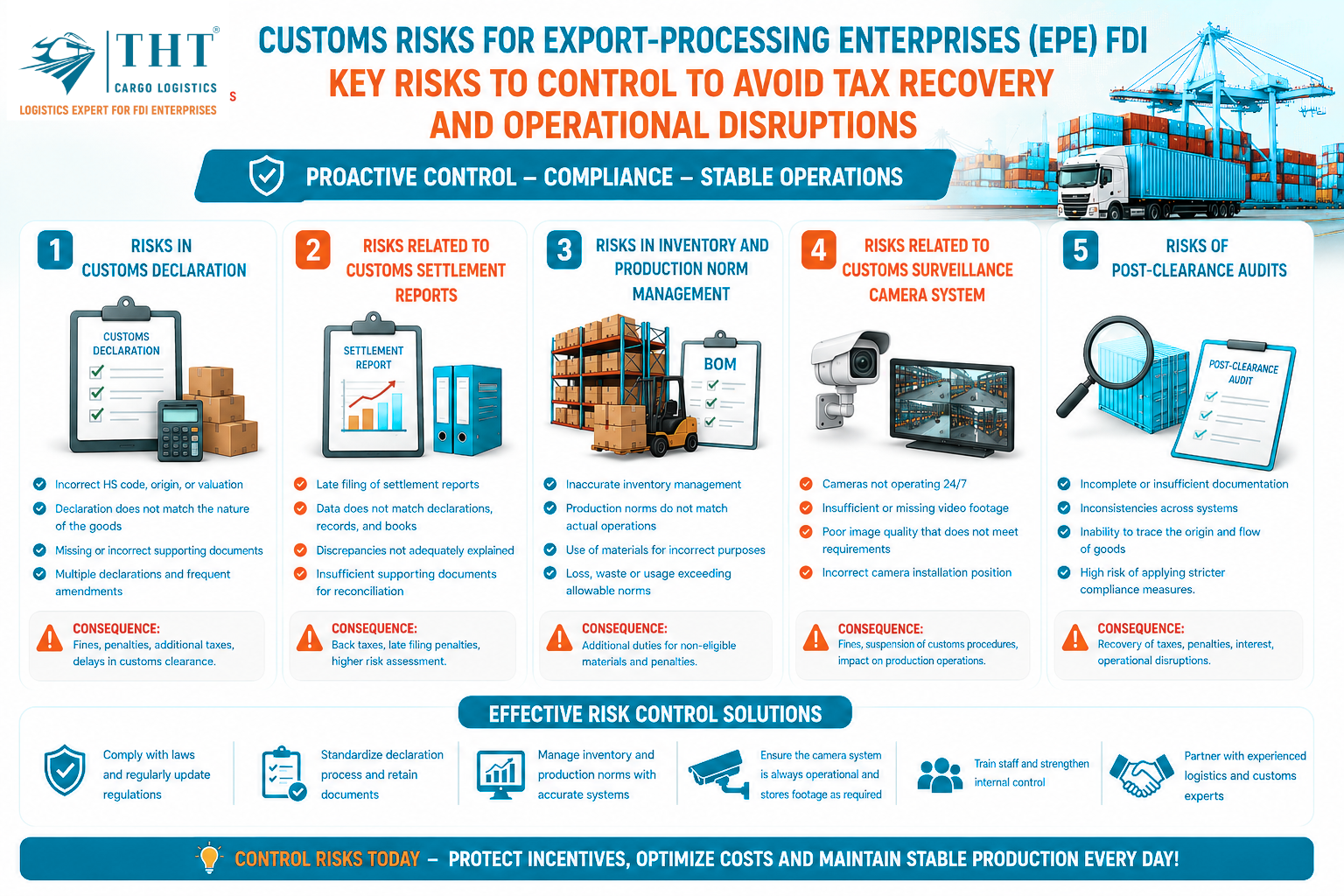
Below are the 5 critical groups of customs risks that EPEs must pay special attention to.
1. Risks in Customs Declarations
Customs declaration is the foundational step in all import-export activities. Errors at this stage can trigger a domino effect of consequences regarding tax, commodity management policies, and post-clearance audits.
Common Risks
| Content | Arising Risks |
|---|---|
| Incorrect HS Code Classification | Retroactive tax assessments, administrative fines, delayed customs clearance |
| Incorrect Customs Valuation | Re-assessment of taxable value, retroactive tax collections, and penalties |
| Misapplication of Commodity Policies | Wrong entity for tax exemption, violation of specialized inspection regulations |
| Incorrect Country of Origin (C/O) | Denial of preferential tariff treatments or retroactive tax assessments |
| Inconsistent Declarations | Requests for formal explanations or supplementary inspections |
Impacts on FDI Enterprises
- Unplanned increases in tax expenditure.
- Prolonged customs clearance turnaround times.
- Disrupted production schedules.
- Elevated risk profiles during customs authority audits.
2. Risks Related to Customs Finalization Reports
For Export Processing Enterprises, the annual finalization report is one of the core focus areas closely scrutinized by customs authorities.
Under current regulations, enterprises must submit their customs finalization reports within 90 days from the end date of their fiscal year.
Common Mistakes
| Mistake | Consequences |
|---|---|
| Data discrepancies between reports and customs declarations | Requests for formal explanations or full audits |
| Abnormal raw material inventory balances | Elevated inspection risk rating |
| Poor management of scrap and defective products | Retroactive tax collections and penalties |
| Inaccurate or unreasonable production norms | Customs re-imposition of production yield norms |
| Late submission of reports | Administrative fines |
Management Perspective
For FDI manufacturing enterprises, the customs finalization report is not merely a legal obligation but directly reflects the integrity of the entire material input-output-inventory management system.
Data discrepancies between departments such as Logistics, Accounting, Warehousing, and Production are the most common root causes leading to vulnerabilities during customs audits.
3. Risks in Inventory Management and Production Norms
This risk group exhibits a high frequency of occurrence among manufacturing-for-export EPEs.
Common Issues Faced by Enterprises
| Content | Exposure/Danger |
|---|---|
| Inaccurate inventory tracking | Retroactive tax assessments on duty-exempt goods |
| Misuse of raw materials for unintended purposes | Incurrence of supplementary tax liabilities |
| Unreasonable production norms | Customs suspicion of material leakage/unreported domestic sales |
| Incorrect declaration of wastage/loss rates | Administrative penalties |
| Non-compliant scrap and waste disposal procedures | Retroactive tax collections and penalties |
Why Is This a Major Risk for EPEs?
Unlike conventional enterprises, EPEs enjoy a duty-free mechanism for a vast range of imported raw materials utilized in export manufacturing.
Consequently, customs authorities pay meticulous attention to:
- The accuracy of physical vs. systemic inventory data.
- The technical rationality of production yield norms.
- The detailed consumption workflow of duty-exempt materials.
- Scrap, waste, and defective product disposal operations.
Note: Any significant chênh lệch (discrepancy) between physical stockpiles and customs filings can expose the enterprise to retroactive tax liabilities for the entire unsubstantiated volume of materials.
4. Risks Concerning Customs Surveillance Camera Systems
To maintain eligible operational status under the EPE model, enterprises must constantly satisfy specific customs surveillance and infrastructure requirements as mandated by current laws.
Common Technical Failures
- Camera feeds fail to cover the entire warehouse area.
- Blind spots present at critical import/export gates.
- Incomplete image or video archiving.
- Data storage retention periods fail to meet statutory durations.
- Failure to maintain uninterrupted online connectivity with customs authorities.
Potential Ramifications
| Non-Compliance | Operational Impact |
|---|---|
| Substandard camera system setup | Mandatory suspension for rectification |
| Failure to preserve surveillance logs | Elevated targeted inspection risks |
| Failure to meet statutory surveillance conditions | Jeopardization of EPE status and regulatory standing |
| Prolonged or repetitive violations | Potential suspension of associated investment incentives |
This is an infrastructure pillar that many enterprises only review during formal inspection notices, whereas it demands continuous, real-time maintenance throughout the plant’s operational life.
5. Risks in Post-Clearance Audits (PCA)
Many enterprises mistakenly assume that once cargo clears the port, all customs obligations are finalized. However, customs authorities retain the statutory right to re-audit data and dossiers for several years from the declaration registration date.
Standard Audit Scopes
- HS code classifications.
- Customs valuations.
- Rules of Origin (C/O) verifications.
- Tax exemption records and dossiers.
- Actual manufacturing production norms.
- Annual finalization reports.
- Warehouse ledgers and raw material inventory balances.
Common Audit Bottlenecks
| Audit Flaw | Consequences |
|---|---|
| Missing original documentation | Insufficient grounds for justification or defense |
| Incomplete record archiving | Classification into high-risk corporate tiers |
| Systemic errors compounding over multiple years | Massive retroactive tax financial exposure |
| Delayed presentation of required dossiers | Prolongation of audit cycles and operational disruption |
For large-scale FDI corporations, a single post-clearance audit can scan historical databases spanning multiple fiscal cycles, draining significant corporate personnel and operational resources.
Strategic Solutions for EPEs to Mitigate Customs Exposure
To minimize retroactive tax exposures and secure uninterrupted manufacturing run-times, enterprises must construct internal compliance controls from day one.
Recommended Frameworks
- Establish unified, synchronized import-export and warehouse management workflows.
- Implement cross-reconciliation protocols between Logistics, Warehousing, Accounting, and Production silos.
- Provide routine internal training on customs regulations, tax shifts, and FTA rules of origin.
- Validate HS code classifications systematically prior to actual import.
- Perform quarterly internal inventory-to-customs data matching.
- Enforce rigid oversight and calibration of actual manufacturing norms.
- Invest in robust ERP or WMS ecosystems capable of mapping end-to-end material balances.
- Conduct proactive internal compliance diagnoses ahead of formal customs audits.
Self-Assessment Checklist for EPE Compliance Management
| Control Scope | Management Objective |
|---|---|
| Audit Commodity HS Codes | Guarantee correct application of trade policies and tariff structures |
| Reconcile Warehouse Balances against Customs Portals | Detect material variances or anomalies in duty-exempt stockpiles early |
| Verify Production Consumption Norms | Ensure strict alignment between actual factory yield and customs declarations |
| Inspect Surveillance Camera Networks | Fulfill statutory customs surveillance conditions required of EPEs |
| Pre-Audit Customs Finalization Reports | Eliminate data mismatches prior to official statutory submissions |
| Review Duty-Exemption Dossiers | Secure bulletproof legal support for verification requests from authorities |
| Archive Import-Export Documentation Structures | Maintain complete readiness for Post-Clearance Audits and inspections |
| Execute Routine Internal Compliance Assessments | Uncover vulnerabilities early and deploy timely corrective blueprints |
The Role of Seasoned Logistics and Customs Partners in Supporting EPEs
For newly established FDI operations or those expanding industrial setups in Vietnam, aligning with an experienced logistics collaborator substantially drops the compliance burden.
Critical support segments typically comprise:
- Advanced customs policy advisory tailored specifically to EPE legal structures.
- Pre-declaration verification and mapping of technical HS codes.
- Structuring and consulting on complex duty-exemption files.
- Data engineering support for annual finalization reports.
- Deploying internal diagnostic mock audits.
- Providing professional representation and technical defense during active customs audits.
- Supply chain engineering and warehouse tracking optimization.
Proactively collaborating with specialized industrial logistics and customs advisory firms does more than facilitate daily tactical clearances—it embeds an enduring, sustainable risk governance culture, buffering the enterprise against long-term tax, customs, and supply chain exposure.
Conclusion
For any Export Processing Enterprise (EPE), customs compliance stretches beyond avoiding retroactive tax outlays or fines; it forms the baseline required to maintain stable factory run-times, preserve hard-earned investment incentives, and insulate global supply chain continuity.
As customs frameworks rapidly evolve into data-driven, automated ecosystems, FDI enterprises must take immediate charge—building robust internal safeguards, ensuring impeccable inventory transparency, and institutionalizing periodic compliance health checks to effectively eliminate regulatory exposures.
Does Your Enterprise Need to Audit Export Licensing Requirements for Your Commodities?
THT Cargo Logistics assists enterprises in diagnosing trade policies, classifying technical HS codes, evaluating export permit requirements, structuring specialized agency profiles, and executing customs procedures—neutralizing clearance delays and unbudgeted overhead costs.
Visits: 26