

- 1. Heightened Risk-Based Supervision of Processing and Manufacturing for Export Enterprises
- 2. Transparent Surveillance and Counter-Trade Fraud Frameworks
- 3. Customs Modernization: Opportunities for Compliant Enterprises
- 4. Critical Preparations for Enterprises to Mitigate Compliance Exposure
- 5. Strategic Recommendations from THT Cargo Logistics
- THT Cargo Logistics – Partnering in Corporate Customs Compliance Governance
REGION II CUSTOMS INTENSIFIES MANAGEMENT OF PROCESSING AND MANUFACTURING FOR EXPORT REGIMES: HOW SHOULD ENTERPRISES PREPARE?
This region also hosts a significant volume of enterprises operating under inward processing, manufacturing for export, and EPE regimes. These operational models inherently involve highly complex compliance management due to duty-free raw material imports, production norm calculations, inventory reconciliation, annual customs finalization reports, and ongoing regulatory compliance obligations throughout their life cycles.
Driven by mandates to enhance regulatory oversight, combat trade fraud, and modernize customs mechanisms, Region II Customs is deploying stringent control measures targeting this corporate segment. Consequently, enterprises must take a more proactive approach to internal data governance, document standardization, and self-compliance frameworks.
THT Cargo Logistics has compiled critical compliance focus points to help enterprises proactively adapt and eliminate legal risks throughout their import-export operations.
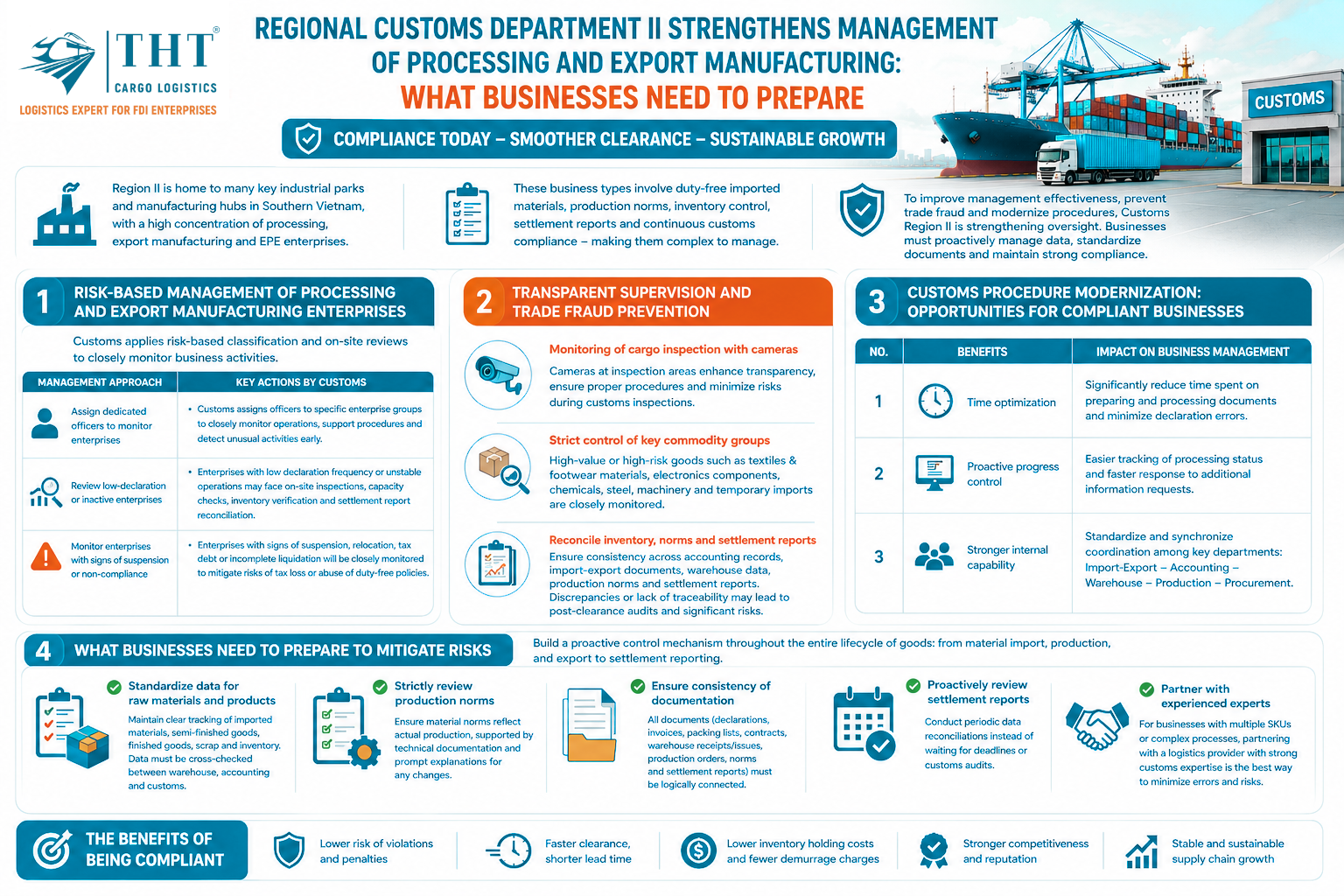
1. Heightened Risk-Based Supervision of Processing and Manufacturing for Export Enterprises
Currently, many processing and manufacturing for export enterprises operate outside centralized industrial zones—dispersed within residential perimeters—or feature offshore management and operational structures. This layout poses distinct oversight challenges for customs authorities regarding manufacturing line monitoring, duty-free material tracking, and systematic compliance evaluations.
As a result, customs authorities are accelerating a targeted management framework based on corporate identity profiling, risk-tiering, and intensified physical operational audits. Key inspection focuses include:
| Regulatory Framework | Key Enforcement Measures by Customs Authorities |
|---|---|
| Dedicated Corporate Account Managers | Customs authorities assign dedicated officials to monitor specific corporate clusters. This ensures close operational oversight, streamlines custom clearance workflows, and facilitates early detection of transactional anomalies. |
| Audits on Low-Declaration Volume Entities | For processing and manufacturing for export enterprises exhibiting low customs declaration frequencies or unstable trade operations, authorities may deploy on-site inspections to verify actual production capacity, perform inventory audits, and cross-examine financial finalization records. |
| Monitoring Dormant or Suspended Operations | Entities showing signs of manufacturing halts, unnotified relocation, tax liabilities, or incomplete liquidity and closure procedures will be placed under strict surveillance. This minimizes bad debt exposure, protects tariff revenue, and prevents abuse of duty-exemptions on manufacturing inputs. |
2. Transparent Surveillance and Counter-Trade Fraud Frameworks
Simultaneously with trade facilitation efforts, Region II Customs is multiplying anti-smuggling and anti-fraud filters to ensure duty-free and preferential commodities are applied strictly to their legally intended manufacturing purposes.
For manufacturing for export, inward processing, and EPE segments, specific surveillance anchors include:
- Camera-Monitored Physical Inspections: Centralized inspection zones are being reinforced with continuous camera surveillance. This enhances procedural transparency, ensures strict adherence to inspection protocols, and minimizes operational frictions during the physical clearance phase.
- Targeted High-Risk Commodity Filters: High-value or high-risk inputs frequently utilized in export manufacturing—such as garments/textiles, footwear materials, electronic components, chemicals, iron/steel, specialized machinery, and temporary import-re-export goods—receive prioritized customs monitoring.
- Reconciliation of Inventory, Yield Norms, and Finalization Reports: Enterprises must ensure absolute data synchronization across financial accounting ledgers, import-export customs declarations, warehouse management systems (WMS), actual production yield norms, and annual finalization reports. Data discrepancies, poor traceability, or inability to substantiate the material balance of duty-free imports will trigger severe exposure during Post-Clearance Audits (PCA).
3. Customs Modernization: Opportunities for Compliant Enterprises
Parallel to strict enforcement, customs authorities are advancing administrative reforms and upgrading information technology systems for dossier intake and digital processing. This shift cuts processing cycles, guarantees transparency, and drives administrative efficiency.
For enterprises maintaining transparent data ecosystems, complete profiles, and strong compliance histories, customs digitization unlocks substantial advantages:
| No. | Modernization Advantages | Practical Impact on Corporate Governance |
|---|---|---|
| 1 | Time Optimization | Significantly accelerates dossier preparation and processing turnaround times, minimizing data discrepancies during declaration entries. |
| 2 | Proactive Milestone Tracking | Enables real-time tracking of clearance statuses, neutralizing operational passivity when authorities issue requests for supplementary data or formal explanations. |
| 3 | Enhanced Internal Governance | Standardizes and aligns the cross-functional coordination workflow between critical silos: Import-Export, Accounting, Warehouse, Production, and Procurement. |
4. Critical Preparations for Enterprises to Mitigate Compliance Exposure
Under rigorous oversight trends, regulatory compliance cannot remain a reactive, audit-driven task. Enterprises must institute internal control mechanisms across the complete lifecycle of cargo: from material import, manufacturing consumption, and finished goods export through to final accounting reconciliation:
| ✔ | Standardize Material and Finished Goods Ledger Data: Establish definitive tracking frameworks for imported raw materials, semi-finished goods, finished items, scrap, waste, and inventory balances. Data streams must allow seamless multi-way reconciliation across physical warehouses, accounting logs, and customs data. |
| ✔ | Audit Actual Production Yield Norms: Material consumption formulas are the legal baseline proving proper utility of duty-exempt cargo. Businesses must guarantee that consumption norms mirror actual factory outputs, maintain technical documentation for variations, and preserve historical data logs. |
| ✔ | Verify Cross-Document System Consistency: Customs declarations, commercial invoices, packing lists, trade contracts, warehouse receipts/issues, production orders, consumption sheets, and finalization reports must contain flawless logical alignments. |
| ✔ | Execute Proactive Internal Finalization Audits: Perform periodic reconciliation reviews and trials throughout the fiscal year instead of rushed compilations prior to official statutory submission deadliness. |
| ✔ | Partner with Specialized Industrial Experts: For entities managing extensive SKU catalogs and complex technical processing structures, collaborating with a logistics partner possessing verified local customs mastery is the most effective approach to neutralize errors. |
5. Strategic Recommendations from THT Cargo Logistics
As customs frameworks shift toward data-driven, highly transparent, and risk-managed models, processing, manufacturing for export, and EPE entities must treat customs compliance as a core pillar of corporate risk governance.
Early alignment safeguards compliance standing before local authorities, secures operational run-times, and blocks exposure to unbudgeted supply chain costs or administrative penalties.
THT Cargo Logistics – Partnering in Corporate Customs Compliance Governance
In a data-centric and increasingly stringent regulatory climate, a seasoned logistics partner does more than accelerate logistics timelines—they provide long-term risk insulation. THT Cargo Logistics – Assisting manufacturers in logistics optimization, trade standardization, and customs risk containment.
Visits: 27