

- Why Must Logistics Be Prepared Right from the Investment Phase?
- Part 1: Defining the Accurate Scope of Activity of the FDI Plant
- Part 2: Pre-Import & Export Commodity Checklist
- Part 3: Machinery Procurement Plan — The First and Most Critical Inbound Segment
- Part 4: Setting Up the Digital Customs System Infrastructure
- Part 5: Documentation Folders for the Maiden Import & Export Cargo Runs
- Part 6: Global Freight Architecture Mapping Across Project Phasing
- Part 7: Post-Clearance Corporate Internal Data Governance
- Summary of Common Pitfalls and Legal Risk Exposures to Avoid
- The Strategic Role of a Specialized Logistics Partner in FDI Plant Stand-up
- THT Cargo Logistics — Specialized Logistics Partner for FDI Plants in Vietnam
IMPORT-EXPORT PROCEDURES GUIDE FOR NEW FDI PLANTS IN VIETNAM: WHAT TO PREPARE FROM DAY ONE
Vietnam continues to be a premier manufacturing destination for foreign investors from Japan, South Korea, China, and Europe. However, alongside investment budgeting, plant construction, and recruitment — a factor that is frequently underestimated but directly affects operational timelines is logistics and import-export procedures.
Practical experience from over 18 years of partnering with FDI factories in Vietnam shows that: the majority of delays in the initial phase do not stem from technical or human resource issues — but from not preparing logistics at the right time.
This article consolidates everything an FDI factory needs to review and prepare before executing its very first import-export shipment in Vietnam.
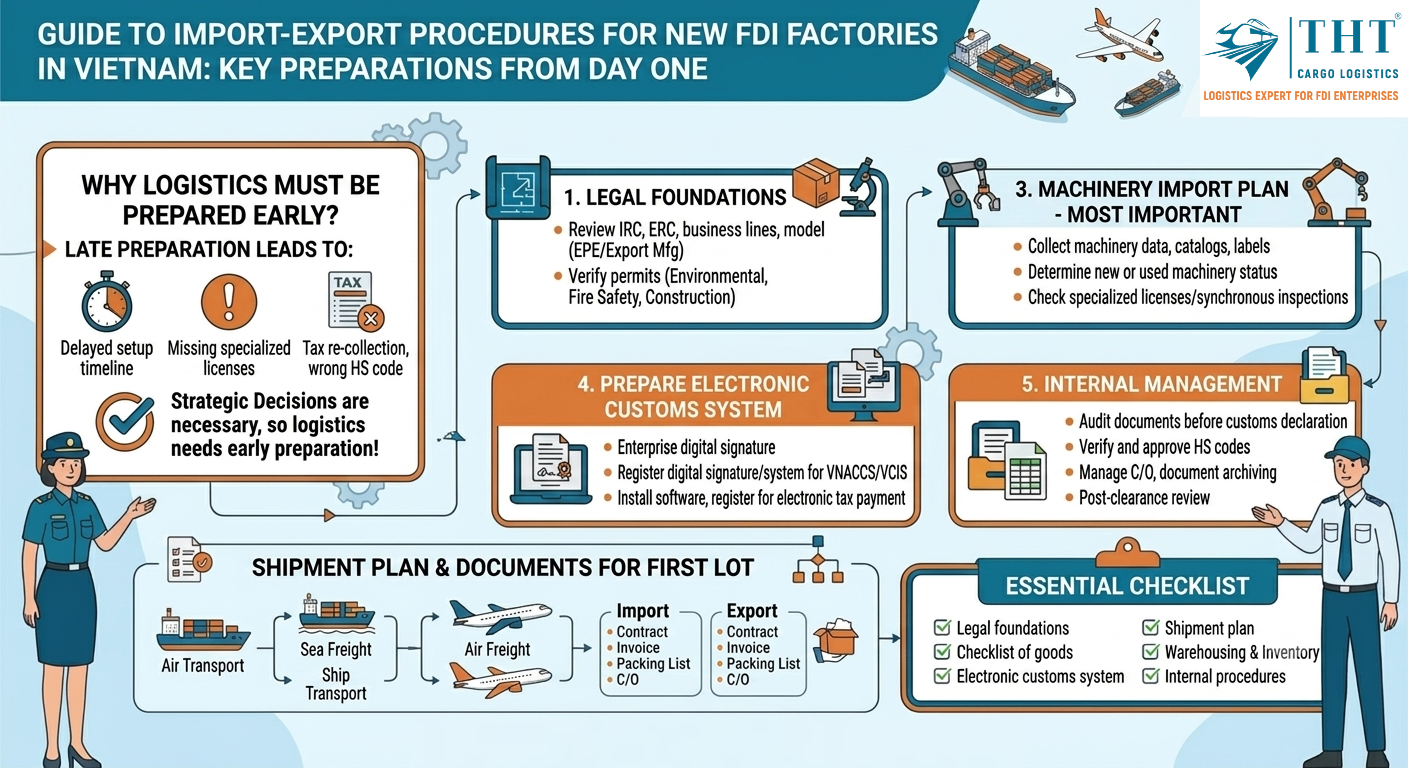
Why Must Logistics Be Prepared Right from the Investment Phase?
Many FDI enterprises only begin searching for a logistics provider when the factory is near completion, or when the first batch of machinery is already packed and ready to ship from abroad. This is one of the most common mistakes.
Logistics is not merely transportation. It is an inseparable part of the project deployment plan. If preparation is delayed, enterprises may face:
| ❌ | Machinery and production lines arriving late compared to the installation schedule. |
| ❌ | Lack of specialized permits/licenses when goods have already arrived at the port. |
| ❌ | Incorrect HS code classification causing customs delays and retroactive tax assessments. |
| ❌ | Unbudgeted overheads such as container demurrage, detention, and port storage charges (Dem/Det). |
| ❌ | Disruption to trial run milestones and commercial production schedules. |
Every single week of delay during this phase incurs significant financial loss, human resource waste, and missed business opportunities. That is why preparing logistics early — in parallel with finishing investment legalities — is a strategic decision, not an administrative formality.
Part 1: Defining the Accurate Scope of Activity of the FDI Plant
Before diving into any specific procedure, businesses must answer a foundational question: Which operational model does your factory fall under? An FDI manufacturing plant importing raw materials and exporting finished products operates under a completely different framework compared to an FDI enterprise importing goods for domestic trading or retail distribution in Vietnam.
The first legal dossiers to cross-check:
| Legal Dossier | Critical Review Focus |
|---|---|
| Investment Registration Certificate (IRC) | Does the project objective explicitly cover manufacturing, importing machinery/raw materials, and exporting products? |
| Enterprise Registration Certificate (ERC) | Verify the official corporate name, Tax Identification Number (TIN), and Legal Representative. |
| Business Sectors & Objectives | Does the registered corporate scope perfectly align with your actual day-to-day operations? |
| Operational Model Regime | Is it registered as a standard enterprise, Export Processing Enterprise (EPE), inward processing, or manufacturing for export? |
| Land/Factory Lease Agreement | Does the physical project location precisely match the coordinates registered in the investment profiles? |
Part 2: Pre-Import & Export Commodity Checklist
Once the operational scope is defined, the enterprise must draft a master catalog of all planned import and export commodities — and cross-examine each item against the following criteria:
| Review Content | Practical Implication & Action Required |
|---|---|
| HS Code Classification | The absolute core baseline to determine tariff rates, customs policies, and mandatory filing structures. |
| Commodity Policy Management | Identify if the goods are eligible for import/export, restricted, conditional, or under a temporary ban. |
| Specialized Permits/Licenses | Applies to chemical segments, specific machinery, medical devices, telecommunications, food products… |
| Quality Control & Quarantine | Mandatory requirements for conformity certifications, technical standard tests, or plant/animal quarantine. |
| Cargo Labeling Regulations | Review the layout of original labels, supplementary labels, and mandatory data points required by Vietnamese law. |
| Certificate of Origin (C/O) | Leverage preferential tariff treatments under FTAs or satisfy criteria dictated by overseas buyers. |
| Used Machinery Import Conditions | Second-hand equipment must strictly comply with isolated statutory criteria regarding machine age and technology safety. |
Standard commodity groups frequently utilized by new FDI factories include: capital machinery lines, CNC machines, robotics, molds, raw materials (plastics, steel, fabrics, electronic components, chemicals), packaging, samples, and replacement spare parts.
Part 3: Machinery Procurement Plan — The First and Most Critical Inbound Segment
For almost every new FDI facility, the first material assets brought into Vietnam are manufacturing machinery and production equipment. This is also the most complex segment regarding regulatory hurdles and operational risks.
Enterprises must clear up and secure the following parameters early on:
- Technical Documentation: Comprehensive equipment item lists, engineering catalogues, and compliant label mock-ups showing exact brand names and origins.
- Equipment Condition: Brand new 100% or second-hand (used machinery is governed by a strict statutory age cap of under 10 years).
- Logistics Parameters: Precise dimensions and unit weights — does the setup require knockdown disassembly into individual containers? Does it involve Out-of-Gauge (OOG) or heavy-lift cargo needing specialized assets?
- Commercial Terms: International trade terms (Incoterms 2020) and international payment structures.
- Project Milestones: Estimated Time of Arrival (ETA) at the destination port — which must match the plant’s civil construction and civil engineering readiness.
Certain machine lines require pre-clearance licensing from specialized ministries, such as printing equipment, used industrial machinery, or wireless radio-transmitting hardware. Turnkey machinery lines imported in disassembled phases may require a unified structural function appraisal certified by authorized inspection bodies.
Filing an incorrect HS code or misrepresenting equipment characteristics exposes the business to administrative fines, customs holds, forced re-exportation, or immense retroactive tax bills. For massive capital investments, verifying HS codes during the pre-shipping setup is an indispensable phase.
Part 4: Setting Up the Digital Customs System Infrastructure
Prior to transmitting any active customs data, the baseline digital framework required to draft, sign, and lodge electronic files must be operational. This is a step new FDI entities often overlook until containers have already crossed into territorial waters.
| Technical Requirement | Mandatory Operational Outcome |
|---|---|
| Corporate Digital Signature (USB Token) | Active, validated, and mapped exactly to the enterprise’s official Tax ID. |
| Customs Portal Token Registration | The General Department of Vietnam Customs maps the signature to active electronic data processing. |
| VNACCS/VCIS System Accounts | Successfully registered with 4 unique connection parameters allocated and user access authorized. |
| Customs Declaration Software | Installed, parameter-configured, and communication links tested successfully with the customs gateway. |
| National Public Service Account | Account established to handle electronic administrative file submissions and tax processing trackers. |
| National Single Window (NSW) Portal | Active registration setup to process line-agency specialized permits and inspection filings. |
| 24/7 Electronic Tax Payment Setup | Linked commercial bank accounts tied directly to customs portals to process immediate tariff releases. |
Part 5: Documentation Folders for the Maiden Import & Export Cargo Runs
📋 Core Dossier Set for the First Import Shipment
| Required Document | Critical Compliance Review Focus |
|---|---|
| Sale Contract / Purchase Order (PO) | Explicitly specify transaction delivery terms (Incoterms) and settlement frameworks. |
| Commercial Invoice | Must detail exact unit pricing, total valuations, active currency codes, and delivery matrix. |
| Packing List | Itemized breakdowns of package volume, net weights, gross weights, and external dimension sizes. |
| Bill of Lading (B/L) / Waybill (AWB) | Cross-check that the consignee identity precisely mirrors information displayed on commercial invoices. |
| Catalogue / Technical Datasheets | Core technical evidence utilized to substantiate HS code choices and specialized ministry audits. |
| Certificate of Origin (C/O) | Valid original hardcopy or verified electronic file to claim preferential import customs tariffs. |
| Specialized Agency Registration/Permits | Must be fully logged in system portals or formal approvals issued prior to transmission of data. |
📋 Core Dossier Set for the First Export Shipment
| Required Document | Critical Compliance Review Focus |
|---|---|
| Sales Contract / Overseas PO | Clear records of international buyer profiles, product technical definitions, and Incoterms. |
| Export Commercial Invoice | Accurately verify factory-gate valuation or delivery pricing points at the export terminal. |
| Export Packing List | Finished goods packaging parameters, piece count, pallet tracking, net/gross weights. |
| Carrier Booking / Waybill File | Coordinate closely with ocean/air links to manage reliable vessel dispatch metrics (ETD/ETA). |
| Outbound Certificate of Origin (C/O) | Register corporate profiles and secure outbound C/O if required for destination country FTA treatments. |
| Bill of Materials (BOM) Data Log | Paramount framework for inward processing and manufacturing-for-export to support statutory year-end balancing audits. |
Part 6: Global Freight Architecture Mapping Across Project Phasing
A new FDI facility features a complex, layered supply chain profile incorporating varied cargo groups with distinctly decoupled handling parameters: structural framework materials, principal machine lines, pilot run testing inputs, and large-scale bulk raw materials. Each subgroup demands specialized forwarding structures.
Enterprises need to construct an end-to-end logistics routing matrix synchronized to project phase targets, addressing:
- Optimal Mode Selection: Balancing Full Container Loads (FCL), Less than Container Loads (LCL) ocean freight, air cargo, or express logistics paths.
- Cargo Characteristics: Strictly isolating complex Project Cargo (requiring engineering blueprints and unified setups) from standard commercial inventory runs.
- Transit Timing Mapping: Factoring ocean passage variations to mirror structural on-site engineering milestones perfectly.
- Heavy-Lift & Specialized Offloading: Securing early route route surveys for out-of-gauge transport lanes and locking down specialized site cranes at the plant site.
Given the challenges of delicate or complex factory machinery, choosing a logistics operator with deep, verifiable project logistics expertise is the defining factor in securing absolute cargo protection from ocean hubs onto factory footings.
Part 7: Post-Clearance Corporate Internal Data Governance
Customs procedures do not terminate when cargo is released from port checkpoints. The enterprise must institute a bulletproof internal record-keeping and archiving ecosystem right from the initial arrivals to service financial accounting, internal audit, and especially statutory Post-Clearance Audits (PCA).
| Mandatory Internal Workflow | Risk Mitigation Objective |
|---|---|
| Pre-Filing Documentation Reviews | Eliminate inconsistencies across packing data, invoice values, transport documentation, and original logs. |
| Centralized HS Code Approval Chain | Lock down classification consistency per SKU, blocking dangerous entry changes across separate shipments. |
| C/O Integrity Management | Rigidly audit expiration boundaries, origin qualification codes, and original dossier backup chains. |
| Digitized Customs Folder Archiving | Catalog complete sets matching declarations cleanly to sustain immediate defense during surprise audits. |
| Regime-Isolated Inventory Systems | Isolate domestic-sale stocks (A11) from manufacturing-for-export inputs (E31), processing (E21), or EPE materials. |
| Internal Mock Compliance Audits | Proactively audit historical post-clearance footprints to uncover and patch errors before authorities intervene. |
Summary of Common Pitfalls and Legal Risk Exposures to Avoid
| Frequent Mistakes in Greenfield Operations | Resulting Penalties & Financial Exposures |
|---|---|
| Neglecting to cross-examine IRC/ERC boundaries | Actual operations fall outside approved corporate scope, inducing immediate regulatory suspension. |
| Misclassifying complex technical HS codes | Incorrect duty calculations, code policy violations, administrative fines, and extensive historical tax clawbacks. |
| Omiting specialized line-agency permit tracking | Cargo seized at arrival terminals, generating massive port storage liabilities and potential forced re-exportation. |
| Delayed token configurations and portal links | Inability to transmit entry filings on time, paralyzing port pull-out loops and factory assembly schedules. |
| Complete reliance on small-scale, unverified forwarders | Corporate loses control over its legal declaration history, leaving the entity solely liable for systemic errors. |
| Uncontrolled production norm variables and stock tracking | Severe risk of report rejection and penal assessments when submitting mandatory finalization files under EPE or export models. |
The Strategic Role of a Specialized Logistics Partner in FDI Plant Stand-up
Within Greenfield Investments, the right logistics partner serves as a critical operational co-pilot rather than a basic transactional freight vendor.
A highly qualified logistics organization directly supports international investors to:
| ✔ | Structure micro-detailed inbound asset procurement schedules and engineer operational logistics risk logs. |
| ✔ | Execute pre-shipping diagnostics, validating technical HS selections and mapping agency policies early. |
| ✔ | Deliver technical advisory, managing ministry license filings and orchestrating foreign C/O verifications. |
| ✔ | Manage professional brokerage declarations and anchor real-time delivery tracking controls. |
| ✔ | Deploy complete project cargo execution, handling heavy machinery transport and precision internal plant positioning. |
| ✔ | Consult on cost optimization and engineer highly resilient local supply chain structures in Vietnam. |
📋 SUMMARY CHECKLIST: LOGISTICS MANAGEMENT FOR NEW FDI PLANTS
(Ensure all components are thoroughly validated before triggering the first inbound shipment)
⬜ Review the strict legality of IRC, ERC, registered business scopes, and corporate operational regimes.
⬜ Secure unified confirmation across environmental permits, fire safety clearances, and civil construction licenses.
⬜ Build detailed SKU logs for all initial machinery imports and targeted outbound finished products.
⬜ Establish definitive HS designations and screen specialized regulatory compliance bounds for each item.
⬜ Audit exact testing matrices, technical standard certifications, and quarantine frameworks required.
⬜ Issue validated digital signature tokens and register connection parameters across VNACCS/VCIS platforms.
⬜ Set up declaration software linkages and clear the electronic 24/7 bank payment link channels.
⬜ Construct complete equipment arrival workflows broken down by factory structural construction phases.
⬜ Appoint optimal shipping modes and execute service level agreements with qualified logistics providers.
⬜ Ready material receiving zones, finished product zones, and secure machine staging spaces.
⬜ Standardize Standard Operating Procedures (SOPs) for warehouse handling and configure mapping software (WMS).
⬜ Institute rigid document validation chains and set up centralized HS code approval paths.
⬜ Build robust data archiving protocols, securing perfect long-term trace records for post-clearance audits.
THT Cargo Logistics — Specialized Logistics Partner for FDI Plants in Vietnam
THT Cargo Logistics possesses a solid track record in managing industrial logistics and customs compliance for multinational FDI operations. We are steered directly by an executive management tier holding 10 to 18 years of deep, practical field expertise. We are proud to have supported leading manufacturing corporations from Japan, South Korea, China, and Europe through complex market roll-outs, daily operational optimizations, and subsequent industrial expansions across Vietnam.
Visits: 0