


- 1. Not every production batch needs to be registered as a new product
- 2. Why can’t raw material suppliers currently be seen on VeriGoods?
- 3. How deeply does a factory need to manage its traceability data?
- 4. What happens if a mandatory product is not subject to traceability implementation?
- 5. What should FDI manufacturing plants do from now?
- VeriGoods Registration
- THT CARGO LOGISTICS’ PERSPECTIVE
- Not sure how far your FDI manufacturing plant needs to implement VeriGoods?
VERIGOODS FROM 01/01/2027: WHAT FDI MANUFACTURING PLANTS NEED TO UNDERSTAND TO AVOID DOING TOO MUCH — OR TOO LITTLE
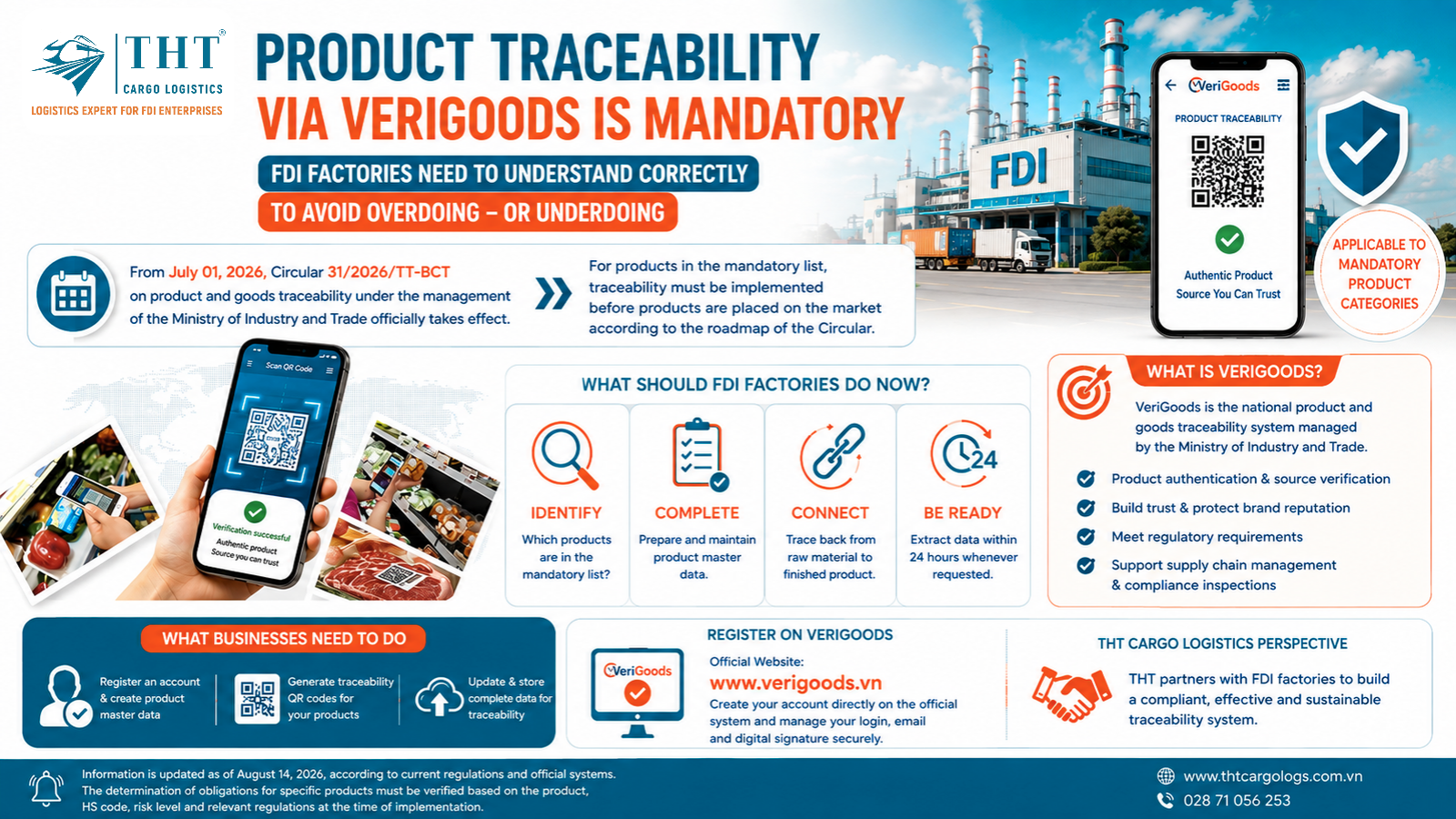
From 01/07/2026, Circular No. 31/2026/TT-BCT on product and goods traceability under the management scope of the Ministry of Industry and Trade officially takes effect. For products subject to mandatory traceability requirements, traceability must be implemented before the goods are placed on the market according to the roadmap set out in the Circular.
1. Not every production batch needs to be registered as a new product
VeriGoods assigns a product identification code to a specific product or product group.
Therefore, if a factory produces multiple batches of the same product, it does not automatically have to register the product again from the beginning for each individual batch.
Example:
Product A → Register product identification
Subsequent batches:
- Batch A001
- Batch A002
- Batch A003…
These batches continue to be managed within the batch/lot-level traceability data layer, rather than being created as three separate products.
Circular 31 stipulates that the lot/batch number or serial number is one of the traceability information elements, while the Ministry of Industry and Trade’s system supports the identification of product types, lots/batches, or individual product units. The current VeriGoods user guidance also describes functionality for registering product and lot/batch identification information.
In simple terms:
The product is identified → subsequent batches are managed and updated with traceability data.
2. Why can’t raw material suppliers currently be seen on VeriGoods?
When searching for a product on VeriGoods, users currently mainly see information such as:
Product name – origin – manufacturer – brand – specifications – certifications – product description…
This is consistent with Circular 31, as the information that consumers are entitled to access publicly mainly consists of basic information such as the product name, origin, images, manufacturer/business entity, brand, lot/batch number or serial number, and expiry date, if applicable.
Therefore:
The fact that raw material suppliers are not visible on the public-facing page does not mean that the business does not need to manage this data.
Two data layers need to be distinguished:
- Public data: used by consumers for product lookup.
- Traceability data: used by businesses for management, system integration, and provision to regulatory authorities when required.
3. How deeply does a factory need to manage its traceability data?
Circular 31 requires minimum traceability data to include key tracking events and the timing of such events throughout the supply chain, in addition to lot/batch numbers and other product information.
For a manufacturing plant, the key requirement is to be able to connect:
Supplier → Raw Material Lot → Production Order → Finished Goods Lot → Warehouse → Customer/Export Shipment.
These detailed data elements do not necessarily all need to be made public to consumers scanning a QR code. However, the business must organize, retain, and manage traceability data in accordance with the applicable requirements.
If an internal traceability system is used, the data must be capable of being connected and shared with VeriGoods through an Application Programming Interface (API), ensuring update history, data integrity, and the ability to provide the data within 24 hours when requested by a competent authority.
Therefore, businesses should not assume:
“Registering the product name on VeriGoods means that traceability requirements have been fully completed.”
4. What happens if a mandatory product is not subject to traceability implementation?
Under Circular 31, products subject to mandatory requirements must have traceability implemented before being placed on the market. Traders are responsible for the information they declare and are subject to inspection and supervision by regulatory authorities.
If the data is inaccurate, untruthful, not properly maintained, or the business fails to implement required corrective measures, the Ministry of Industry and Trade may suspend or cancel the confirmation for displaying traceability information in accordance with the prescribed cases.
5. What should FDI manufacturing plants do from now?
Do not start with the question:
Instead, start with these four questions:
- Which products manufactured by the factory are actually subject to mandatory requirements?This determination should be made by cross-checking Circular 31, the list under Circular 33/2026/TT-BCT, and relevant specialized regulations.
- Does each product have complete identification data?
- For any given production batch, can the business trace it back to the raw material lot and supplier?
- If requested by a regulatory authority, can the business extract the required data within 24 hours?
VeriGoods Registration
Official website: https://www.verigoods.vn/
Businesses should create an account directly on the official system and retain administrative control over the account, email address, and digital signature of the business itself. The official registration guidance requires businesses to update their company profile before registering product identification information.
THT CARGO LOGISTICS’ PERSPECTIVE
THT does not view VeriGoods simply as a “code registration” service.
For an FDI manufacturing plant, the more important value is helping the business determine:
- Which products are subject to the requirements
- Which data needs to be made public
- Which data needs to be managed by lot/batch
- Which data needs to be maintained in the internal system
- How to connect everything into a complete traceability chain.
The ultimate objective is:
A product is identified once, while every batch can be traced back through the entire history required whenever necessary.
The check is actually very simple:
If a finished goods batch were selected at random tomorrow, could the factory quickly identify which raw materials and suppliers were used to produce it, and where that batch has gone?
If not, that is the part the business needs to prepare before 2027.
This information is updated based on regulations and system information published as of 14/08/2026. The obligations applicable to a specific product should be determined by cross-checking the product, HS code, risk level, and relevant specialized regulations applicable at the time of implementation.
Not sure how far your FDI manufacturing plant needs to implement VeriGoods?
THT Cargo Logistics supports FDI manufacturing plants in reviewing products subject to traceability requirements, determining the data that needs to be managed by lot/batch, checking the ability to trace finished products back to raw materials and suppliers, and advising on how to organize data in accordance with applicable management requirements.
If your business is preparing for the VeriGoods 2027 roadmap and is unsure whether its current data is sufficient to meet the requirements, contact THT Cargo Logistics for a traceability data review.
Visits: 11
This is a useful and practical explanation of VeriGoods implementation for FDI manufacturing plants. The distinction between product registration and batch-level traceability is especially helpful, as it highlights the importance of maintaining a complete and reliable traceability chain.