


- IMPORTING LEAD / LEAD ALLOYS: VIETNAM CUSTOMS CLARIFIES THE ASSESSMENT OF LICENSING REQUIREMENTS FOR CHEMICALS REQUIRING SPECIAL CONTROL
- 1. WHAT HAS CHANGED?
- 2. WHO MAY BE AFFECTED?
- 3. WHAT SHOULD ENTERPRISES PAY ATTENTION TO?
- First, lead is included in the List of Chemicals Requiring Special Control.
- Second, the 1% by-mass threshold is an important benchmark for mixtures.
- Third, where goods are determined to constitute chemicals requiring special control, an import license is generally required.
- Fourth, there is no general transitional exemption merely because the enterprise imported the same goods in the past.
- Fifth, applicable exemptions must still be reviewed.
- 4. IMPACT ON FDI FACTORIES
- 5. ACTION CHECKLIST
- 6. THT’S ASSESSMENT
- 7. OFFICIAL REFERENCES
- Need Support Reviewing Your Lead / Lead Alloy Imports?
IMPORTING LEAD / LEAD ALLOYS: VIETNAM CUSTOMS CLARIFIES THE ASSESSMENT OF LICENSING REQUIREMENTS FOR CHEMICALS REQUIRING SPECIAL CONTROL
RED — CRITICAL
Urgency: IMMEDIATE ACTION required for enterprises currently importing or planning to import goods containing Lead (Pb).
1. WHAT HAS CHANGED?
On 28 August 2026, the Vietnam Customs Department issued Official Dispatch No. 21103/CHQ-GSQL in response to an enterprise’s inquiry regarding the regulatory requirements applicable to imported lead ingots.
The Official Dispatch is not a new legal instrument, nor is it a ruling directly applicable to every type of lead alloy or product containing lead. Nevertheless, it provides an important indication of how Customs authorities are currently assessing goods containing lead during import customs clearance.
The Customs Department referred to:
- Law on Chemicals No. 69/2025/QH15, effective from 1 January 2026;
- Decree No. 24/2026/ND-CP, effective from 17 January 2026, prescribing the lists of chemicals governed by the Law on Chemicals;
- Decree No. 26/2026/ND-CP, effective from 17 January 2026, governing chemical activities and hazardous chemicals in products and goods.
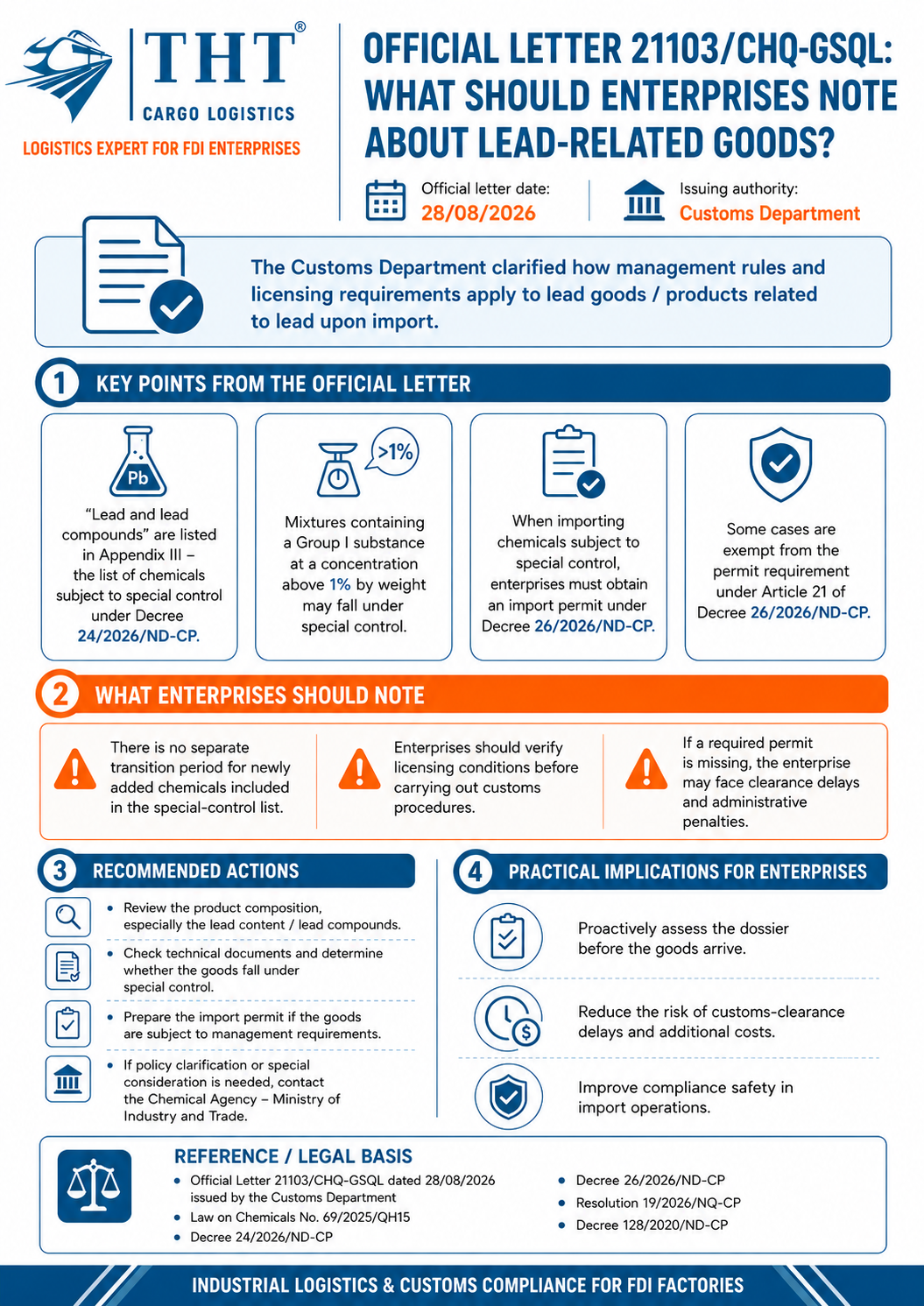
Notably, Official Dispatch No. 21103 confirms that “Lead and lead compounds” are classified under Group 1 of the List of Chemicals Requiring Special Control in Appendix III to Decree No. 24/2026/ND-CP.
2. WHO MAY BE AFFECTED?
FDI enterprises should conduct an immediate review if they import:
- Pure lead or lead ingots;
- Lead alloys;
- Semi-finished goods, raw materials or materials containing lead;
- Goods whose COA or SDS indicates a significant concentration of Lead (Pb);
- Materials used in electrical and electronics manufacturing, batteries, mechanical engineering, metal casting, components, industrial materials or other industries using lead-containing alloys.
Relevant departments should coordinate the review, including:
Import-Export / Customs – Procurement – Engineering / R&D – QA – EHS / Regulatory Affairs – Warehouse – Production
3. WHAT SHOULD ENTERPRISES PAY ATTENTION TO?
Based on the approach outlined by the Customs Department in Official Dispatch No. 21103:
First, lead is included in the List of Chemicals Requiring Special Control.
“Lead and lead compounds” are listed under Group 1 of Appendix III to Decree No. 24/2026/ND-CP.
Second, the 1% by-mass threshold is an important benchmark for mixtures.
Under Part II of Appendix III to Decree No. 24/2026/ND-CP, a mixture containing at least one Group 1 component at a concentration exceeding 1% by mass falls within the category of mixtures requiring special control.
This provision is also directly cited by the Customs Department in Official Dispatch No. 21103.
Third, where goods are determined to constitute chemicals requiring special control, an import license is generally required.
The Customs Department states that where chemicals requiring special control are imported, the enterprise must obtain a License to Import Chemicals Requiring Special Control.
The application dossier and procedures are governed by Article 14 of Decree No. 26/2026/ND-CP.
Fourth, there is no general transitional exemption merely because the enterprise imported the same goods in the past.
Official Dispatch No. 21103 notes that the specialized legislation does not provide a general transitional period for chemicals newly included in Appendix III.
Accordingly, once Decree No. 24/2026/ND-CP and Decree No. 26/2026/ND-CP became effective, enterprises falling within the licensing requirement are required to comply when carrying out customs procedures.
Fifth, applicable exemptions must still be reviewed.
Official Dispatch No. 21103 also refers to Article 21 of Decree No. 26/2026/ND-CP, as amended and supplemented by Resolution No. 19/2026/NQ-CP, which provides exemptions from certain export and import licensing requirements.
4. IMPACT ON FDI FACTORIES
Customs / Import-Export
The regulatory risk is no longer limited to the commercial description or HS code.
Customs authorities may examine the goods in greater depth based on:
chemical composition → concentration → nature of the goods → intended use → applicable exemptions
Therefore, descriptions provided by suppliers such as “Lead Alloy”, “metal part”, “lead piece” or “finished part”, or the fact that the goods have already been cast, cut or otherwise formed, do not automatically exclude them from chemical regulatory requirements.
QA / Engineering / EHS
The SDS, COA and product specifications become critical supporting documents for determining:
- Pb concentration;
- Other elements or chemical compounds present;
- Whether the imported goods constitute a substance, mixture, or product/goods containing hazardous chemicals;
- The actual intended use of the goods;
- Whether any licensing exemption applies.
Procurement
Enterprises should not place purchase orders or instruct suppliers to ship goods solely on the basis that:
“We have been importing this item for many years.”
The applicable regulatory requirements must be assessed based on the regulations in force at the time of the current importation.
Production / Warehouse
If a licensing requirement is discovered only after the cargo has arrived at the port, the enterprise may face:
- Customs clearance delays;
- Disruption to material supply and production schedules;
- Additional container demurrage/detention and terminal or storage charges;
- Additional specialized regulatory procedures;
- Potential administrative penalties, depending on the specific documentation, timing and circumstances of the case.
5. ACTION CHECKLIST
6. THT’S ASSESSMENT
THT considers Official Dispatch No. 21103/CHQ-GSQL an important enforcement signal for enterprises importing lead and lead alloys into Vietnam.
The key point is that Customs authorities are increasingly examining the actual chemical composition and concentration of the imported goods, rather than relying solely on the commercial description or on whether the goods have already been cast, cut or otherwise formed.
However, THT does not recommend stating that “every lead alloy product containing more than 1% lead automatically requires an import license.”
Official Dispatch No. 21103 addresses lead ingots imported by a specific enterprise, and the Official Dispatch itself also requires consideration of applicable exemptions under Article 21 of Decree No. 26/2026/ND-CP.
Three-step assessment before determining whether an import license is required
Step 1 — Composition
Does the product contain Lead (Pb), a Group 1 chemical, and does the concentration exceed the applicable control threshold?
Step 2 — Legal Classification of the Goods
Does the imported item legally constitute a mixture requiring special control, or should it instead be classified as a product or goods containing hazardous chemicals?
Step 3 — Exemption
Does the specific import transaction qualify for an exemption under Article 21 of Decree No. 26/2026/ND-CP and the applicable amendments currently in force?
If the assessment concludes that the goods constitute a chemical or mixture requiring special control and no applicable exemption is available, the enterprise must obtain the relevant import license before carrying out customs clearance procedures.
This approach provides a more legally prudent basis for compliance while accurately reflecting the level of regulatory risk indicated by Official Dispatch No. 21103.
7. OFFICIAL REFERENCES
- Official Dispatch No. 21103/CHQ-GSQL dated 28 August 2026 issued by the Vietnam Customs Department – Re: issues and recommendations concerning regulations applicable to lead ingots.
- Law on Chemicals No. 69/2025/QH15, issued on 14 June 2025 and effective from 1 January 2026.
- Decree No. 24/2026/ND-CP, effective from 17 January 2026 – Lists of chemicals governed by the Law on Chemicals.
- Decree No. 26/2026/ND-CP, effective from 17 January 2026 – Management of chemical activities and hazardous chemicals in products and goods.
- Resolution No. 19/2026/NQ-CP dated 29 April 2026 – including amendments and simplification of certain administrative procedures and business conditions under the management of the Ministry of Industry and Trade.
COMPLIANCE NOTE
The licensing requirement for each imported item should be determined based, at a minimum, on its chemical composition, concentration, SDS/COA, physical structure, intended use and applicable exemptions.
Enterprises should not determine the regulatory status of an item solely from the commercial description “Lead Alloy” or its HS code.
Need Support Reviewing Your Lead / Lead Alloy Imports?
THT Cargo Logistics supports FDI manufacturers in reviewing chemical composition, SDS/COA, import licensing requirements, applicable exemptions and customs compliance risks before shipment and customs declaration.
Visits: 14