

- From 9 September 2026: EPEs Must Update the “Enterprise’s Internal Management Number” Declaration for Automated Confirmation Through the Customs Supervision Area
From 9 September 2026: EPEs Must Update the “Enterprise’s Internal Management Number” Declaration for Automated Confirmation Through the Customs Supervision Area
1. WHAT IS CHANGING?
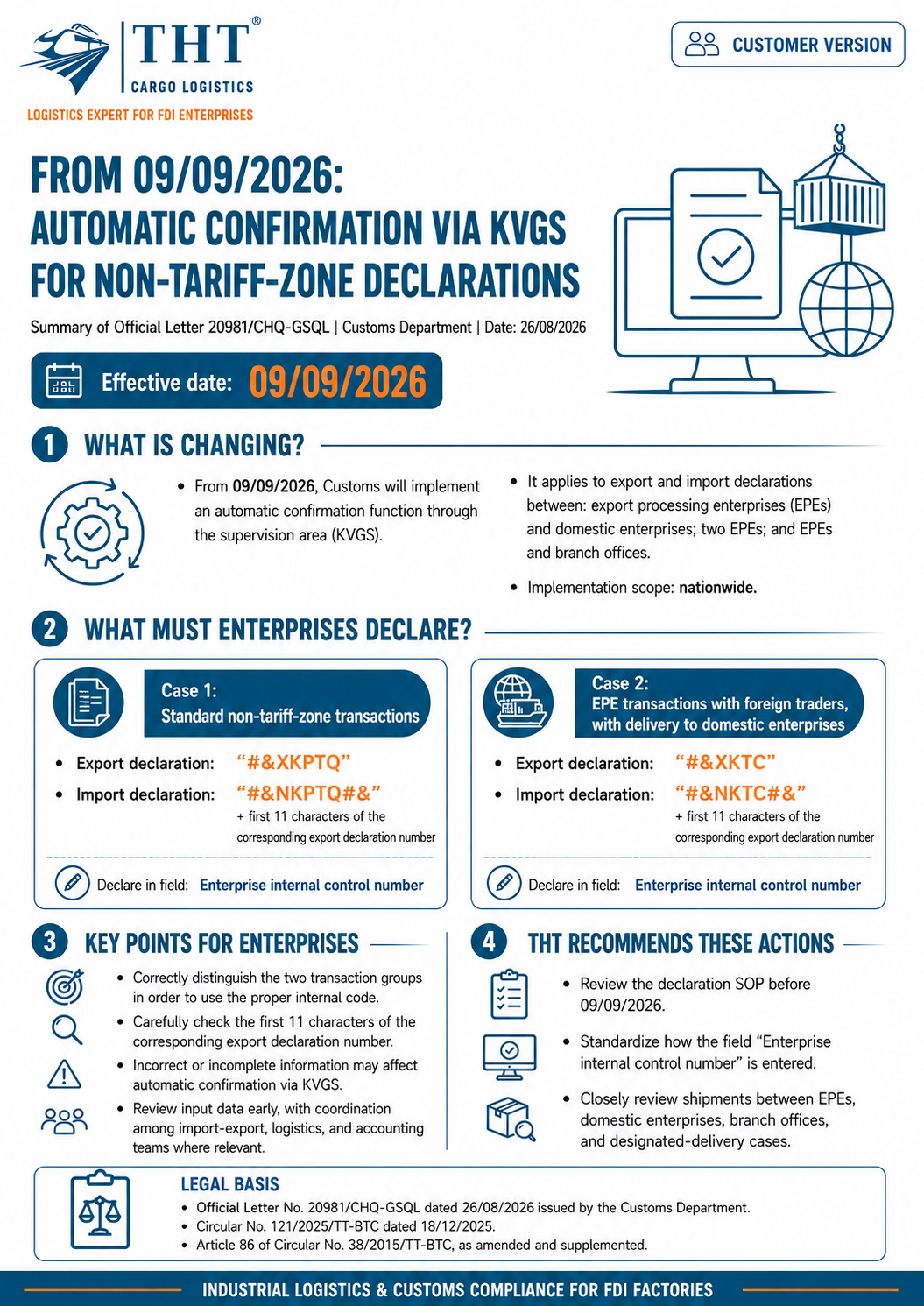
According to Official Letter No. 20991/CHQ-GSQL dated 26 August 2026 issued by the Customs Department, from 9 September 2026, Vietnam Customs will roll out nationwide functionality for automated confirmation through the customs supervision area for export and import customs declarations involving:
- An Export Processing Enterprise (EPE) and a domestic enterprise;
- Two EPEs;
- An EPE and a branch.
For customs declarations registered on or after 9 September 2026, customs declarants must enter the required information in the “Enterprise’s Internal Management Number” field using the prescribed format under Circular No. 121/2025/TT-BTC.
9 September 2026 is the implementation date of the automated confirmation functionality, not the effective date of Circular No. 121/2025/TT-BTC.
Circular No. 121/2025/TT-BTC was issued on 18 December 2025 and took effect on 1 February 2026.
2. WHO IS AFFECTED?
This compliance alert is particularly relevant to:
- Export Processing Enterprises (EPEs) conducting transactions with domestic enterprises;
- Domestic enterprises purchasing, selling, leasing or borrowing goods from EPEs;
- Transactions involving goods between two EPEs;
- Transactions between an EPE and a branch where customs procedures are required;
- EPEs purchasing, selling, processing, leasing or borrowing goods from foreign traders where the foreign trader designates delivery of the goods to a domestic enterprise or another EPE in Vietnam.
Factory functions that should pay particular attention include Import-Export/Customs, Logistics, Warehouse, and other teams involved in cargo handover and receipt.
3. WHAT EXACTLY IS CHANGING?
Case 1 — Transactions Between an EPE and a Domestic Enterprise, Between Two EPEs, or Between an EPE and a Branch
For customs declarations registered on or after 9 September 2026:
This must be entered in the “Enterprise’s Internal Management Number” field of the export customs declaration.
The importer must correctly link the import declaration to the corresponding export declaration of the exporting enterprise.
The XKPTQ/NKPTQ declaration format is consistent with Circular No. 121/2025/TT-BTC for this category of transactions. Circular 121 specifically requires #&XKPTQ on the export declaration and the corresponding export declaration number in the internal management number field of the import declaration.
Case 2 — On-the-Spot Export/Import Transactions Designated by a Foreign Trader
Where an EPE purchases, sells, processes, leases or borrows goods from a foreign trader, and that foreign trader designates delivery of the goods to a domestic enterprise or another EPE in Vietnam, customs procedures continue to be carried out under the provisions governing on-the-spot export/import in Article 86 of Circular No. 38/2015/TT-BTC, as amended and supplemented by Circular No. 121/2025/TT-BTC.
The required declaration format is:
⚠️ A CRITICAL DISTINCTION
XKPTQ/NKPTQ
→ Applicable to the non-tariff-zone transaction category described in Case 1.
XKTC/NKTC
→ Applicable to on-the-spot export/import transactions where a foreign trader designates delivery of goods within Vietnam.
These two transaction types have different legal characteristics and should not be treated as interchangeable merely because a company has historically used the same declaration format.
4. IMPACT ON FDI FACTORIES
Customs / Import-Export Team
From 9 September 2026, the “Enterprise’s Internal Management Number” field will play a direct role in enabling the customs system to identify and match the corresponding export and import customs declarations.
🔴 Errors to avoid:
- Using XKPTQ/NKPTQ instead of XKTC/NKTC, or vice versa;
- Omitting the required declaration format;
- Entering incorrect first 11 characters of the export declaration number;
- Linking the import declaration to the wrong export declaration.
Such errors may prevent the customs system from correctly identifying the corresponding declaration pair for automated confirmation through the customs supervision area.
This may result in additional verification or handling by Customs and could affect cargo handover, receipt, or operational timelines.
Warehouse / Logistics Team
Cargo handover and receipt procedures between an EPE and its counterparty should be aligned with the status of the corresponding export-import customs declaration pair, rather than checking each declaration independently.
IT / Customs Declaration Software Team
Enterprises should review their systems before implementation if they currently use:
- Customs declaration templates;
- Pre-set declaration data;
- Middleware or interfacing software;
- Functions that copy data from previous customs declarations;
- Automated tools that populate customs declaration fields.
Any pre-configured information relating to the “Enterprise’s Internal Management Number” field should be reviewed and updated before the new system functionality goes live.
5. ACTION CHECKLIST
Before 9 September 2026, THT recommends that enterprises:
- Review customs declaration SOPs for transactions involving EPEs.
- Clearly identify which transactions fall under XKPTQ/NKPTQ and which fall under XKTC/NKTC.
- Update existing customs declaration templates and master data.
- Review customs declaration software and automation tools where information in the “Enterprise’s Internal Management Number” field has been pre-configured.
- Add a control step to verify the first 11 characters of the corresponding export customs declaration number before transmitting the import customs declaration.
- Add a specific export-import declaration matching check to the customs clearance checklist.
- Inform relevant Import-Export/Customs, Logistics and Warehouse personnel of the system implementation date of 9 September 2026.
- For multi-party transactions or cases where it is unclear whether a transaction constitutes a non-tariff-zone transaction or an on-the-spot export/import transaction, determine the actual transaction structure before selecting the declaration format.
6. THT ASSESSMENT
THT assesses that this is not a major change in import-export tax policy. However, it is an important operational change in the way the Customs system controls, identifies and automates the matching of corresponding customs declarations.
The practical risk lies in enterprises continuing to use previous declaration templates or selecting the wrong declaration format after the system transition.
In particular, enterprises should avoid assuming that all EPE-related transactions must use XKPTQ/NKPTQ.
Where a foreign trader designates delivery of goods within Vietnam, the transaction must still be assessed against the provisions governing on-the-spot export/import, and XKTC/NKTC should be used where the transaction falls within the applicable legal conditions.
THT therefore recommends that enterprises go beyond merely updating declaration codes in their customs software. They should also review the legal and operational nature of each transaction flow, customs clearance SOPs, and controls for matching corresponding export and import customs declarations.
THT Cargo Logistics will continue to monitor implementation guidance from the Customs authorities as the automated functionality officially goes live from 9 September 2026 and will provide further updates should additional guidance or material changes arise during actual implementation.
7. OFFICIAL SOURCES
Official Letter No. 20991/CHQ-GSQL dated 26 August 2026 issued by the Customs Department
Re: Confirmation through the customs supervision area for non-tariff-zone customs declarations.
📎 View Attached Official Letter No. 20991/CHQ-GSQL
Circular No. 121/2025/TT-BTC dated 18 December 2025 issued by the Ministry of Finance
Effective from 1 February 2026, amending and supplementing provisions governing customs procedures, customs inspection and supervision, export and import duties, and tax administration for exported and imported goods.
🔗 View Circular No. 121/2025/TT-BTC on the Government Portal
IS YOUR EPE READY FOR 9 SEPTEMBER 2026?
If your company operates an EPE/EPE-related supply chain, now is the time to review your transaction flows, declaration formats, customs SOPs and export-import declaration matching controls before the automated confirmation functionality goes live.
Industrial Logistics & Customs Compliance for FDI Factories
Visits: 11