

- Decree 275/2026/ND-CP Takes Effect on 25 August 2026: What Should Enterprises Review Regarding Chemical Compliance?
- 1. Chapter II – Section 2: Key provisions enterprises should pay particular attention to
- 2. Five areas enterprises should review before the Decree takes effect
- THT Cargo Logistics’ perspective
- What should enterprises do now?
- Proactive Chemical Compliance
- Reference Documents
- Need support reviewing your chemical compliance?
Decree 275/2026/ND-CP Takes Effect on 25 August 2026: What Should Enterprises Review Regarding Chemical Compliance?
On 08 July 2026, the Government of Vietnam issued Decree No. 275/2026/ND-CP on administrative penalties for violations in the field of chemicals and industrial explosives.
The Decree will officially take effect from 25 August 2026, replacing the relevant regulations under Decree No. 71/2019/ND-CP, as amended by Decree No. 17/2022/ND-CP.
This regulation is important not only for companies whose core business is chemical trading.
Manufacturing enterprises that import, use, store or handle chemicals as raw materials, additives or supporting substances in their production processes should also review their current compliance status.
The key question for manufacturers is not simply “How much is the penalty?” but whether their licenses, chemical documentation, declared information and actual factory operations remain consistent with one another.
1. Chapter II – Section 2: Key provisions enterprises should pay particular attention to
Articles 15 to 28 of Decree 275/2026/ND-CP address violations relating to the management of chemical activities, including a number of matters commonly encountered in factory operations, such as:
- Safety conditions for chemical manufacturing, trading and storage services;
- Certificates and licenses for conditional chemicals and specially controlled chemicals;
- Chemical trading and storage activities;
- Declaration of imported chemicals;
- Import and export of regulated chemicals;
- Updating information in the specialized chemical database;
- Chemical classification under the GHS system;
- Safety Data Sheets (SDS/MSDS);
- Registration and management of new chemicals.
An important point regarding penalty levels
Under the general penalty principle of Decree 275/2026/ND-CP, the monetary penalties stated in Chapter II generally apply to individuals, except for certain provisions specifically prescribed otherwise.
For an organization committing the same violation, the monetary penalty is generally twice the amount applicable to an individual.
Individuals: VND 3 million – VND 50 million
Organizations: VND 6 million – VND 100 million per violation
Accordingly, for violations under Section 2, the penalties stated for individuals may range from VND 3 million to VND 50 million, depending on the specific violation.
For companies and other organizations, the corresponding penalty may therefore range from VND 6 million to VND 100 million per violation, depending on the nature and seriousness of the violation.
However, the monetary fine may not always be the most significant business risk.
Certain violations may also result in additional penalties or remedial measures. In cases involving imported chemicals, depending on the specific violation, the enterprise may also face measures such as compulsory removal of goods from Vietnamese territory or re-export.
For FDI manufacturers, such consequences may directly affect:
- Raw-material import schedules;
- Customs clearance;
- Production plans;
- Delivery commitments;
- Overall supply-chain continuity.
2. Five areas enterprises should review before the Decree takes effect
01. Licenses and specialized certificates
Enterprises should first determine the exact type of chemicals involved and the nature of their actual activities.
Key questions include:
- Does the enterprise require a specialized license or certificate for the relevant chemical activity?
- Are all existing licenses and certificates still valid?
- Does the registered operating location correspond with the actual location?
- Is the actual manufacturing, trading or storage scale within the approved scope?
- Have required amendments or reissuance procedures been completed following changes in company information, operating location or business activities?
The new penalty framework does not only address cases where an enterprise operates without the required license. Risks may also arise when actual activities are conducted outside the approved location, scope or registered conditions.
02. Factory and chemical warehouse conditions
Enterprises should avoid treating compliance as a simple checklist of whether a warehouse or warning sign exists.
The more important question is whether the actual conditions are appropriate for the chemicals being stored and the scale of operations.
Items to review may include:
- Chemical safety regulations and internal rules;
- Warning signs and hazard information;
- Chemical segregation and storage arrangements;
- Safe operating procedures;
- Emergency-response equipment;
- Warehouse and factory conditions appropriate to the type and quantity of chemicals handled.
A facility may still face compliance risks even when equipment or warning signs are already in place if they are incomplete, inappropriate or inconsistent with applicable technical requirements.
03. Imported chemical declaration documents
For manufacturers that regularly import chemical raw materials, this is one of the areas that should be controlled before the shipment arrives in Vietnam.
Enterprises should pay particular attention to:
- Accuracy of imported chemical declarations;
- Invoices and supporting commercial documents;
- Safety Data Sheets;
- Information required to be updated after importation;
- Whether the chemical is subject to declaration requirements or qualifies for an exemption.
Incorrect or incomplete declarations may result in administrative penalties.
More serious cases involving failure to declare imported chemicals, or incorrect declaration for the purpose of improperly qualifying for an exemption, may result in significantly higher penalties and additional remedial measures as prescribed by law.
04. Chemical classification and SDS/MSDS consistency
Enterprises should review the consistency of the entire information chain:
Actual chemical → Composition/CAS Number → GHS Classification → SDS/MSDS → Label → Import Declaration → Specialized Chemical Database
A discrepancy at any point in this chain may create risks during customs clearance or during subsequent inspections by competent authorities.
Manufacturers should therefore verify that:
- Chemicals are correctly classified under the applicable GHS requirements;
- SDS documents accurately reflect the actual chemical composition;
- Vietnamese-language SDS information is complete where required;
- Labels and declarations are consistent with the SDS;
- Information recorded in the specialized chemical database remains accurate and up to date.
05. Chemical compliance should not end at customs clearance
One of the common weaknesses in factory compliance management is focusing heavily on getting a shipment cleared while paying less attention to what happens afterwards.
For chemicals, compliance may continue well beyond the import stage.
Enterprises may still need to maintain:
- Supporting documentation;
- Specialized database information;
- Valid licenses and certificates;
- Compliant storage conditions;
- Records of chemical activities;
- Consistency between imported materials and chemicals actually being used at the factory.
Chemical compliance should be treated as an ongoing control process rather than a one-time import procedure for each shipment.
THT Cargo Logistics’ perspective
For FDI manufacturers, chemical compliance risks often arise at the intersection of several departments:
Purchasing – Import/Export – Production – Warehouse – EHS – Customs
An import declaration may appear correct from a commercial-document perspective but still present compliance risks if:
- Chemical composition or CAS information in the SDS is inconsistent;
- A regulated chemical has not been properly identified;
- The enterprise’s existing license no longer reflects its actual operations;
- Declared information differs from internal factory records;
- Storage conditions do not satisfy applicable requirements.
Therefore, THT recommends that manufacturers do not wait until a shipment encounters problems or an inspection is initiated before conducting a compliance review.
Under our positioning of:
Industrial Logistics & Customs Compliance for FDI Factories
THT Cargo Logistics focuses on helping manufacturers identify and control risks from the perspective of actual factory operations — from import documentation, customs and chemical declarations to specialized licensing and post-clearance compliance matters that may affect the continuity of production.
What should enterprises do now?
Before Decree 275/2026/ND-CP takes effect on 25 August 2026, enterprises involved in chemical activities should consider taking at least the following three steps:
01 — Review the complete list of chemicals currently being imported, used, traded or stored.
The review should not be limited to products officially described internally as “chemicals”. Raw materials, additives, solvents, treatment substances and production-supporting chemicals may also need to be assessed.
02 — Match each chemical against its applicable compliance requirements.
For each chemical, enterprises should verify the relevant:
- License or certificate requirements;
- SDS/MSDS;
- Import declaration obligations;
- GHS classification;
- Specialized management requirements;
- Applicable exemptions, where relevant.
03 — Compare legal documentation with actual factory operations.
The purpose is to determine whether:
what is licensed → what is declared → what is stored → what is actually used in production
remains consistent.
Proactive compliance review is not only about avoiding administrative penalties.
More importantly, it can help reduce the risk of:
- Shipments being held;
- Raw materials arriving late;
- Compulsory re-export;
- Production interruptions;
- Unexpected compliance issues during inspections.
Proactive Chemical Compliance
Review before the Decree takes effect — not after a shipment encounters a problem.
Reference Documents
📎
Download the full text of Decree No. 275/2026/ND-CP
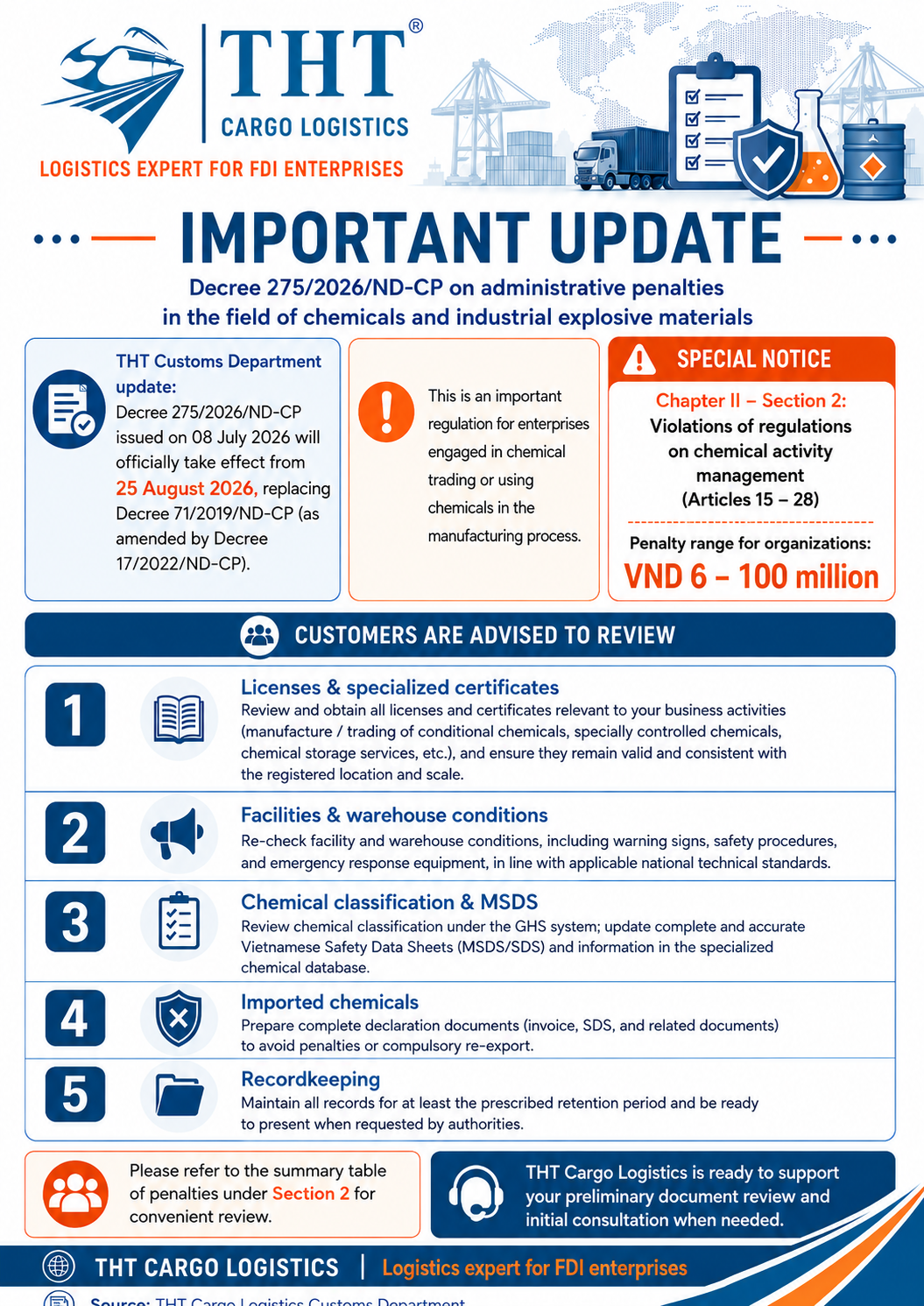
📊 Infographic: Key areas enterprises should review before 25 August 2026 – available above.
If your company would like a preliminary review of matters relating to imported chemicals, SDS/MSDS, chemical declarations or specialized licenses, THT Cargo Logistics is available to assist in reviewing the relevant documentation and identifying key compliance points before implementation.
Need support reviewing your chemical compliance?
THT Cargo Logistics supports FDI manufacturers in reviewing imported chemical documentation, SDS/MSDS, chemical declarations, specialized licenses and compliance risks that may affect customs clearance and production continuity.
THT CARGO LOGISTICS
Logistics expert for FDI enterprises
Industrial Logistics & Customs Compliance for FDI Factories
Disclaimer: This article is prepared by THT Cargo Logistics for regulatory updates and general compliance awareness. The actual application of Decree 275/2026/ND-CP should be determined based on the specific chemical, intended use, type of business activity and actual documentation of each enterprise. This content does not replace a case-specific legal or regulatory assessment.
Visits: 29