

UPDATE ON GOODS MANAGEMENT FOR EXPORT PROCESSING ENTERPRISES (EPEs) UNDER OFFICIAL LETTER 15225/CHQ-GSQL
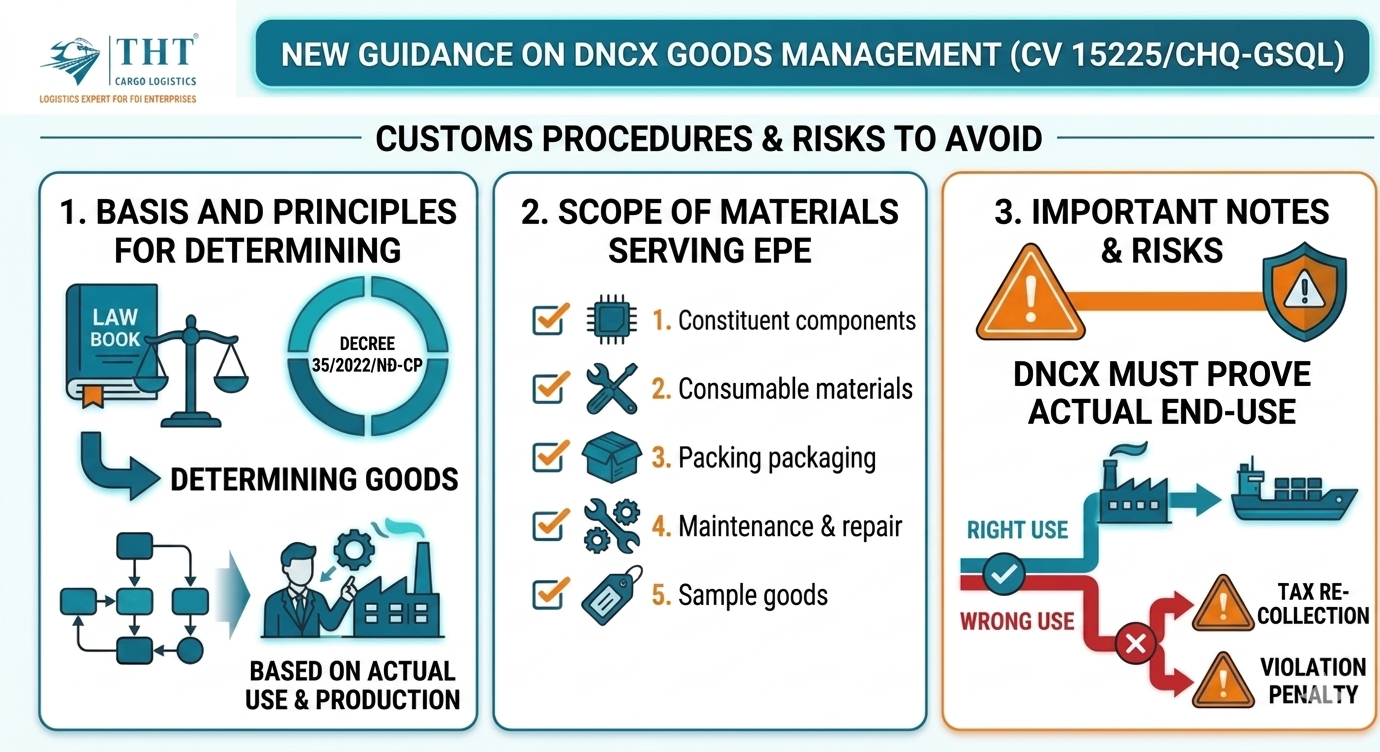
1. Principles for Determining Goods of EPEs
Goods of EPEs are subject to a specific regulatory framework, based on:
- Decree No. 35/2022/ND-CP (amending Decree 82/2018/ND-CP)
- Relevant regulations governing production, processing, and business activities of EPEs
The classification of goods must be determined based on the actual usage, production process, and transaction nature, rather than solely on documentation.
2. Key Notes under Circular 39/2018/TT-BTC
Businesses should carefully review the scope of imported materials, supplies, machinery, and equipment used for export production, including:
- Raw materials, semi-finished goods, and components directly forming export products
- Consumables used during production but not physically incorporated into the final product
- Finished goods imported for:
- Assembly into export products
- Packaging together as export sets
- Packaging materials for export
- Materials and components for warranty, repair, and recycling
- Samples used for export production
All such goods must be supported by clear evidence demonstrating their actual use in export production or processing activities.
Failure to justify the intended use or misuse of goods may result in:
- Retrospective tax collection
- Administrative penalties
3. Recommendations for Businesses
To ensure compliance and reduce risks, businesses are advised to:
- Standardize internal management processes for imported materials
- Maintain complete and accurate supporting documentation
- Regularly reconcile actual usage with customs declarations
- Work closely with logistics providers and customs brokers
Conclusion
The updated guidance reinforces stricter control over goods used by EPEs. Proactive compliance and transparent management will help businesses minimize risks and ensure smooth import-export operations.
Looking for an optimized logistics solution?
We provide end-to-end logistics solutions to help your business optimize costs, ensure compliance, and operate efficiently in a complex global trade environment.
Visits: 32