

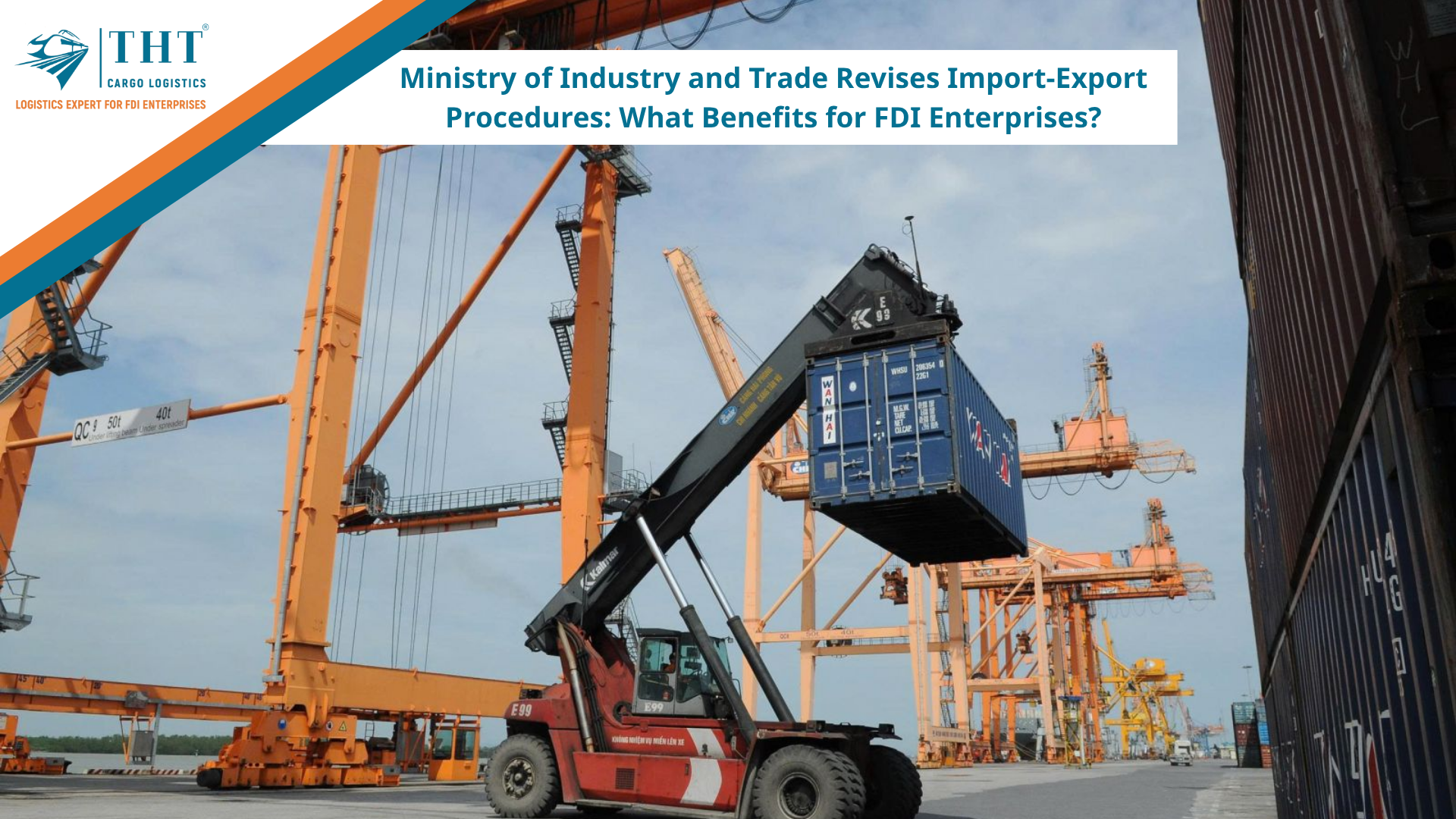
Ministry of Industry and Trade Revises Import-Export Procedures: What Benefits for FDI Enterprises?
Overview: Accelerating Administrative Reform in Import-Export Activities
Accordingly, the revised list of administrative procedures reflects newly issued legal regulations while removing outdated requirements. The new regulations will officially take effect from May 1, 2026.
This is considered a significant step in administrative reform, especially as businesses are under increasing pressure to optimize costs and time within global supply chains.
Key Focus: Certificate of Origin (C/O) Procedures
A major highlight of this revision is the focus on procedures related to the issuance of Certificates of Origin (C/O).
- Issuance of preferential C/O under Free Trade Agreements (FTAs)
- Issuance of non-preferential C/O
- Re-issuance, retrospective issuance, and back-to-back C/O
- Origin certification for special cases
The updated C/O forms apply to major markets and key agreements such as ASEAN, China, Korea, Japan, CPTPP, RCEP, and UKVFTA.
Standardizing and updating these procedures ensures alignment with the current legal framework and provides greater convenience for enterprises applying for origin certification.
Expansion of Self-Certification of Origin Mechanism
In addition to revising traditional C/O procedures, the Ministry also amended regulations regarding the approval for traders to self-certify the origin of goods within ASEAN.
- Reduced dependence on C/O issuing authorities
- Shorter processing time
- Greater flexibility in export operations
For enterprises with strong compliance capabilities, this mechanism significantly optimizes logistics and export processes.
Impact on FDI Enterprises in Vietnam
Simplified procedures reduce processing time, helping lower warehousing, storage, and operational costs.
Enhancing Access to Tariff Preferences
More transparent C/O procedures make it easier for enterprises to meet FTA requirements and enjoy tariff incentives.
Increased Compliance Requirements
Enterprises must ensure accuracy in documentation and maintain strict control over product origin, especially when applying self-certification.
What Should Businesses Prepare?
- Standardize origin documentation systems: Ensure full traceability and data accuracy
- Stay updated with new regulations: Avoid disruptions to export activities
- Assess readiness for self-certification: Evaluate internal compliance and data management capabilities
- Work with logistics and customs partners: Leverage expert support to minimize risks
Conclusion
The amendment and supplementation of administrative procedures in the import-export sector mark a significant step toward improving Vietnam’s business environment.
These changes not only reduce administrative burdens but also enable enterprises to better leverage Free Trade Agreements.
In an increasingly competitive environment, FDI enterprises must proactively adapt, strengthen compliance capabilities, and optimize logistics processes to maintain their competitive advantage in the global market.
Looking for Optimal Logistics Solutions?
With extensive experience and a deep understanding of the international market, we are confident in providing safe, fast, and cost-effective transport solutions.
Visits: 33
This actually answered my drawback, thank you!
50 Price cut Regarding All Private Proxies! Top notch good, Unending bandwith, 1000 mb/s superspeed, 99,9 uptime, Un sequential IP’s, Not any intake constraints, Multiple subnets, USA or even Eu proxies – Acquire At this point – DreamProxies.com
I enjoy gathering useful information , this post has got me even more info! .
I got what you intend,saved to favorites, very nice website .
You have remarked very interesting points! ps nice internet site.