

Impact of Regional Customs Restructuring on FDI Enterprises – Key Considerations
For FDI enterprises, this is a critical period that requires close monitoring and proactive adaptation to minimize risks in logistics and compliance.
1. Background: Large-Scale Customs Restructuring
Since 2025, Vietnam Customs has entered a major restructuring phase aimed at streamlining operations and improving management efficiency.
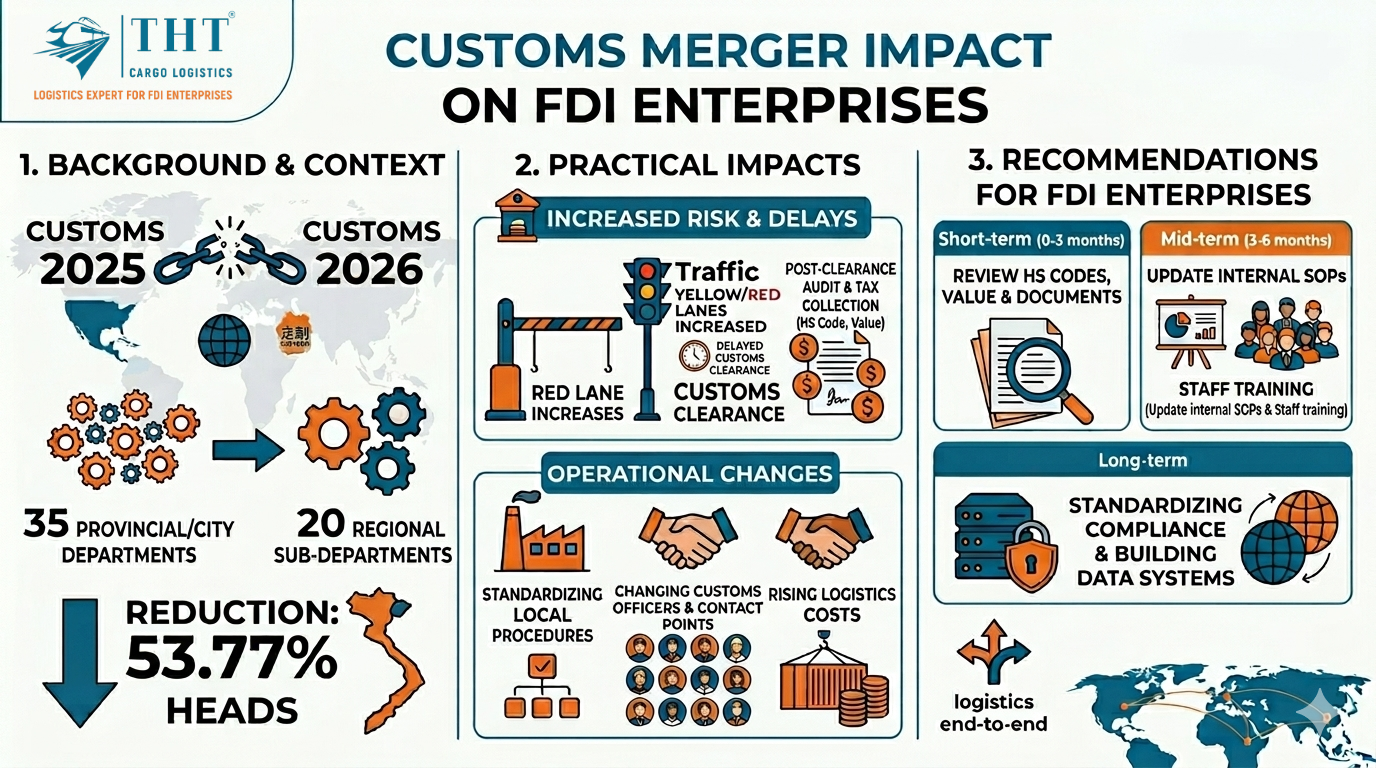
- 35 provincial Customs Departments reorganized into 20 Regional Customs Sub-Departments
- Reduction of approximately 53.77% of organizational units
- Each regional unit may manage multiple provinces simultaneously
In Southern Vietnam, some units may handle up to ~50% of the country’s cargo volume.
This highlights the scale of impact, especially for FDI enterprises with frequent import-export activities.
2. Practical Impacts on FDI Enterprises
(1) Changes in Procedures and Policy Application
New regional customs units will not only inherit but also standardize the application of regulations. Previously “accepted practices” at local levels may no longer apply.
(2) Increased Risk of Inspection and Post-Clearance Audits
The centralized management model typically leads to stricter risk control and standardized classification.
- Higher probability of yellow/red channel inspections
- More frequent post-clearance audits
- Potential tax reassessment due to interpretation differences
(3) Clearance Delays During Transition
Although the goal is uninterrupted operations, transitional challenges are unavoidable.
- Slower declaration processing
- Longer inspection times
- Local congestion at ports and warehouses
(4) Changes in Working Contacts
Assigned customs officers and coordination mechanisms may change, requiring businesses to rebuild working relationships.
(5) Increased Operational and Logistics Costs
- Demurrage and storage fees due to delays
- Additional costs from inspection location changes
- Higher internal compliance costs
(6) Reduced Predictability in the Short Term
In the first 3–6 months, it will be difficult to accurately predict clearance time and inspection rates.
3. Positive Outlook (Mid–Long Term)
- Standardized procedures nationwide
- Reduced inconsistency between local authorities
- Improved transparency and digitalization
- Stronger centralized management capability
This transformation aligns with global supply chain standards and increasing compliance requirements for FDI enterprises.
4. Recommendations for FDI Enterprises
Short-term (0–3 months)
- Review HS codes, declared values, and import documentation
- Build buffer time into delivery schedules
- Proactively engage with new customs authorities
Mid-term (3–6 months)
- Update internal SOPs
- Retrain logistics and import-export teams
- Reassess risk management strategies
Long-term
- Strengthen compliance systems
- Build transparent data management processes
- Enhance internal control frameworks
The restructuring of Vietnam’s customs system represents a major administrative reform.
While FDI enterprises may face short-term disruptions such as procedural changes, increased inspections, and clearance delays,
this transformation lays the foundation for a more transparent, standardized, and internationally aligned customs system in the long run.
THT Cargo Logistics supports FDI enterprises in reviewing documentation, optimizing customs procedures, and ensuring fast, compliant, and cost-effective clearance.
Visits: 26