

CASE STUDY | HS CODE ALONE MAY NOT BE ENOUGH: HOW ONE CAS No. CAN CHANGE THE ASSESSMENT OF AN INDUSTRIAL RAW MATERIAL SHIPMENT
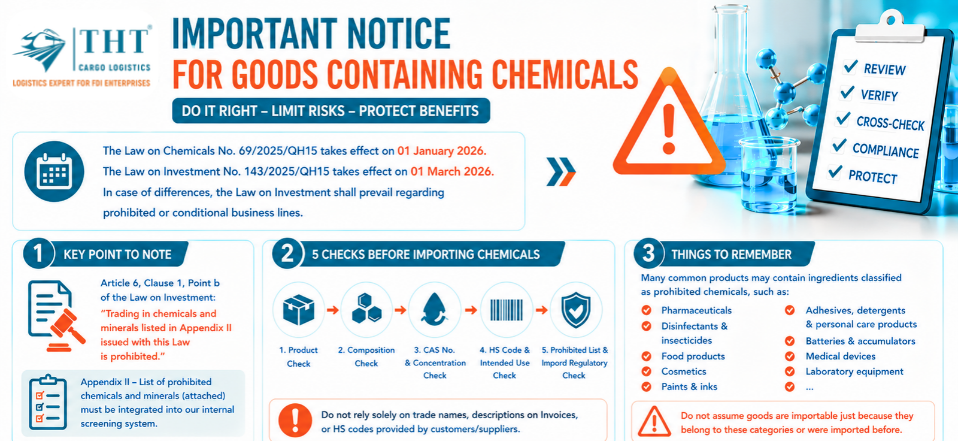
For raw materials containing chemical components, determining import requirements should not stop at the product name and HS Code.
In a review involving raw material intended for cosmetic manufacturing, one chemical component highlighted why manufacturers should perform a deeper compliance check before booking and before the cargo leaves the country of export.
1. THE SITUATION
A company planned to import chemical-containing raw material for manufacturing in Vietnam.
The initial documentation included:
- Product name;
- SDS/MSDS;
- Chemical composition;
- CAS Numbers;
- Concentrations;
- Intended use;
- Preliminary HS Code;
- Information required for import-policy assessment.
No significant issue was identified during the initial review.
However, when the product was reviewed at individual component and CAS Number level, one component required further verification against Appendix II – the List of Prohibited Chemicals and Minerals under Vietnam’s Law on Investment.
2. A COMMON COMPLIANCE GAP
A common import review may follow:
For chemical-related materials, a more comprehensive approach may be required:
3. CHEMICAL REGULATIONS SHOULD NOT BE REVIEWED IN ISOLATION
Vietnam’s Law on Chemicals refers to the prohibited chemical and mineral list established under the Law on Investment.
Therefore, chemical compliance should be assessed as an interconnected regulatory framework rather than as separate lists.
If a CAS Number appears to match a controlled or prohibited substance, further questions need to be answered:
- What is the specific substance?
- What is its concentration?
- Is the shipment a substance, mixture or product containing the substance?
- What is the actual end-use?
- Is it imported for manufacturing, internal use or commercial supply?
- Is the activity subject to an exception, permit or specific regulatory condition?
A CAS match requiring verification does not automatically mean that the entire product is prohibited from import.
4. WHY THIS MATTERS TO FDI MANUFACTURERS
For a factory, import compliance is not merely a Customs issue.
A problem discovered after shipment may lead to:
Customs delay
→ Storage/Demurrage/Detention
→ Raw-material delay
→ Inventory disruption
→ Production-plan impact
→ Customer-delivery impact.
For manufacturers operating with tight inventory and production schedules, one shipment can become a supply-chain issue.
At THT, our view is simple:
Compliance should start before shipment — not after the cargo arrives at port.
PRE-SHIPMENT CHECKLIST
Before booking chemical-related raw materials, manufacturers should consider reviewing:
Product name → SDS → Chemical composition → CAS No. → Concentration → End-use → HS Code → Import regulations → Permit/Conditions → Shipment decision
THT CARGO LOGISTICS VIEWPOINT
Industrial Logistics is not simply about moving a container from Point A to Point B.
For manufacturing supply chains, greater value comes from identifying potential risks before the shipment starts moving.
KEY MESSAGE
Don’t stop at the product name and HS Code.
For chemical-containing raw materials, review the CAS Numbers, concentrations, end-use and the complete regulatory framework before shipment.
Reference framework: Law on Chemicals No. 69/2025/QH15; Law on Investment No. 143/2025/QH15; Decree No. 24/2026/ND-CP and other applicable regulations.
Disclaimer: This article is provided for informational and risk-awareness purposes only. Import requirements should be assessed based on the actual shipment documentation and regulations effective at the time of importation. It does not constitute legal advice or replace decisions made by competent authorities.
Visits: 19