

- 1. What Does TT26 Change in the C/O Issuance Process?
- 2. 6 Common Challenges in C/O Issuance After August 1, 2026
- 3. WO-Origin Documentation — The Highest-Risk Group
- 4. How Should Exporters Prepare Their C/O Documentation?
- 5. THT C/O Documentation Support Services
- 6. Frequently Asked Questions (FAQ)
- Need Support with C/O Procedures or the Latest Regulatory Updates?
Circular 26/2026/TT-BCT on C/O Issuance: 6 Common Challenges and How Exporters Can Overcome Them
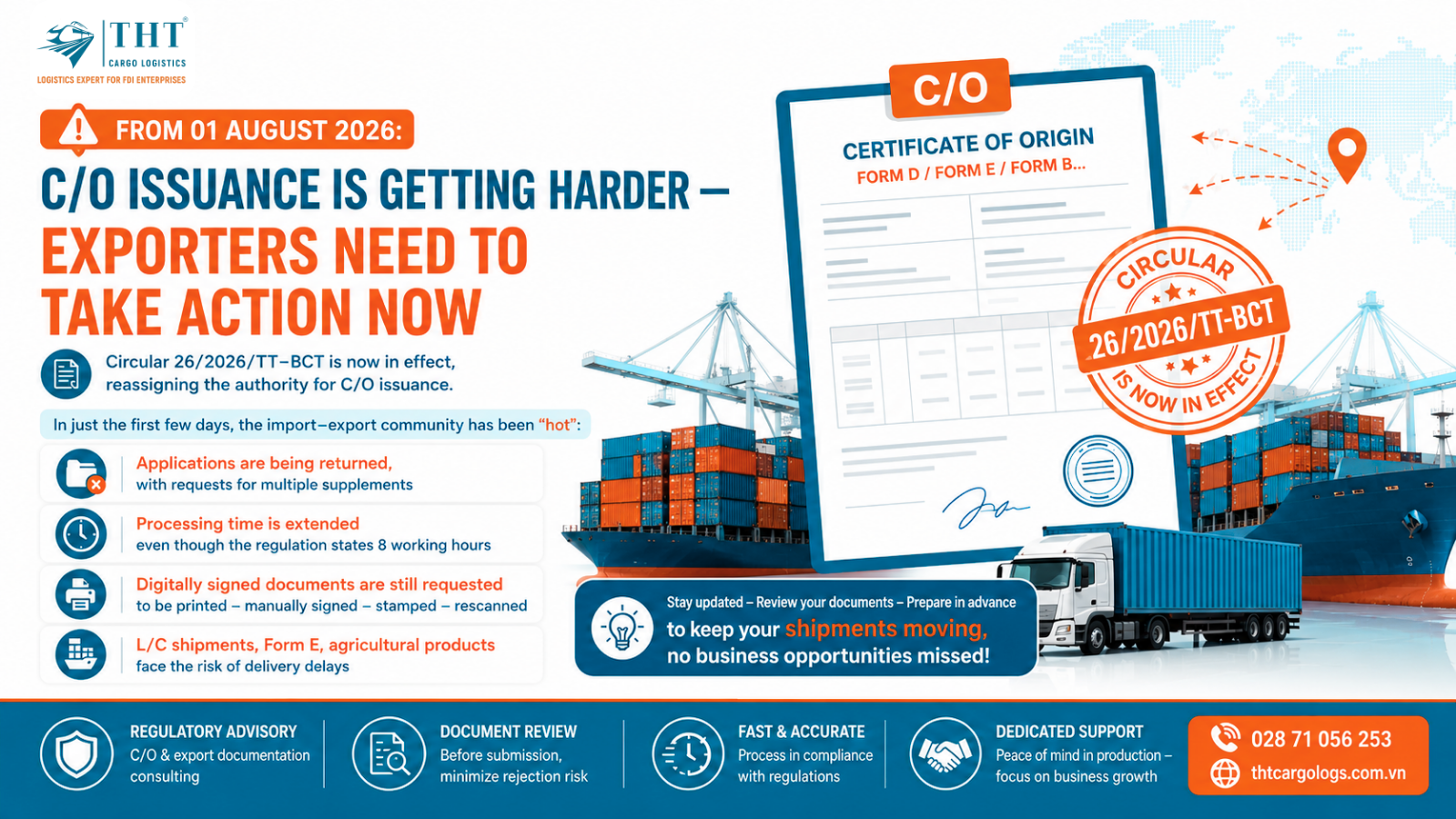
Effective from August 1, 2026, Circular 26/2026/TT-BCT issued by the Ministry of Industry and Trade officially takes effect, changing the way Certificates of Origin (C/O) are issued in Vietnam. In the first days of implementation, many exporters have encountered challenges when preparing C/O applications. This article summarizes 6 common challenges and how to prepare C/O documentation correctly from the outset.
1. What Does TT26 Change in the C/O Issuance Process?
The 12 key preferential C/O forms (EVFTA, UKVFTA, Japan, Korea, Australia, New Zealand, ASEAN, etc.) will continue to be issued by the Import-Export Department through 4 Import-Export Management Offices: Hanoi, Ho Chi Minh City, Binh Duong, and Dong Nai. The eCoSys system has been updated since August 1.
2. 6 Common Challenges in C/O Issuance After August 1, 2026
- Overload and longer processing times due to the absence of territorial restrictions on application submission; applications are concentrated at major processing offices.
- High application return rates and inconsistent requests for additional documents; many minor errors that could previously be corrected on the spot now require a written explanation.
- Electronic processing issues: digitally signed documents may still be requested in printed form, with wet signatures and company stamps, before being scanned and resubmitted; file size is limited to ~2 MB.
- Requests for documents beyond what is necessary: customs supervision barcodes, images of each production stage, and input invoices from entities under the same ownership.
- Limitations of the decentralized model: only 4 locations still have Import-Export Management Offices operating alongside local Departments, creating localized pressure on processing capacity.
- Direct risks to cash flow and delivery schedules: L/C shipments and Form E shipments may face C/O delays; agricultural products waiting at border gates may incur additional costs and suffer quality deterioration.
3. WO-Origin Documentation — The Highest-Risk Group
Applications under the WO criterion (purchased raw materials without input invoices — typically agricultural products, seafood, and processed goods) are among the most likely to be returned during this period. Businesses should prepare complete appendices containing raw material information with valid signatures, procurement commitments under Appendix X, and a clear description of each stage in the production process.
4. How Should Exporters Prepare Their C/O Documentation?
- Review immediately all C/O applications approaching their deadlines, prioritizing L/C shipments and Form E shipments.
- Standardize the supporting documents before submission.
- Allow additional time for the C/O issuance process when planning delivery schedules.
- Have an experienced service provider review the documents before submission to reduce the likelihood of the application being returned at the first review stage.
5. THT C/O Documentation Support Services
THT is a licensed customs brokerage agent with nearly 7 years of operational experience, specializing in C/O documentation support for FDI factories.
THT reviews applications before submission based on an operational checklist, with particular focus on WO documentation, understands EPE/SXXK/processing regimes, and operates its headquarters in Ho Chi Minh City with branches in Dong Nai, Binh Duong, and Ba Ria–Vung Tau — staying close to the C/O issuing offices across the Southeast region.
6. Frequently Asked Questions (FAQ)
Does TT26 change the rules of origin?
No. TT26 only reallocates the authority and procedures for C/O issuance; it does not change the criteria for determining origin.
Where should businesses submit their C/O applications?
Key preferential C/O forms are submitted to the 4 Import-Export Management Offices (Hanoi, Ho Chi Minh City, Binh Duong, and Dong Nai); other forms are submitted to the local Department of Industry and Trade through the eCoSys system.
Why are so many C/O applications being returned?
During the initial implementation period, requirements for additional documents have not been consistent, and many applications are being returned for clarification of minor documentation issues.
Need Support with C/O Procedures or the Latest Regulatory Updates?
THT Cargo Logistics supports FDI enterprises with guidance on rules of origin, C/O document review and preparation, updates on the latest regulatory changes, and coordination of import-export procedures, helping businesses stay proactive with their documentation and minimize the risk of C/O issuance delays. If your business is facing challenges in applying Circular 26/2026/TT-BCT, particularly with WO documentation, or needs its C/O application reviewed before submission, contact THT Cargo Logistics for support from our experienced team.
Visits: 36