

- VERIFICATION OF GOODS ORIGIN: A RISK MANAGEMENT AND COMPLIANCE COST CHALLENGE FOR BUSINESSES
- 1. A Major Shift from Pre-Clearance Inspection to Risk-Based Post-Clearance Verification
- 2. Clearer Evaluation Criteria and Origin-Related Risk Scenarios
- 3. Expanded Decentralized Authority and Multi-Agency Coordination Mechanisms
- 4. THT Cargo Logistics’ Comprehensive Support Solutions
- 5. Conclusion
- Need Support with C/O Documentation and Origin Compliance?
VERIFICATION OF GOODS ORIGIN: A RISK MANAGEMENT AND COMPLIANCE COST CHALLENGE FOR BUSINESSES
To help businesses proactively identify risks and optimize compliance costs, THT Cargo Logistics would like to highlight key updates from the draft Circular on the inspection and verification of export goods origin (intended to replace Circular No. 39/2018/TT-BCT), which is currently under consultation by the Ministry of Industry and Trade.
1. A Major Shift from Pre-Clearance Inspection to Risk-Based Post-Clearance Verification
One of the most notable changes in the draft is the separation between the issuance of Certificates of Origin (C/O) and post-issuance verification activities.
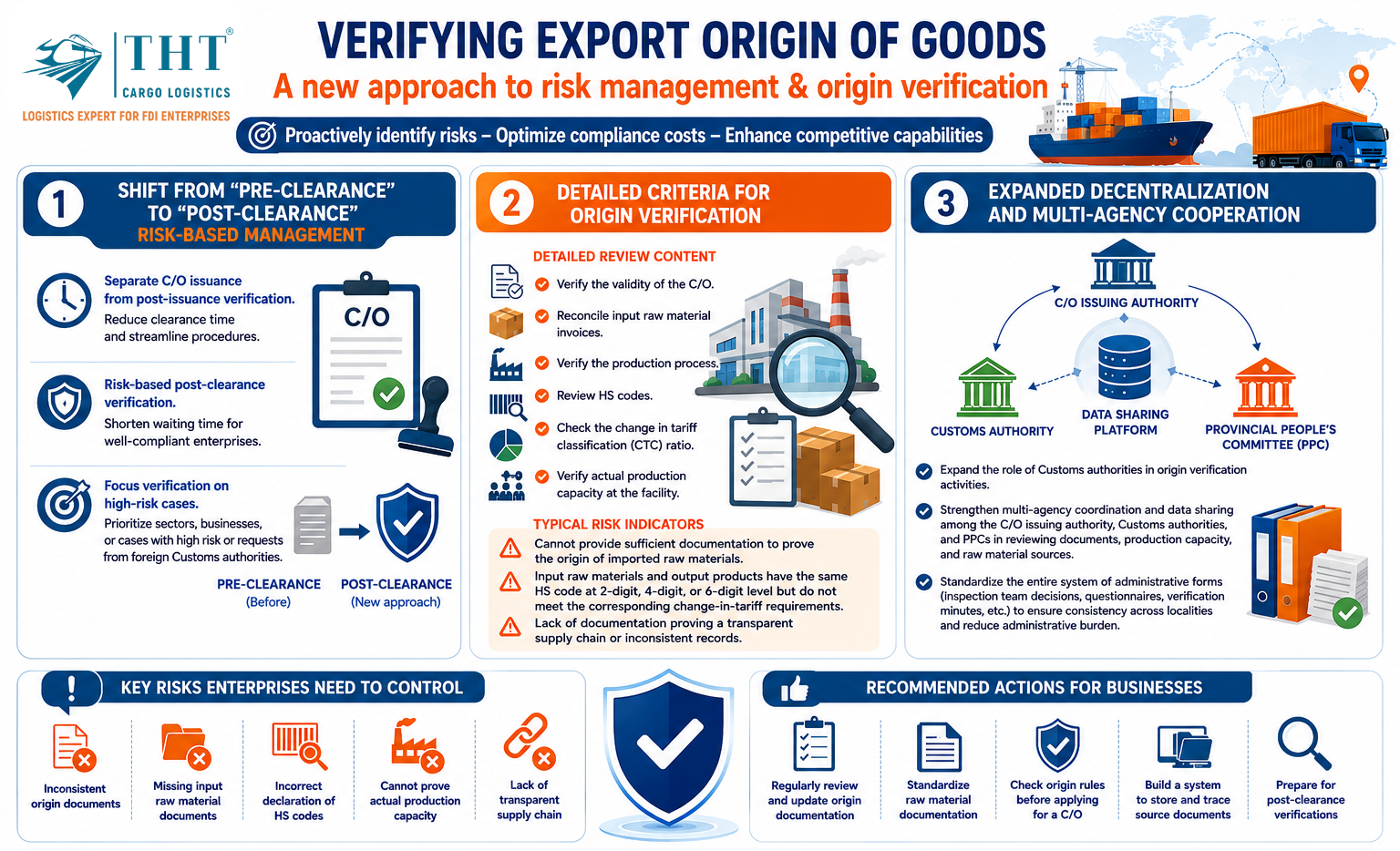
- New approach: Instead of focusing heavily on pre-clearance inspections that may prolong processing times, authorities are shifting toward a risk-based post-verification mechanism. This change aims to streamline procedures and reduce waiting times for businesses with a strong compliance record.
- Resource prioritization: Regulatory agencies will focus inspections on high-risk industries, suspicious cases, or verification requests received from foreign Customs authorities, rather than conducting broad and resource-intensive inspections.
2. Clearer Evaluation Criteria and Origin-Related Risk Scenarios
The draft Circular provides more detailed guidance on practical inspection scenarios, helping improve transparency and reduce subjective interpretation during origin verification.
- Separation of verification activities: A clear distinction is established between document reviews and on-site production facility verification.
- Detailed review criteria: Authorities may assess the validity of C/O documents, compare raw material invoices, examine manufacturing processes, verify HS classifications, and evaluate compliance with Change in Tariff Classification (CTC) requirements.
- Additional risk scenarios: Examples include situations where businesses fail to provide sufficient evidence of raw material origin or where imported materials and finished products share the same HS codes at the 2-digit, 4-digit, or 6-digit level without meeting the applicable origin transformation requirements.
These detailed criteria provide businesses with clearer guidance for establishing effective origin management systems and maintaining supporting documentation for future audits and inspections.
3. Expanded Decentralized Authority and Multi-Agency Coordination Mechanisms
To ensure smoother information flow and more effective supervision, the draft also expands the responsibilities of relevant authorities and strengthens inter-agency cooperation.
- Expanding the role of Customs authorities in the inspection and verification of export goods origin.
- Establishing a coordinated mechanism among C/O issuing authorities, Customs authorities, and provincial governments for reviewing documentation, production capacity, and raw material sources.
- Standardizing administrative templates such as verification team appointment decisions, questionnaires, and verification reports to ensure consistent implementation nationwide.
These measures are expected to create a more unified regulatory framework while minimizing inconsistencies in origin verification practices across different localities.
4. THT Cargo Logistics’ Comprehensive Support Solutions
As origin compliance risks continue to increase, businesses need to move beyond manual document management and adopt more structured, traceable, and data-driven origin management systems.
- Digitalization through Bots & VBA Solutions: Automating data extraction from source documents, standardizing data templates, supporting raw material consumption tracking, and generating origin criteria reports with high accuracy to prepare for any post-verification review.
- Specialized Consulting Services: Assisting businesses in reviewing documentation, analyzing Product Specific Rules (PSR) under trade agreements such as EVFTA, CPTPP, and RCEP, and preparing technical documentation for on-site verification activities.
5. Conclusion
The transition from pre-clearance inspection to risk-based post-verification reflects a broader regulatory trend toward greater transparency and stronger accountability in origin compliance.
This is the right time for businesses to review their origin management processes, standardize documentation practices, and strengthen traceability systems to meet increasingly stringent requirements from regulators and international trading partners.
Need Support with C/O Documentation and Origin Compliance?
THT Cargo Logistics is ready to support your business in digitalizing origin-related data, standardizing C/O documentation, managing raw material traceability, and preparing for post-verification audits with confidence.
Visits: 24
Enjoy every single day
Every day is a new beginning
Hahahaha You are so good
Good a blog toper