


CHINA–US FREIGHT RATES SLIGHTLY DECLINE: SHIPPING LINES COMPETE FOR LIMITED CARGO
March 2026 marked a significant turning point in global trade, as multilateral cooperation mechanisms continue to weaken, replaced by unilateral policies and emerging technical barriers.
The failure of the 14th WTO Ministerial Conference to extend the moratorium on e-commerce tariffs has officially ended the era of duty-free digital trade, paving the way for the rise of “digital borders”.
As the United States maintains a 15% surcharge while China responds with investigations into clean energy trade barriers, the global logistics market is entering a “multi-speed” environment filled with volatility and uncertainty.
1. WTO Turning Point and Trade Fragmentation
The consensus-based global trade model is gradually being replaced by unilateral decision-making. While a group of 66 countries continues to support digital trade rules, major economies such as the US and China are increasingly relying on tariffs and industrial investigations.
This shift forces import-export businesses to adapt quickly to a more complex, fast-changing, and less predictable regulatory environment.
2. Ocean Freight Market: Rate Cuts to Stimulate Demand
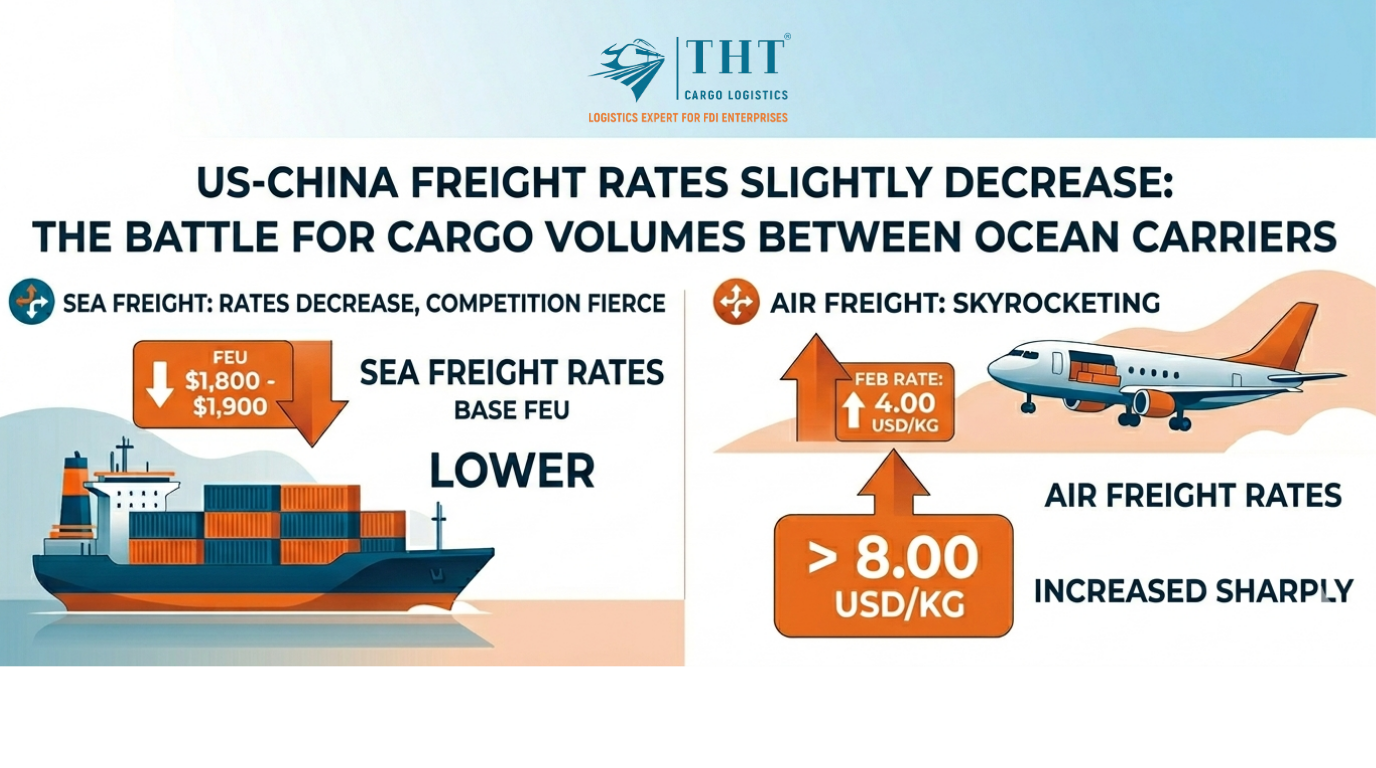
The ocean freight market is currently experiencing a tug-of-war between declining demand and rising operating costs. To secure limited cargo volumes, shipping lines have started to slightly reduce freight rates.
Reference Freight Rates (FEU):
- China → US West Coast (USWC): 1,800 – 1,900 USD (floor rates ~1,650 USD)
- China → US East Coast (USEC): 2,800 – 2,900 USD (competitive rates ~2,450 USD)
Notably, instead of monthly pricing, shipping lines now offer rates valid for only 7 days, reflecting the highly dynamic nature of the market.
3. Air Freight: Surging Above 8.00 USD/kg
In contrast to ocean freight, air freight rates have surged dramatically, exceeding 8.00 USD/kg — doubling from around 4.00 USD/kg in mid-February.
This sharp increase highlights the sensitivity of air freight to fuel price fluctuations and geopolitical instability, creating significant cost pressure for time-sensitive shipments.
4. Mid-Term Outlook: Emergency Fuel Surcharge (EFS)
The industry is closely monitoring the potential implementation of the Emergency Fuel Surcharge (EFS), expected around April 11–12.
However, if cargo volumes fail to recover, shipping lines may postpone this surcharge to avoid further weakening demand.
Conclusion
The global logistics market is entering a highly volatile phase, characterized by trade fragmentation, declining ocean freight rates, and rising air freight costs. Businesses must stay proactive, closely monitor market trends, and adopt flexible logistics strategies to optimize costs and mitigate risks.
Looking for Optimal Logistics Solutions?
With extensive experience and a deep understanding of the international market, we are confident in providing safe, fast, and cost-effective transport solutions.
Visits: 61