

- 1. First and Foremost, Correctly Define the FDI Factory’s Scope of Operations
- 2. Avoid the Misconception of Needing a Generic “Import-Export License”
- 3. Legal Compliance Checklist Prior to Import-Export Operations
- 4. Product Inventory Checklist for Intended Import-Export
- 5. E-Customs System Registration Checklist
- 6. Documentation Checklist for the First Import Shipment
- 7. Documentation Checklist for the First Export Shipment
- 8. Post-Clearance Internal Governance Checklist
- 9. Common Pitfalls Made by FDI Plants Starting Import-Export Operations
- 10. Conclusion
- Is Your FDI Enterprise Preparing to Launch Import-Export Operations?
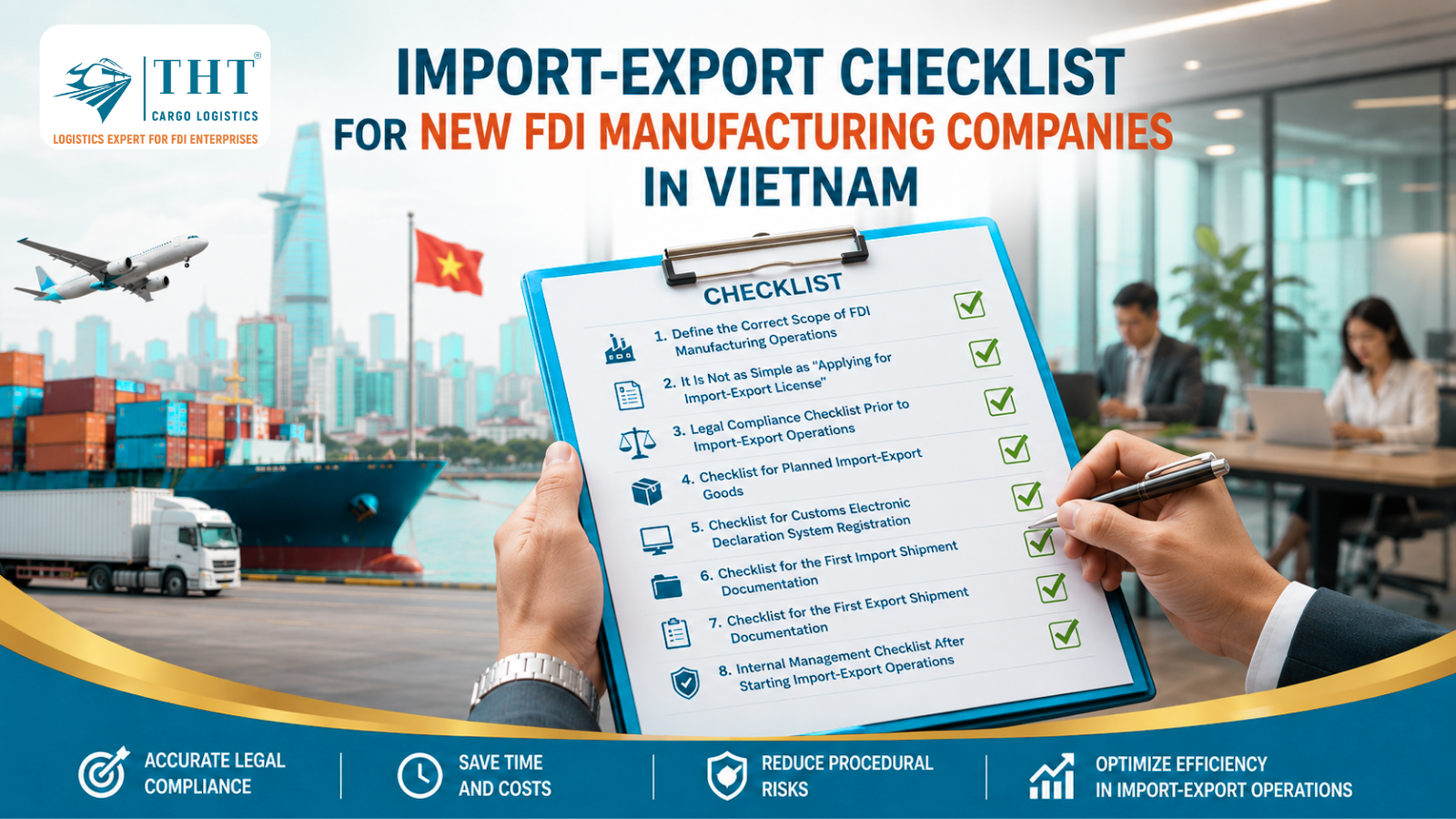
IMPORT-EXPORT CHECKLIST FOR NEW MANUFACTURING FDI ENTERPRISES IN VIETNAM
However, before handling the very first shipment, businesses should look beyond basic commercial documents like contracts, commercial invoices, packing lists, or bills of lading.
An FDI factory needs to concurrently review multiple compliance areas, including investment legalities, registered business scope, commodity policies, HS codes, specialized permits, customs digital signatures, electronic customs declaration accounts, and internal record management workflows.
The article below summarizes the essential checklist items that an FDI factory should verify before initiating import-export operations in Vietnam.
1. First and Foremost, Correctly Define the FDI Factory’s Scope of Operations
Not all FDI enterprises share the same import-export model. An FDI manufacturing plant might only import machinery and raw materials strictly for its own production and export its self-manufactured products.
This scenario differs significantly from an FDI enterprise that imports goods for resale, distribution, retail, or standalone commercial trading activities.
Therefore, prior to deployment, businesses must verify foundational legal documents such as:
| Review Item | Purpose |
|---|---|
| Investment Registration Certificate (IRC) | Verify whether the project objectives encompass manufacturing, machinery/raw material import, and product export. |
| Enterprise Registration Certificate (ERC) | Verify legal entity information, tax identification number (business code), and the legal representative. |
| Business Lines & Operational Objectives | Ensure actual operations align perfectly with the registered scope. |
| Operational Model | Determine whether the enterprise operates as a standard business, an Export Processing Enterprise (EPE), an inward processing (subcontracting) entity, a manufacturing-for-export entity, or a commercial importer. |
| Commercial/Distribution Activities (if any) | Determine if a Business License or additional conditional permits are required. |
Under the Law on Investment, projects by foreign investors fall into categories that require an Investment Registration Certificate as prescribed by law. Consequently, the IRC is one of the primary documents to review when preparing an FDI factory for operations in Vietnam.
For FDI enterprises engaging in goods trading and activities directly related to goods trading in Vietnam, close attention must be paid to Decree No. 09/2018/ND-CP. This decree governs goods trading and directly related activities conducted by foreign investors and foreign-invested economic organizations in Vietnam.
2. Avoid the Misconception of Needing a Generic “Import-Export License”
An important point to note is that an FDI factory does not always require a single, generic “import-export license” to execute all import-export activities.
Instead, enterprises must navigate compliance through multiple layers of conditions:
- Whether the enterprise is legally authorized to perform that activity according to its investment and corporate registrations.
- Whether the prospective imported or exported items are subject to prohibitions, restrictions, specialized management, or licensing requirements.
- Whether the enterprise has fully set up its electronic customs systems, digital signatures, declaration accounts, and documentation workflows.
- Whether the enterprise has established post-clearance management workflows, archiving systems, material consumption norm tracking, inventory controls, and customs finalization reports.
Decree No. 69/2018/ND-CP is one of the cornerstone regulations on foreign trade management, providing detailed guidelines on several articles of the Law on Foreign Trade Management regarding export and import activities.
Enterprises should cross-reference commodity policies with current regulations and relevant specialized legal documents.
3. Legal Compliance Checklist Prior to Import-Export Operations
Before executing the first shipment, the FDI factory should thoroughly audit the following legal documents:
| No. | Item | Key Verifications |
|---|---|---|
| 1 | IRC | Project objectives, location, scale, products, and manufacturing operations. |
| 2 | ERC | Company name, business code (tax ID), and legal representative. |
| 3 | Business Lines/Objectives | Ensure eligibility to import machinery/raw materials and export finished products. |
| 4 | Type of Customs Entity | Export Processing Enterprise (EPE), standard enterprise, outward processing, or manufacturing-for-export. |
| 5 | Land/Factory Lease Agreement | Confirm that the actual project execution site matches the investment registration. |
| 6 | Environmental, Fire Safety (PCCC), and Construction Permits | Ensure the factory meets all legal prerequisites for actual operation. |
| 7 | Business License under Decree 09/2018/ND-CP (if applicable) | Required when participating in goods trading, distribution, retail, or licensable commercial activities. |
Conversely, if the enterprise imports goods for domestic resale, distribution rights, retail, e-commerce, logistics, or commercial brokerage, a more rigorous review of the conditional criteria applicable to foreign-invested enterprises is required.
4. Product Inventory Checklist for Intended Import-Export
Following the legal document audit, the enterprise should list out all planned import and export items.
| Cargo Category | Examples |
|---|---|
| Machinery & Equipment | Production lines, CNC machines, injection molding machines, robots, testing equipment. |
| Raw Materials | Plastics, steel, fabrics, electronic components, chemicals, accessories. |
| Packaging Materials | Carton boxes, pallets, labels, packaging bags. |
| Samples | Product samples, material samples, testing samples. |
| Export Products | Finished goods manufactured by the factory. |
| Replacement & Warranty Items | Spare parts, replacement components, repair tools. |
For each specific commodity, the enterprise should verify at least the following details:
| Verification Item | Significance |
|---|---|
| HS Code | The core basis for determining duty rates, commodity policies, and customs documentation requirements. |
| Commodity Policy | Determines whether the goods are permitted, restricted, or banned from import/export. |
| Specialized Permits | Applies to regulated goods such as chemicals, medical devices, food, or specific industrial machinery. |
| Quality Control, Quarantine, Regulation Conformity | Mandatory inspections based on specific commodity groups. |
| Product Labeling | Verify compliance with regulations regarding original labels, secondary labels, and mandatory disclosures. |
| Certificate of Origin (C/O) | Determines eligibility for preferential tariff treatments or meets customer criteria. |
| Used/Second-hand Machinery | Requires verification against specific import conditions and age restrictions for used machinery and equipment. |
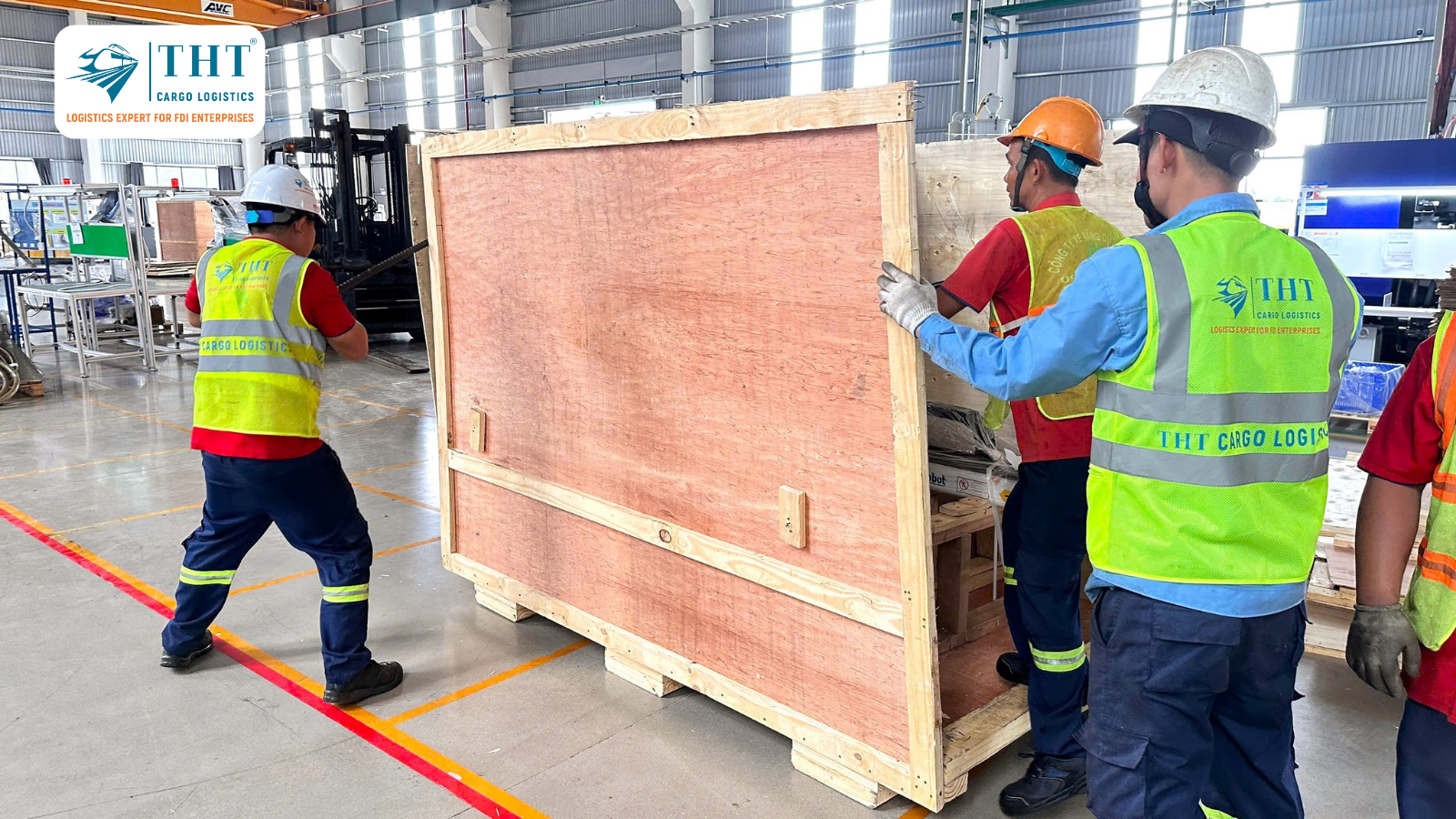
THT Cargo Logistics supports FDI Enterprises in transporting machinery cargo
5. E-Customs System Registration Checklist
Prior to lodging customs declarations, businesses must establish the digital infrastructure required to complete, sign, and submit declarations.
| No. | Setup Item | Required Outcome |
|---|---|---|
| 1 | Corporate Digital Signature (Token) | Valid digital signature matching corporate tax information. |
| 2 | Customs Registration of Digital Signature | Digital signature successfully mapped and approved on the customs portal. |
| 3 | Customs User Accounts | Active login credentials with defined user permissions. |
| 4 | Customs Declaration Software | Installed, configured, and communication links verified. |
| 5 | Online Customs Public Services Account | Access established to submit dossiers and monitor administrative procedures. |
| 6 | National Single Window (NSW) Account (if needed) | Used to secure specialized licensing and clear specialized inspections. |
| 7 | E-Tax Payment Registration | Ensures prompt payment of duties and fees to prevent clearance delays. |
Per Vietnam Customs guidelines, enterprises engaging in electronic customs clearance must register their digital signatures; customs authorities accept digital certificates from licensed providers that have successfully synchronized with the customs database.
Furthermore, enterprises must complete user registration on the VNACCS/VCIS system and connected public service platforms to facilitate seamless declaration submissions, document attachments, and data processing.
6. Documentation Checklist for the First Import Shipment
For the maiden import shipment, companies should assemble and audit the following dossier in advance:
| Document/Dossier | Critical Considerations |
|---|---|
| Sales Contract or Purchase Order | Accurate seller/buyer data, delivery terms, and payment terms. |
| Commercial Invoice | Declared cargo value, Incoterms, and transaction currency. |
| Packing List | Total packages, gross/net weight, dimensions, and packaging specifications. |
| Bill of Lading | B/L, AWB, or equivalent international transport document. |
| Catalog / Technical Specifications | Required to justify HS classification and fulfill specialized inspections. |
| C/O (if applicable) | Leveraged to secure preferential import tariff treatments when criteria are met. |
| Specialized Permits / Inspection Registrations | Applies strictly to goods falling under specialized ministerial management. |
| Import Customs Declaration | Declared with the exact customs regime code, HS code, valuation, and origin. |
| Payment Documentation | Supports customs valuation checks, international banking, and accounting audits. |
| Exemption, Reduction, or Tax Refund Dossiers (if any) | Varies depending on the custom profile and corporate entity classification. |
7. Documentation Checklist for the First Export Shipment
When processing the initial export of finished products, companies must ensure commercial, logistics, and customs documentation are fully synchronized.
| Document/Dossier | Critical Considerations |
|---|---|
| Sales Contract or Purchase Order | Buyer details, product specifications, and delivery conditions. |
| Commercial Invoice | Export value, Incoterms, and settlement currency. |
| Packing List | Packaging configuration, piece counts, and total weight. |
| Booking / Bill of Lading | Shipping line/airline details and ETD/ETA schedules. |
| Export C/O (if requested by buyer) | Compilation of origin proof matching specific FTA rules of origin. |
| Export License (if any) | Applicable only to goods under specialized export control lists. |
| Export Customs Declaration | Correct choice of export regime code, item code, and loading port. |
| Quality Certificate / Test Report (if any) | As demanded by the buyer or the importing country’s destination regulations. |
| Bill of Materials (BOM) / Consumption Norms | Highly critical when imported raw materials are processed into export products. |
For manufacturing-for-export enterprises, internal records such as BOMs, material actual consumption rates, warehouse receipts, stock issuance notes, inventory balances, and manufacturing logs play a vital role during customs audits or explanations.
8. Post-Clearance Internal Governance Checklist
Import-export operations do not conclude at the point of customs release. Post-clearance, the enterprise must maintain structured records for accounting, corporate tax, customs audits, duty refunds, annual finalization reports (Báo cáo quyết toán), and post-clearance audits (PCA).
FDI factories should establish strict internal standard operating procedures (SOPs) for the following:
| Workflow Area | Objective |
|---|---|
| Pre-Declaration Document Review Workflow | Minimize discrepancies across invoices, packing lists, HS classifications, and values. |
| HS Code Approval & Standardization Procedure | Prevent inconsistent declarations of identical items across different shipments. |
| C/O Compliance & Tracking Process | Monitor validity periods, preference conditions, and downstream origin verification files. |
| Customs Archival & File Retention System | Ensure complete data availability for regulatory audits within the statutory retention period. |
| Inventory Reconciliation by Customs Regime | Segregate stock for domestic sales, manufacturing-for-export, processing, and EPE schemes. |
| Forwarder / Customs Broker Management SOP | Define clear boundaries of legal liability, processing timelines, and sign-off protocols. |
| Internal Post-Clearance Self-Audit Routine | Identify compliance slips early to perform voluntary disclosures and corrections. |
9. Common Pitfalls Made by FDI Plants Starting Import-Export Operations
FDI plants navigating their initial import-export transactions often stumble on the following errors:
| Common Pitfalls | Potential Compliance Risks |
|---|---|
| Neglecting IRC/ERC Scope Verification | Actual operations run out of compliance with approved corporate legal permissions. |
| Misguided HS Code Classification | Incorrect tax rates, violation of commodity policies, duty back-payments, or administrative penalties. |
| Overlooking Specialized Licensing Requirements | Cargo hits the port but remains blocked due to missing specialized clearances. |
| Delayed Digital Signature or Customs Profiling | Inability to lodge declarations on time, triggering supply chain delays. |
| Total Dependence on Third-Party Forwarders | The enterprise loses visibility and control over its primary legal liabilities. |
| Fragmented or Missing Document Archiving | Failure to defend positions during mandatory post-clearance customs audits. |
| Weak Management of Production Norms & Stocks | High tax exposure and fines during annual finalization reports for EPE, processing, or manufacturing-for-export regimes. |
Consequently, enterprises should develop comprehensive checklists early, map explicit institutional roles across teams, and audit every operational variable before physical cargo moves.
10. Conclusion
For an FDI factory in Vietnam, executing import-export activities involves far more than simply transmitting data to the customs system. It demands thorough preparation bridging investment legalities, authorized business lines, commodity controls, HS codes, specialized permits, digital signatures, and VNACCS/VCIS accounts, through to downstream post-clearance record systems.
An exhaustive checklist ensures the enterprise mitigates threats related to cargo holdups, missing certifications, incorrect HS code choices, wrong customs regime declarations, or audit failures during post-clearance evaluations.
Prior to launching the first shipment, the FDI factory should systematically cross-check its setup against actual cargo matrices, operating frameworks, and corporate legal standing. For specialized items or activities touching distribution, retail, or commercial trade, additional niche conditions must be audited and met before deployment.
Is Your FDI Enterprise Preparing to Launch Import-Export Operations?
THT Cargo Logistics assists FDI businesses with investment dossier auditing, commodity policy checks, HS code advisory, specialized permit execution, customs clearance, and the design of robust import-export record management systems right from the plant setup phase.
Visits: 50