



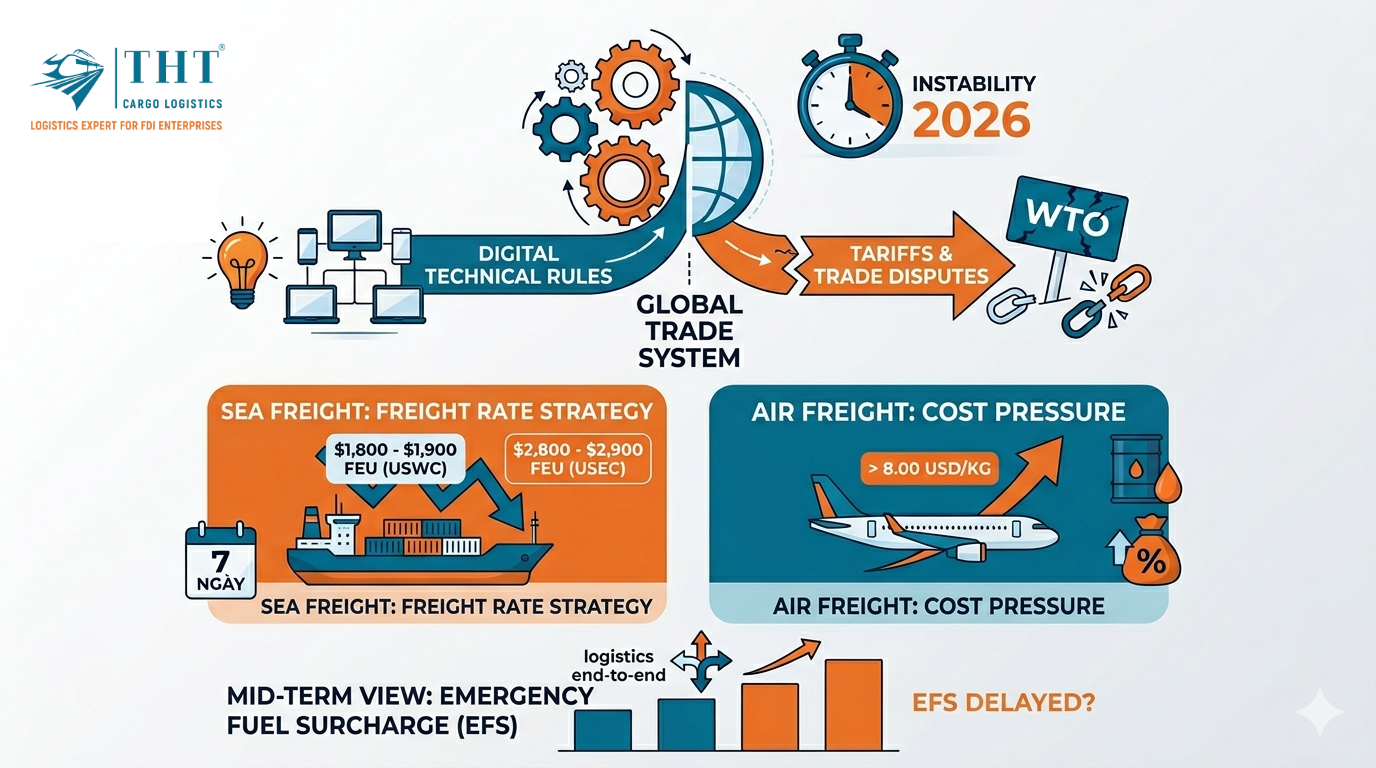
- Freight Rate Forecast 2026: Why Ocean Freight Rates Are Falling and What Businesses Should Do?
Freight Rate Forecast 2026: Why Ocean Freight Rates Are Falling and What Businesses Should Do?
1. Overview of the Ocean Freight Market in 2026
After reaching record highs in 2021–2022, the global container shipping market has completely reversed in 2026. Freight rates on major trade lanes have dropped by more than 70% from their peak, with some routes even falling below pre-pandemic levels.
The main reason for this shift is the imbalance between supply and demand. During the high-rate period, shipping lines ordered a large number of new container vessels. As these vessels are delivered between 2024 and 2026, total fleet capacity has surged while global shipping demand has not grown at the same pace. This has created a significant oversupply in global shipping capacity.
At the same time, import demand in the US and Europe has weakened due to inflation, high interest rates, and reduced consumer spending on goods. In addition, the nearshoring trend is reducing long-haul shipments from Asia to Western markets.
Another notable point in 2026 is that the pre-Chinese New Year shipping surge was weaker than in previous years. This indicates that container demand is not only declining cyclically but also undergoing structural changes in the global supply chain.
2. Key Reasons Behind the Decline in Freight Rates
(1) Global Container Vessel Oversupply
The primary driver of falling freight rates is excess container vessel capacity. Between 2020 and 2023, shipping lines ordered hundreds of new vessels to capitalize on high profits. As these ships are delivered from 2024 to 2026, total capacity has increased significantly while cargo volumes have not kept pace.
In the shipping industry, even a 5% oversupply can significantly push rates down. In 2026, oversupply on major routes has exceeded 10%, forcing carriers to cut prices to fill capacity.
(2) Declining Import Demand from the US and Europe
Lower consumer demand in the US and Europe has reduced container volumes. Consumers are shifting spending from goods to services such as travel, entertainment, and finance.
Additionally, cross-border e-commerce is impacting container shipping. Many platforms now ship goods via air freight in small parcels instead of bulk ocean containers, reducing demand for container transport.
(3) Stabilizing Geopolitical Conditions
During periods of geopolitical instability, vessels may reroute or incur war risk surcharges, driving up freight rates. As conditions stabilize, these surcharges decline or disappear, routes normalize, transit times shorten, and effective capacity increases—contributing to lower freight rates.
Despite the decline, ocean freight rates cannot fall indefinitely due to structural cost factors.
First, environmental regulations such as carbon taxes and emission reduction requirements can add between USD 150 and USD 400 per container.
Second, carriers implement blank sailing strategies to reduce capacity and prevent rates from falling too sharply.
Third, risks such as port strikes and congestion in the US and Europe can quickly drive rates back up if disruptions occur.
These factors create a “price floor” in the freight market.
3. Risks and Opportunities for Import-Export and FDI Businesses
Opportunities from Lower Freight Rates
Lower freight rates present a major opportunity for businesses to optimize logistics costs. Companies can renegotiate shipping rates, shift from long-term contracts to spot rates, or secure long-term contracts at favorable prices.
Businesses can also switch from LCL (less-than-container load) to FCL (full container load) by consolidating shipments over time, taking advantage of lower container rates to reduce cost per unit.
Monitoring freight indices such as Drewry, Freightos, and Xeneta can help businesses determine the best timing for booking shipments and signing contracts.
Risks to Consider
Despite lower freight rates, total import costs may not decrease accordingly. Import duties, anti-dumping taxes, and new trade policies can offset savings from lower transportation costs.
Additionally, risks such as port strikes, congestion, route changes, and new environmental regulations may increase logistics costs again in the future.
Therefore, businesses should not focus solely on freight rates but instead evaluate total landed cost when planning imports and logistics strategies.
4. Conclusion
In 2026, the ocean freight market is entering a low-rate phase due to excess capacity and declining global demand. This creates a favorable environment for import-export and FDI enterprises to optimize logistics costs and restructure transportation strategies.
However, freight rates are only one component of total supply chain costs. Import duties, environmental regulations, port risks, and global supply chain shifts can still significantly impact overall logistics expenses.
In a volatile market environment, businesses need to continuously monitor freight trends, choose the right timing for contract negotiations, and build flexible logistics strategies to take advantage of low rates while managing supply chain risks.
Looking to Optimize Your Logistics Costs?
THT Cargo Logistics supports businesses with freight market insights, transportation optimization, and end-to-end supply chain solutions to ensure efficiency and cost control.
Visits: 94