

- Decree 292/2026/ND-CP Vietnam: Key Changes for FDI Manufacturers from 5 September 2026
- 1. What Is Changing Under Decree 292/2026/ND-CP?
- 2. Which FDI Manufacturers Are Affected?
- 3. What Are the Key Changes for FDI Manufacturers?
- 3.1. Updated Import-Export Control Lists and New Supply Chain Risks
- 3.2. Foreign-Invested Enterprises May Conduct Merchanting Trade Within a Limited Scope
- 3.3. Certificate of Free Sale Procedures Become Faster and Clearer
- 3.4. Processing for Foreign Traders Requires Closer Alignment Between Contracts and Production Data
- 3.5. Temporary Import for Re-export for Warranty and Repair Is Clarified
- 4. What Does Decree 292 Mean for FDI Factories?
- 5. Compliance Checklist for FDI Manufacturers
- 6. THT Assessment
- 7. Official Sources & Reliability
- Is Your FDI Factory Ready for Decree 292/2026/ND-CP?
Decree 292/2026/ND-CP Vietnam: Key Changes for FDI Manufacturers from 5 September 2026
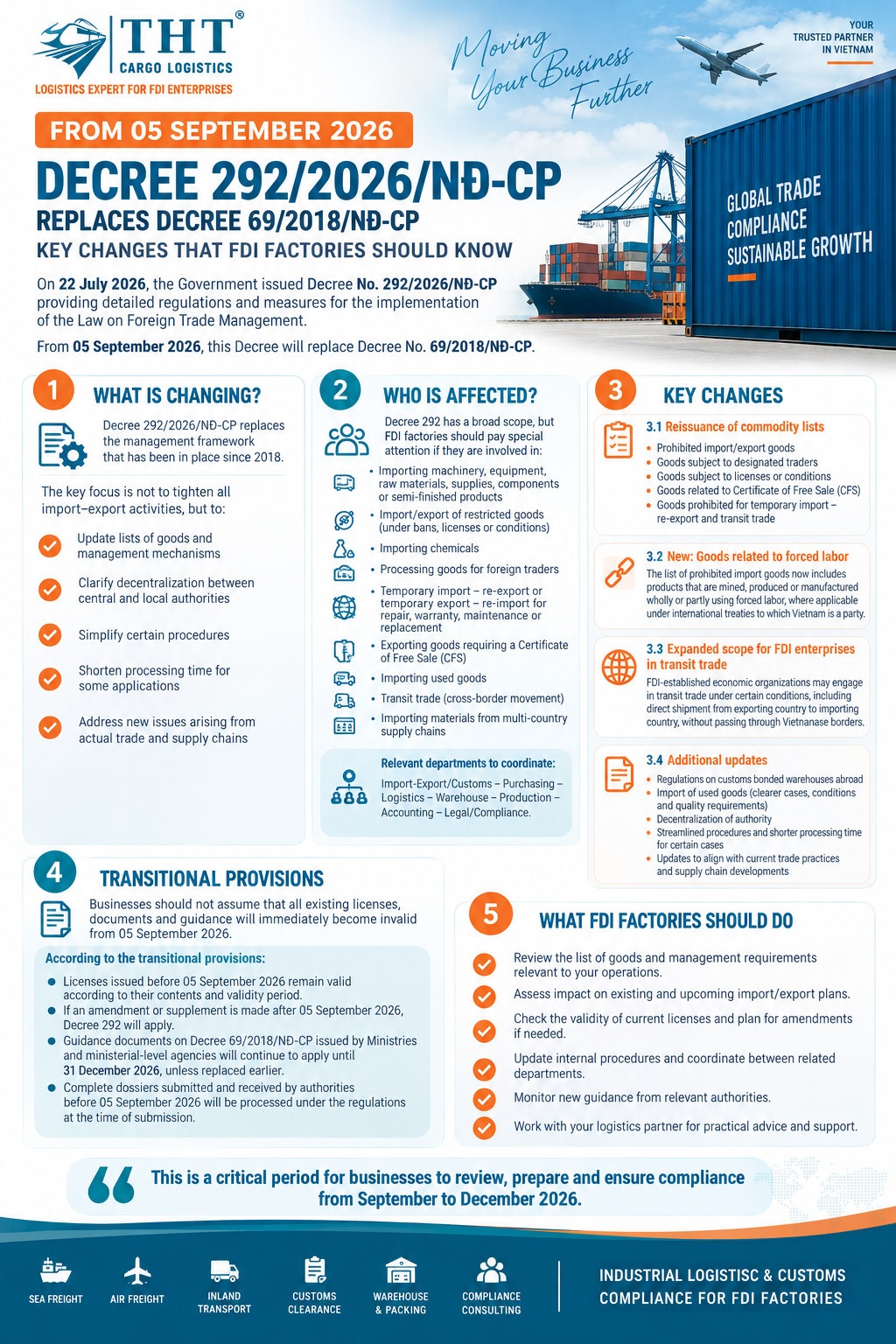
On 22 July 2026, the Government of Vietnam issued Decree No. 292/2026/ND-CP, providing detailed regulations and implementation measures under the Law on Foreign Trade Management.
From 5 September 2026, Decree 292/2026/ND-CP officially replaces Decree No. 69/2018/ND-CP, which had governed many of Vietnam’s import-export and foreign trade activities since 2018.
For Foreign Direct Investment (FDI) manufacturers in Vietnam, the new Decree is particularly relevant to imported raw materials and machinery, controlled goods, processing for foreign traders, Certificates of Free Sale, temporary import and re-export, merchanting trade and international supply chain compliance.
THT identifies five areas that FDI manufacturers should review first.
1. What Is Changing Under Decree 292/2026/ND-CP?
Decree 292 is not simply an update to Vietnam’s lists of prohibited exports and imports.
The new regulatory framework:
- Updates lists of prohibited goods and goods subject to licenses or conditions;
- Revises certain foreign trade administrative procedures;
- Further decentralizes selected regulatory responsibilities;
- Allows foreign-invested enterprises to conduct merchanting trade within a defined scope;
- Updates certain requirements for processing goods for foreign traders;
- Clarifies rules on temporary import for re-export and temporary export for re-import;
- Updates procedures relating to Certificates of Free Sale (CFS).
⚠️ Transitional Period: What Businesses Need to Know
The effective date of Decree 292 does not mean that all existing licenses and previous implementing regulations automatically became invalid on 5 September 2026.
Under the transitional provisions:
- Licenses issued before 5 September 2026 remain valid according to their approved contents and validity periods;
- Amendments or supplements made after 5 September 2026 must comply with Decree 292;
- Certain ministerial regulations previously guiding Decree 69 may continue to apply during the transitional period until 31 December 2026;
- Complete administrative applications received before 5 September 2026 continue to be processed under the rules applicable when they were received.
Why does this matter?
Between September and December 2026, businesses may need to consider both Decree 292 and transitional implementing guidance.
2. Which FDI Manufacturers Are Affected?
FDI manufacturers in Vietnam should review Decree 292 if their operations include:
- Importing raw materials, components or semi-finished products;
- Importing machinery and equipment;
- Importing or exporting goods subject to licenses, conditions or specialized regulatory control;
- Importing chemicals;
- Processing goods for foreign traders;
- Temporary import for re-export or temporary export for re-import for warranty, maintenance, repair or replacement;
- Exporting products requiring a Certificate of Free Sale (CFS);
- Conducting merchanting trade;
- Importing used goods;
- Sourcing materials through complex or multi-country supply chains.
This review should not be handled by the Customs team alone.
Relevant functions may include:
3. What Are the Key Changes for FDI Manufacturers?
3.1. Updated Import-Export Control Lists and New Supply Chain Risks
Decree 292 reissues important regulatory lists covering:
- Prohibited exports and imports;
- Goods subject to designated trader requirements;
- Goods subject to import-export licenses or conditions;
- Goods related to Certificates of Free Sale;
- Goods prohibited from temporary import for re-export and merchanting trade.
Forced Labor Becomes a Supply Chain Compliance Issue
One particularly important provision concerns products and goods that are mined, produced or manufactured, wholly or partly, through forced labor, where applicable under relevant international treaties to which Vietnam is a party.
For FDI manufacturers, this expands the compliance perspective.
Traditional import compliance commonly focuses on:
HS (Harmonized System) is the international system used to classify traded goods for customs purposes.
Supply chain risk assessment may now also need to consider:
However, businesses should avoid over-interpreting this requirement.
Decree 292 does not currently establish a universal requirement for every imported shipment to carry a separate “forced-labor-free certificate.”
The practical recommendation is therefore to strengthen supplier due diligence and traceability where supply chain risk is significant, while continuing to monitor further implementation guidance.
Specially Controlled Chemicals
Decree 292 also reflects the updated regulatory framework for specially controlled chemicals.
Manufacturers importing chemicals should not rely on Decree 292 alone to determine licensing requirements.
The applicable assessment may also require review of the Law on Chemicals and specialized chemical regulations in force at the time of import.
3.2. Foreign-Invested Enterprises May Conduct Merchanting Trade Within a Limited Scope
This is one of the more commercially significant changes for foreign-invested enterprises.
Under the previous framework, foreign-invested economic organizations were restricted from conducting merchanting trade.
Under Decree 292, foreign-invested enterprises may conduct merchanting trade where:
The activity must also be consistent with the enterprise’s registered business or investment activities.
Example
A Vietnam FDI company:
- Purchases goods from South Korea;
- Sells them to a customer in Indonesia;
- The goods are shipped directly from South Korea to Indonesia.
Such a transaction may fall within the new permitted scope, subject to the applicable conditions.
⚠️ Important Limitation
This is not an unrestricted right to conduct merchanting trade.
If the goods enter or pass through a Vietnamese border gate, port or other relevant territory, businesses should reassess the applicable legal mechanism before proceeding.
3.3. Certificate of Free Sale Procedures Become Faster and Clearer
A Certificate of Free Sale (CFS) is commonly required for certain exports where the importing country requests evidence that the product may be legally manufactured and circulated in Vietnam.
Under Decree 292:
- Notification of an incomplete application is generally made within 2 working days;
- A CFS is generally issued within 2 working days after a complete and valid application is received;
- An export CFS is valid for 5 years from the date of issuance, unless specialized legislation provides otherwise;
- The basic dossier is simplified compared with the previous framework.
What does this mean for FDI manufacturers?
Manufacturers that regularly export products requiring a CFS should review:
Important Clarification
The decentralization of export CFS issuance to provincial authorities did not begin entirely with Decree 292.
Certain decentralization measures had already been introduced before the Decree.
Therefore, businesses should focus primarily on the current application requirements, processing timeline and validity rules, rather than assuming that every aspect of the CFS framework is completely new.
3.4. Processing for Foreign Traders Requires Closer Alignment Between Contracts and Production Data
For manufacturers processing goods for foreign traders, Decree 292 places greater emphasis on maintaining consistency between contractual information and actual production data.
Relevant information may include:
- Raw materials;
- Auxiliary materials;
- Supplies;
- Components;
- Semi-finished products;
- Material usage norms;
- Consumption norms;
- Wastage rates.
Where certain norms or production inputs change during contract performance, the relevant changes may need to be reflected in an appendix to the processing contract before implementation, depending on the applicable provision.
Why is this important?
The Customs team should not manage these data independently from Production and Warehouse.
THT recommends checking consistency across:
Where:
- BOM (Bill of Materials) means the list or structure of materials and components required to manufacture a product;
- ERP (Enterprise Resource Planning) means an integrated enterprise resource planning and management system.
Important Distinction
A BOM is not automatically the same as a customs consumption norm.
The BOM is a production-data source that may support the establishment and control of customs-related material consumption data.
If actual production changes but the relevant contractual or customs records are not updated accordingly, businesses may face difficulties during customs reconciliation, explanation or finalization reporting.
3.5. Temporary Import for Re-export for Warranty and Repair Is Clarified
Decree 292 provides clearer rules for certain goods that:
- Were manufactured by the trader;
- Were previously exported;
- Are returned to Vietnam for warranty, maintenance, repair or replacement;
- Will subsequently be re-exported to the foreign customer.
Where statutory conditions are satisfied, a temporary import for re-export license may not be required.
Why is this useful for manufacturers?
This is particularly relevant to FDI manufacturers that handle:
- Customer returns;
- Warranty cases;
- Defective exported products;
- Repair or maintenance;
- Replacement of exported goods.
⚠️ Important Limitation
Businesses should not assume that “Any product previously exported and returned for repair automatically qualifies.”
The regulatory conditions must be checked carefully, particularly regarding who manufactured the goods, who exported them, why they are being returned and whether they will be re-exported.
4. What Does Decree 292 Mean for FDI Factories?
Potential Benefits
Faster CFS Procedures
Shorter processing times and clearer validity rules may reduce administrative lead time.
More International Trading Options
Eligible FDI enterprises may have an additional option for merchanting trade between two foreign countries.
Clearer Warranty and Repair Procedures
Manufacturers may have a clearer regulatory basis for handling certain returned exported goods.
Further Administrative Decentralization
Certain procedures can be handled closer to the enterprise’s operating location.
Key Compliance Risks
1. Existing Product Compliance Databases May Be Outdated
Businesses using internal regulatory master lists created under Decree 69 should review them against the new framework.
2. Supply Chain Compliance Is Becoming More Important
The forced-labor provision makes supplier origin and traceability increasingly relevant to import compliance.
3. Processing Data Must Match Operational Reality
Differences between contracts, material norms, warehouse records, production data and customs records may create compliance risk.
4. Transitional Rules May Cause Confusion
Decree 292 is already effective, while certain previous implementing regulations may remain applicable during the transition period.
5. “Used Goods” Does Not Mean All Used Machinery Is Prohibited
Certain categories of used goods are prohibited or controlled.
However, this does not mean all used industrial machinery and equipment are prohibited from import into Vietnam.
Used industrial machinery must still be assessed under the relevant specialized regulations.
5. Compliance Checklist for FDI Manufacturers
THT recommends that FDI manufacturers take the following actions:
☐ Review the company’s current import-export product master list.
☐ Recheck HS codes, product descriptions and applicable specialized regulations for higher-risk products.
☐ Review goods subject to prohibition, licensing or conditional import-export requirements.
☐ For complex supply chains, assess supplier origin, manufacturing location and traceability.
☐ For merchanting trade, verify the actual cargo flow and registered business/investment scope before signing the transaction.
☐ For CFS-related exports, update the application procedure, authority, documentation and expected processing time.
☐ For processing operations, review contracts, appendices, production norms, BOM, warehouse data, production data and customs records.
☐ Review Standard Operating Procedures (SOPs) for temporary import for re-export and temporary export for re-import involving warranty, maintenance, repair or replacement.
☐ Identify existing licenses and pending applications to determine whether transitional rules or Decree 292 apply.
☐ For new products or unusual transactions, conduct a regulatory review before purchase order issuance or shipment, rather than after the cargo arrives in Vietnam.
6. THT Assessment
THT does not view Decree 292 as a broad tightening of Vietnam’s import-export regulations.
Its overall direction can be summarized as:
For FDI manufacturers, five points should not be misunderstood:
Some rules continue or further develop mechanisms introduced under earlier regulations.
Businesses should focus on the current procedures, processing time and validity requirements.
THT Recommendation
The most effective response is not simply to ask the Customs team to read the new Decree.
FDI factories should conduct a cross-functional compliance review involving:
with one practical objective:
7. Official Sources & Reliability
Level 1 — Official Legal Sources
1. Decree No. 292/2026/ND-CP dated 22 July 2026 of the Government of Vietnam
Effective from 5 September 2026 and replacing Decree No. 69/2018/ND-CP.
📎 View / Download Decree No. 292/2026/ND-CP – English Version
2. Decree No. 69/2018/ND-CP dated 15 May 2018 of the Government of Vietnam
Previous foreign trade management framework used for comparison.
3. Decree No. 146/2025/ND-CP dated 12 June 2025 of the Government of Vietnam
Relevant to decentralization and delegation in the industry and trade sector.
4. Circular No. 41/2026/TT-BCT dated 22 July 2026 of the Ministry of Industry and Trade
Regulating lists of scrap and used goods temporarily suspended from temporary import for re-export and merchanting trade.
COMPLIANCE NOTE
This compliance alert is intended to help businesses identify key regulatory changes and prepare appropriate compliance measures. The regulatory treatment of each shipment must be determined based on its HS code, product description and characteristics, intended use, enterprise type, transaction structure and specialized regulations in force at the time of implementation.
Is Your FDI Factory Ready for Decree 292/2026/ND-CP?
THT Cargo Logistics supports FDI manufacturers in reviewing import-export product policies, controlled goods, merchanting trade, processing activities, CFS procedures, temporary import for re-export, used goods and supply chain compliance risks based on the actual products and transaction flows of each factory.
Visits: 0