

- 5 points businesses should check before claiming FTA preferential tariff treatment
- 1. One shipment may have multiple FTA options
- 2. The lowest tariff rate is not necessarily the best option if the goods do not satisfy the rules of origin
- 3. Even a C/O issued in the correct form does not necessarily mean the documentation package is safe
- 4. The greatest risk may not appear at the time of customs clearance
- 5. THT’s 5-layer C/O control process before businesses claim FTA preferential treatment
- 6. A safe C/O does not start when the customs declaration is opened
- 7. THT CARGO LOGISTICS – CONTROL C/O RISKS BEFORE THEY BECOME COSTS
- Need your C/O checked before claiming FTA preferential tariff treatment?
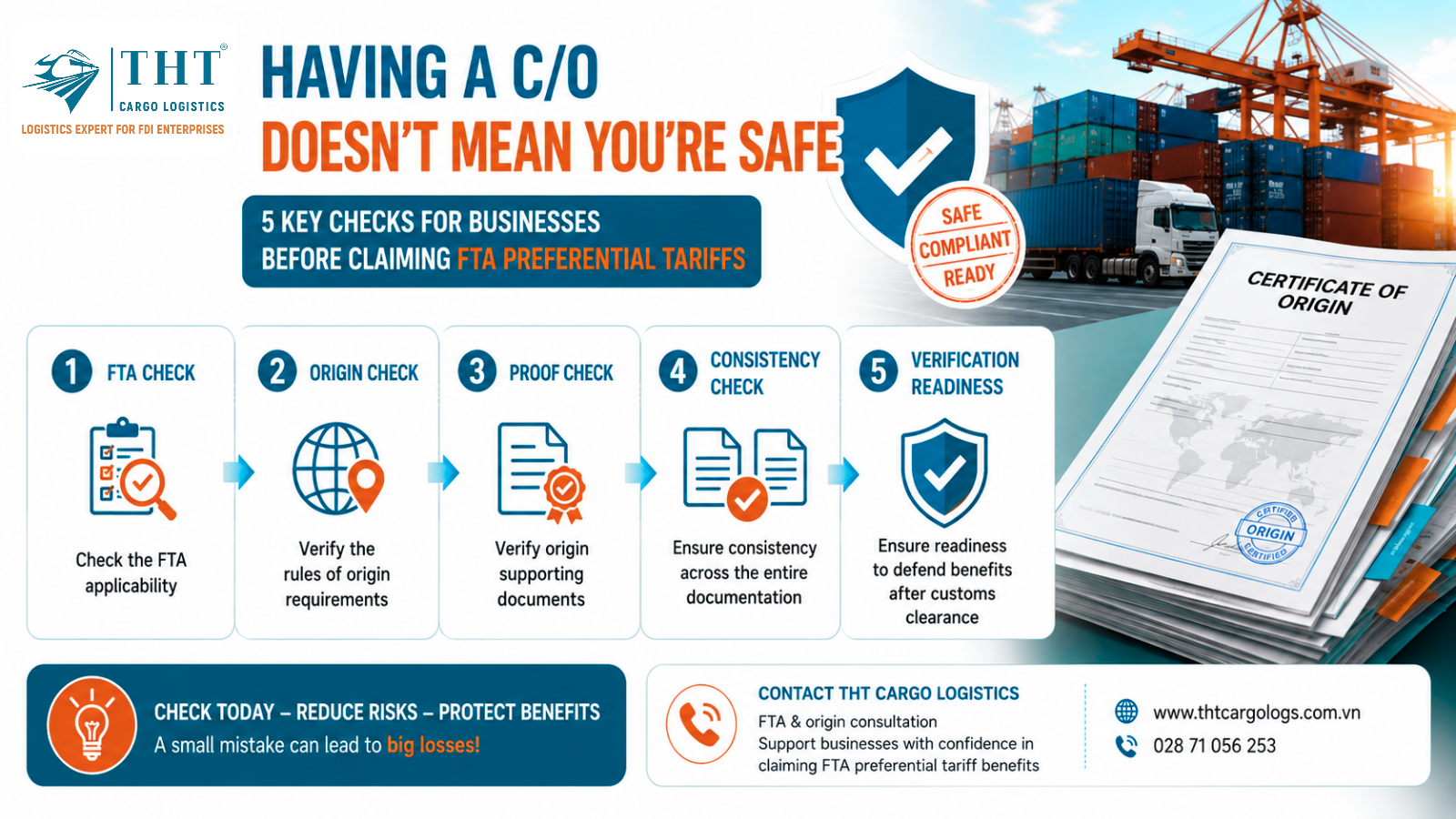
HAVING A C/O DOES NOT NECESSARILY MEAN YOU ARE SAFE
5 points businesses should check before claiming FTA preferential tariff treatment
A factory imports raw materials from South Korea.
The supplier asks:
“Do you need a C/O under VKFTA, AKFTA or RCEP?”
If the purchasing department simply answers:
“Any form is fine, as long as we have a C/O to reduce the tax.”
The risk may have already started at that point.
For imported goods, having a C/O does not automatically mean that the goods are eligible for preferential tariff treatment.
A certificate of origin only truly provides a basis for preferential treatment when the business simultaneously gets several things right: selecting the appropriate FTA, applying the correct HS code, satisfying the applicable rules of origin, using the correct type of origin document, making the appropriate customs declaration, and being able to substantiate the origin if the Customs authority conducts an inspection or verification later.
That is why a C/O should not simply be treated as a document that the “supplier sends together with the shipment”.
1. One shipment may have multiple FTA options
South Korea is a typical example.
For goods originating in South Korea and imported into Vietnam, depending on the specific goods and applicable conditions, businesses may need to consider VKFTA, AKFTA and RCEP instead of automatically using only one familiar FTA. In particular, the AKFTA rules of origin were updated under Circular No. 49/2025/TT-BCT, effective from 01/05/2026, including updates to the PSR based on HS 2022.
A similar issue also arises with goods sourced from other markets.
Goods from Japan may be subject to VJEPA, AJCEP or RCEP; the VJEPA C/O uses the VJ form, not the AJ form.
ASEAN-origin goods may be subject to ATIGA and, where appropriate, may need to be compared with RCEP. Under the traditional ATIGA framework, ASEAN-origin goods are associated with the Form D C/O.
RCEP establishes a common origin framework among ASEAN and partners including China, South Korea, Japan, Australia and New Zealand; it also allows originating materials to be cumulated among member countries when the conditions of the Agreement are satisfied.
EVFTA has its own origin certification mechanism, and the Agreement’s rules of origin applicable in Vietnam were updated under Circular No. 14/2026/TT-BCT, effective from 10/05/2026.
This leads to a very important principle:
Businesses should not start by asking “Which C/O form do we need?”, but rather “Which FTA is the most appropriate for this shipment?”
2. The lowest tariff rate is not necessarily the best option if the goods do not satisfy the rules of origin
Assume that the same product imported from South Korea may be eligible under multiple FTAs.
The business sees that one FTA offers a very low preferential import tariff and asks the supplier to issue the origin document under that FTA.
But there is a more important question:
Do the goods actually satisfy the rules of origin under the selected FTA?
Depending on the FTA and specific HS code, the goods may need to satisfy criteria such as wholly obtained origin, change in tariff classification, regional value content, specific processing requirements, or product-specific rules – PSR.
Therefore, the selection of a C/O cannot be based solely on:
Country of export + tariff rate.
Instead, businesses must check simultaneously:
HS code + FTA tariff schedule + rules of origin + production process + source of materials + supporting documents.
This is an area that businesses can easily overlook if C/O handling stops at the purchasing or documentation department.
3. Even a C/O issued in the correct form does not necessarily mean the documentation package is safe
Another risk often becomes visible only during customs clearance or when the Customs authority requests clarification: the C/O may appear valid on its own, but inconsistencies may emerge when it is compared with the complete set of documents.
The product description on the certificate of origin is presented in one way.
The invoice shows it differently.
The packing list contains quantities or weights that do not fully correspond.
Information relating to the exporter, manufacturer, invoice issuer or transaction structure may present special circumstances.
Or the business purchases goods through a trading company in a third country without properly assessing the requirements for third-country invoicing.
Not every minor discrepancy automatically invalidates a C/O. However, inconsistencies may lead to requests for explanation, inspection or origin verification. The determination of origin of imported goods is currently governed by relevant regulations, including Circular No. 33/2023/TT-BTC of the Ministry of Finance.
Therefore, C/O checking should not mean checking a single document in isolation.
The “logic of the shipment” must also be reviewed.
4. The greatest risk may not appear at the time of customs clearance
A shipment being cleared through customs and receiving FTA preferential tariff treatment does not mean that the business can consider the origin documentation process completed.
Customs authorities have mechanisms to inspect and verify origin when there are grounds or indications requiring clarification; many FTAs also establish verification procedures between the authorities of the importing country and the relevant authorities or organizations in the exporting country. RCEP, for example, contains specific provisions on origin certification and verification.
At that point, the question is no longer:
“Does the C/O look fine at the time of importation?”
Instead, it becomes:
“Does the business have sufficient documentation to prove that the preferential tariff treatment claimed was properly supported?”
This is precisely the gap between “a C/O that can be used for customs clearance” and “a C/O that is sufficiently robust to protect the business in the event of a subsequent inspection”.
5. THT’s 5-layer C/O control process before businesses claim FTA preferential treatment
At THT Cargo Logistics, C/O checking does not stop at verifying whether all information on the form has been completed.
THT reviews the documentation through 5 layers of control:
- FTA CHECK – Verify the appropriate FTA
Identify the FTAs that may apply to the exporting country and the relevant goods; compare the available options to avoid situations where businesses use a C/O out of habit while overlooking a more suitable preferential mechanism. - ORIGIN CHECK – Verify origin eligibility
Identify the rules of origin applicable to the specific HS code; check criteria such as CTC, RVC, PSR, cumulation and other relevant conditions before concluding that the goods qualify for preferential treatment. - PROOF CHECK – Verify origin documentation
Check the type of C/O or origin document, issuing authority or authorized entity, origin criterion, issuance date and mandatory information fields required under the relevant FTA. - CONSISTENCY CHECK – Verify consistency across the complete documentation package
Cross-check the C/O against the commercial invoice, packing list, bill of lading, contract and intended customs declaration data; identify potential issues that may trigger requests for clarification before the documents are used. - VERIFICATION READINESS – Assess the ability to defend preferential treatment after customs clearance
Review the documentation not only by asking “can the shipment clear customs?”, but also “if the Customs authority requests origin verification later, does the business have sufficient evidence to substantiate the preferential tariff treatment claimed?”
6. A safe C/O does not start when the customs declaration is opened
It starts much earlier.
When selecting the supplier.
When determining the HS code.
When deciding which FTA to use.
When asking the supplier to prepare the origin documentation.
And more importantly, when the business verifies whether the origin basis behind the C/O actually supports the preferential tariff treatment it is preparing to claim.
A wrong C/O can create tax risks.
But a C/O that is “formally correct” yet selected based on an incorrect origin logic can be even more dangerous, because the risk may not appear immediately at the time of customs clearance.
7. THT CARGO LOGISTICS – CONTROL C/O RISKS BEFORE THEY BECOME COSTS
If your business regularly imports raw materials, components, machinery or other goods from South Korea, China, Japan, ASEAN, the EU or other markets that have FTAs with Vietnam, do not simply ask:
“Does the supplier have a C/O?”
Also check three additional questions:
Is the FTA currently being used actually the most appropriate option?
Does the origin documentation provide sufficient basis for the business to claim preferential treatment?
If the Customs authority requests origin verification after customs clearance, does the current documentation package have sufficient evidence to defend the preferential treatment already claimed?
THT Cargo Logistics reviews C/O based on the complete logic of the shipment – from FTA selection, rules of origin and documentation to customs declaration and readiness for post-clearance verification.
The objective is not simply to have a C/O to claim preferential tariff treatment.
The objective is to use FTA preferential treatment on a proper basis and control risks before the customs declaration is submitted.
Need your C/O checked before claiming FTA preferential tariff treatment?
Send your C/O and shipment documents to THT before opening the customs declaration so we can identify the risks that need to be addressed.
THT Cargo Logistics supports businesses in reviewing FTA selection, origin requirements, C/O documentation, consistency across the documentation package and readiness for post-clearance verification.
Note: The application of preferential tariff rates and acceptance of origin documents depend on the HS code, applicable FTA, rules of origin, actual documentation of each shipment and the assessment of the competent Customs authority. The above content is provided for professional informational purposes and does not replace a specific assessment of an individual shipment.
Visits: 15
Bài viết rất hữu ích, cảm ơn đã chia sẻ! Letco là công ty tư vấn du học Hàn Quốc uy tín, hỗ trợ trọn gói từ hồ sơ, visa đến học bổng. Tham khảo thêm tại letco.vn nhé.