

- 1. Why is it so easy to get this wrong?
- 2. The list is much broader than the two words “printing machine”
- 3. “Declaration” ≠ “License application” — but it is still mandatory
- 4. The cost of overlooking one step
- 5. 3 checks to perform before placing an order
- 6. Why FDI enterprises choose THT Cargo for this category of goods
- Not sure whether your machine requires a declaration?
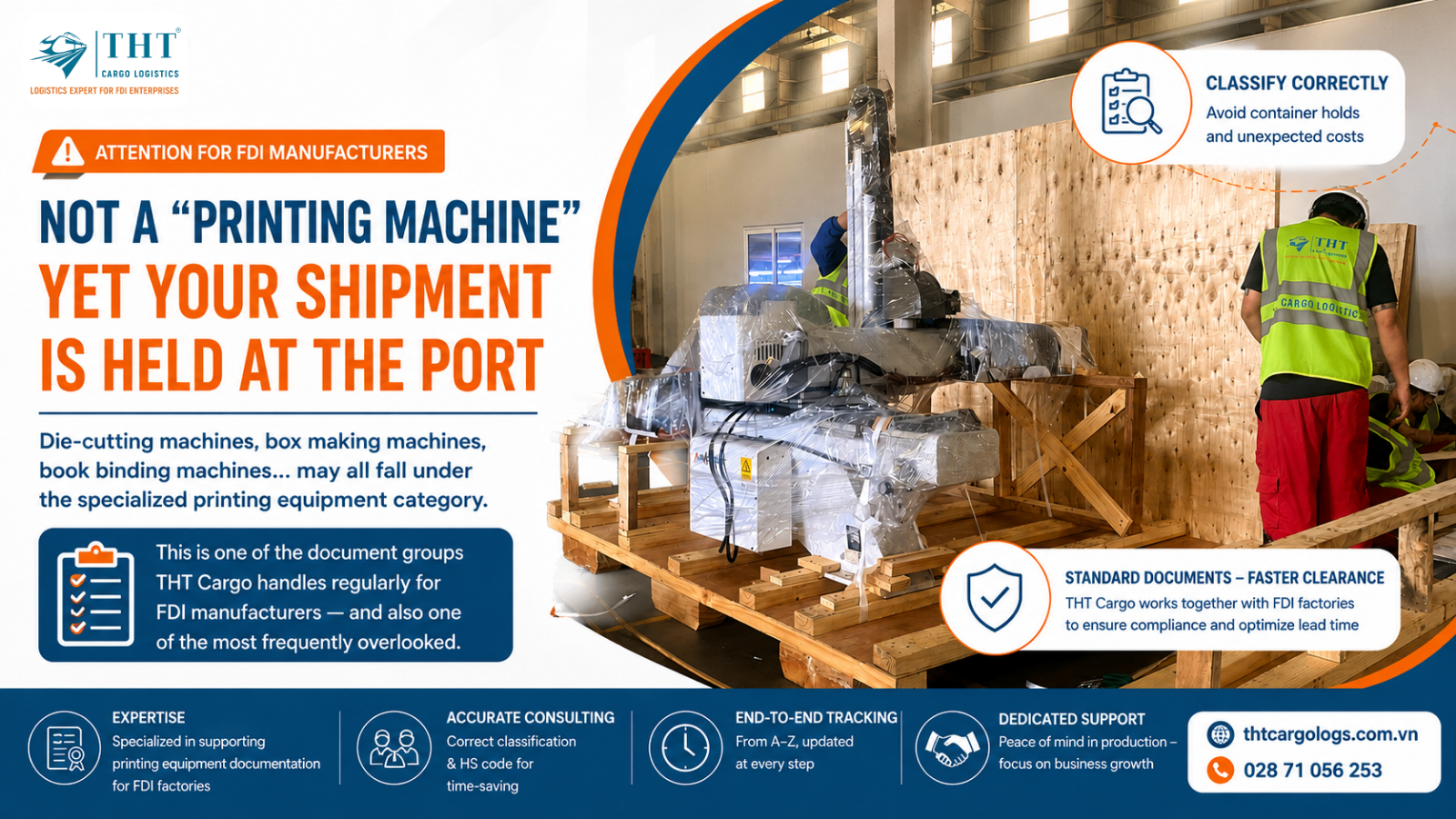
Not a “printing machine” — yet the shipment is still held at the port
Die-cutting machines, box-making machines, bookbinding machines, and other equipment may fall under the specialized regulatory list for the printing sector. This is one of the equipment categories that THT Cargo regularly handles for FDI factories — and also one of the categories businesses are most likely to overlook.
You import a die-cutting machine for a packaging production line. To you, it is simply a mechanical processing machine — seemingly unrelated to the “printing industry.” The customs documents are prepared as they would be for a standard machinery shipment.
Only when the shipment reaches the customs clearance stage do you discover that the machine’s HS code is included in the List of Imported Goods Subject to Printing-Sector Management. Under the regulations, the equipment must be declared as imported printing equipment before customs clearance — but this step was not included in your documentation.
This is not an uncommon situation. Among the equipment shipments that THT Cargo supports for packaging, bookbinding, and prepress operations, this is one of the categories most likely to encounter regulatory issues — and the root cause is almost always the same.
1. Why is it so easy to get this wrong?
Common assumption: only printing machines (offset, flexographic, digital, etc.) require specific procedures; cutting, folding, binding, and box-making machines are simply auxiliary equipment.
Reality: Vietnam’s regulatory framework for printing activities does not regulate only “printing machines.” Under Decree No. 60/2014/ND-CP (as amended by Decree No. 25/2018/ND-CP and Decree No. 72/2022/ND-CP), specialized regulatory management covers the entire printing process: prepress – printing – post-press processing.
And it is precisely the “post-press processing” stage — where cutting, folding, bookbinding, and packaging equipment operates — that contains many of the machines subject to declaration, while also being the area most easily overlooked.
2. The list is much broader than the two words “printing machine”
The List of Imported Goods in the Printing Sector is established based on HS codes, cross-referenced with Circular No. 31/2022/TT-BTC, and further clarified under Circular No. 11/2024/TT-BTTTT (issued on September 23, 2024). Many machine categories have names that do not appear to have anything to do with “printing”:
- Heading 84.40 – Bookbinding machinery: stapling machines, thread-sewing machines, hot-melt binding machines, cover-making machines, paper folding machines, combined finishing machines, and production lines for finishing printed products.
- Heading 84.41 – Cutting and packaging machinery: paper cutting machines (one-side and three-side), slitting machines, die-cutting machines, bag – sack – envelope making machines, and especially machinery for making corrugated cartons, boxes, cylindrical and drum-shaped containers — equipment that is very familiar to packaging and paper-box manufacturers.
- Heading 84.42 – Prepress machinery: film recorders, plate recorders, gravure cylinder engraving machines, plate exposure machines, plate developing/washing machines, and coating machines (offset, flexographic, gravure, letterpress, and screen printing).
- Heading 84.43 – Printing machines and photocopying machines of various types.
Most of the equipment listed above does not carry the name “printing machine” — yet it still falls within the scope of specialized regulatory management based on its HS code. These are precisely the details that THT’s team reviews for customers before ordering, so there are no surprises at the port.
3. “Declaration” ≠ “License application” — but it is still mandatory
The good news is that the procedure is now simpler than before. The declaration of imported printing equipment can be completed entirely online through the National Public Service Portal, with applications received by the Authority of Publication, Printing and Distribution under the Ministry of Culture, Sports and Tourism.
Simpler — but it cannot be skipped. If the equipment has an HS code included in the list, the company is still required to:
- Prepare the Imported Printing Equipment Declaration
- Prepare technical documents and catalogue
- Submit the application online through the Public Service Portal
Skipping this step — even simply because you believe “this is not a printing machine” — means the shipment lacks the required documentation: customs clearance may be delayed, additional documents may be requested, and the company may even face administrative violation proceedings.
4. The cost of overlooking one step
- Warehouse, storage yard, and container detention charges increase with every day the shipment remains on hold.
- Production lines fall behind schedule — affecting orders and delivery commitments to customers.
- Legal and compliance risks arise if the company is found to have incomplete documentation or incorrect declarations.
- Loss of control — urgent handling after the shipment has already arrived at the port is always much more costly than preparing in advance.
5. 3 checks to perform before placing an order
Important: simply matching an 8-digit HS code does not automatically mean that the equipment must be declared (Point b, Clause 2, Article 1 of Decree No. 72/2022/ND-CP). Only goods whose HS codes are listed and whose descriptions identify them as printing equipment in the relevant list are subject to the declaration requirement. Therefore:
- Cross-check the HS code and the machine’s actual technical description (catalogue, machine nameplate) against the List of Imported Goods in the Printing Sector.
- Do not assume that “only printing machines require specific procedures.”
- Prepare the declaration documents in parallel with the ordering process — do not wait until the shipment is about to arrive before taking action.
This review may sound simple, but it sits at the boundary between the “technical description” and the “description in the regulatory list” — an area where an experienced specialist in printing-sector regulations is needed to reach an accurate conclusion.
6. Why FDI enterprises choose THT Cargo for this category of goods
- Specialized expertise in printing-sector regulations: THT reviews the HS-code list for printing-sector goods as an established process — not on a case-by-case basis.
- Review from the ordering stage: determine whether the machine is subject to declaration before the shipment is loaded onto the vessel, so you have full control over the required documentation.
- End-to-end online declaration support: from preparing the declaration and technical documents to submitting the application through the Public Service Portal.
- Supporting FDI factories: understanding the pressure of production schedules and delivery commitments — the goal is on-time customs clearance with no unnecessary waiting charges.
Not sure whether your machine requires a declaration?
Do not let a single HS code leave your shipment “stuck” at the port.
📩 Send us the model and catalogue of the equipment you are planning to import — THT Cargo will review the relevant list and provide you with a conclusion, together with guidance on the required documentation.
Visits: 15