

Air Freight Under Pressure: Capacity Shortage & Rising Costs in 2026
Air cargo is no longer just a flexible backup solution, but has become a high-cost and risk-sensitive segment within the global logistics landscape.
1. Dual Pressure: Limited Capacity & Increasing Costs
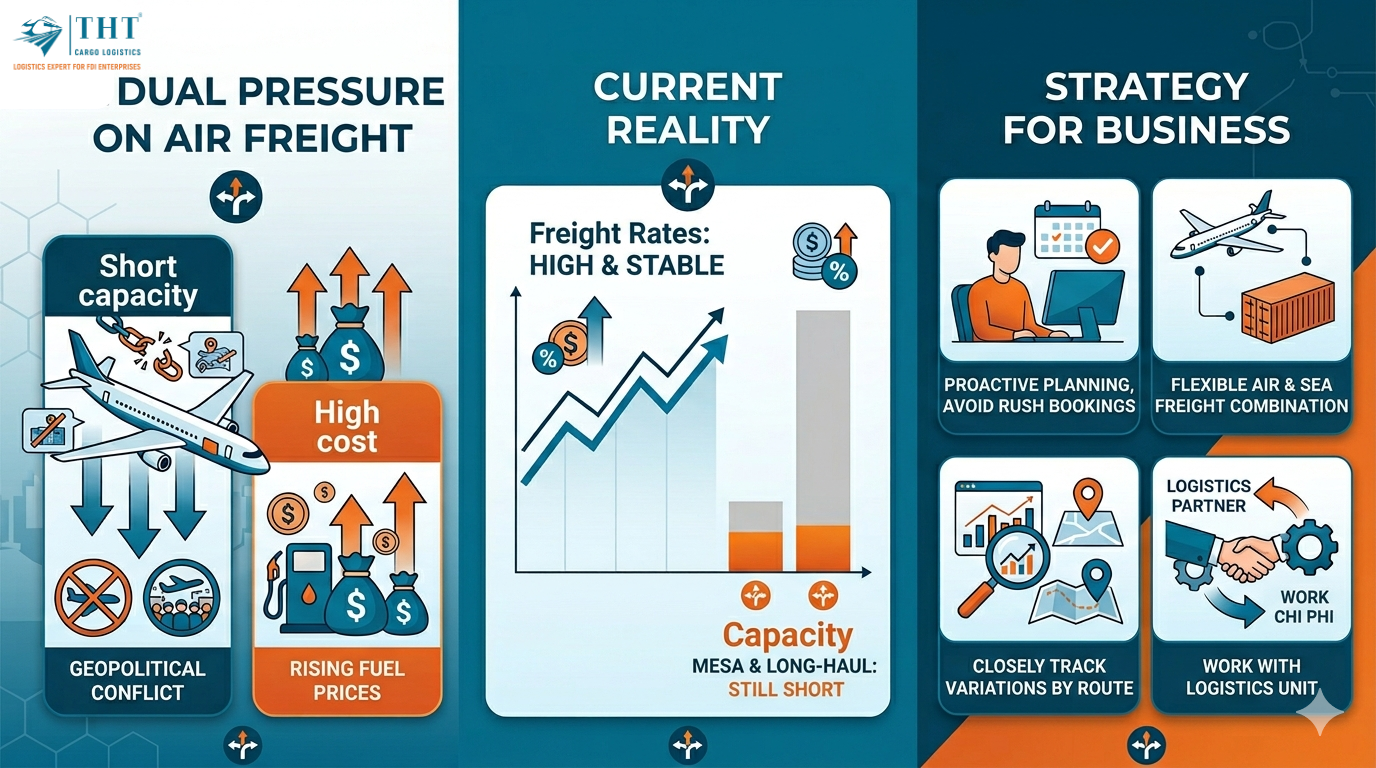
Air freight operations have been heavily impacted by airspace restrictions in conflict-affected regions. Airlines are forced to reroute flights, increasing travel distance, fuel consumption, and reducing effective payload capacity.
As aircraft fly longer routes, fuel costs rise significantly while operational efficiency declines. This results in a persistent shortage of cargo capacity, particularly on long-haul routes such as Asia–Europe and Middle East–Europe.
At the same time, jet fuel prices continue to surge, becoming a key driver behind elevated operational costs. As a result, air freight rates remain at high levels across most major trade lanes.
2. Market Signals: Stabilization at a High Level
- Average global spot rate increased by +1% WoW to $3.73/kg (Week 16)
- Rates have surged by +40% since late February
- Asia Pacific spot rates rose +3% to $5.14/kg
Although the rate of increase has slowed, this does not indicate a cooling market. Instead, it reflects a stabilization at a high cost baseline, as businesses gradually adapt to the new pricing environment.
The relative stability is partly supported by the ongoing ceasefire since early April, allowing limited recovery of capacity in affected regions. However, the situation remains fragile.
3. Capacity Recovery Remains Uneven
- Middle East & South Asia capacity still down ~30% compared to pre-conflict levels
- South Asia capacity has nearly recovered
- Middle East capacity gap narrowed but remains significantly constrained
Despite improvements, supply remains insufficient to meet demand, especially as disruptions in ocean freight push more cargo toward air transport.
4. Demand Remains Strong Despite High Costs
Ongoing disruptions in ocean shipping have forced many businesses to shift part of their cargo to air freight in order to meet delivery deadlines.
This shift maintains strong demand for air cargo, even as prices remain elevated. As a result, the market continues to operate under:
- Freight rates: High and stable
- Capacity: Limited, especially on long-haul routes
- Market condition: Stabilizing but at elevated cost levels
5. Key Insight for Businesses
Air freight is no longer a purely flexible backup option. It is now a cost-intensive logistics solution exposed to geopolitical risks, fuel price volatility, and capacity constraints—similar to ocean freight.
Businesses must rethink their logistics strategies by balancing cost, speed, and risk, while diversifying transportation modes where possible.
The air freight market in 2026 is entering a phase of high-cost stability rather than decline. While rate increases are slowing, prices remain significantly higher than previous years.
Companies should proactively adapt by optimizing logistics planning and closely monitoring market developments to maintain operational efficiency.
Looking for reliable air freight solutions?
THT Cargo Logistics provides end-to-end logistics solutions, from planning and customs clearance to transportation and delivery.
We help businesses optimize costs while ensuring speed, compliance, and supply chain stability.
Visits: 30