

- Why Should Businesses Pay Attention?
- 1. Customs Declaration Requirements
- 2. Carefully Review Certificates of Origin (C/O)
- 3. Product Labeling Requirements for Imported Goods
- 4. Physical Inspection of Goods
- 5. Product Categories Subject to Enhanced Inspection
- Recommendations from THT Cargo Logistics
- Need Assistance Reviewing Product Origin, Labeling, or Customs Documentation?
CUSTOMS STRENGTHENS ORIGIN VERIFICATION AND PRODUCT LABELING INSPECTIONS: WHAT IMPORTERS AND EXPORTERS NEED TO KNOW
📄 Reference Document
Businesses are encouraged to review the full content of Official Dispatch No. 17552/CHQ-GSQL to stay updated on the latest requirements regarding origin verification and product labeling management for import and export activities.
Why Should Businesses Pay Attention?
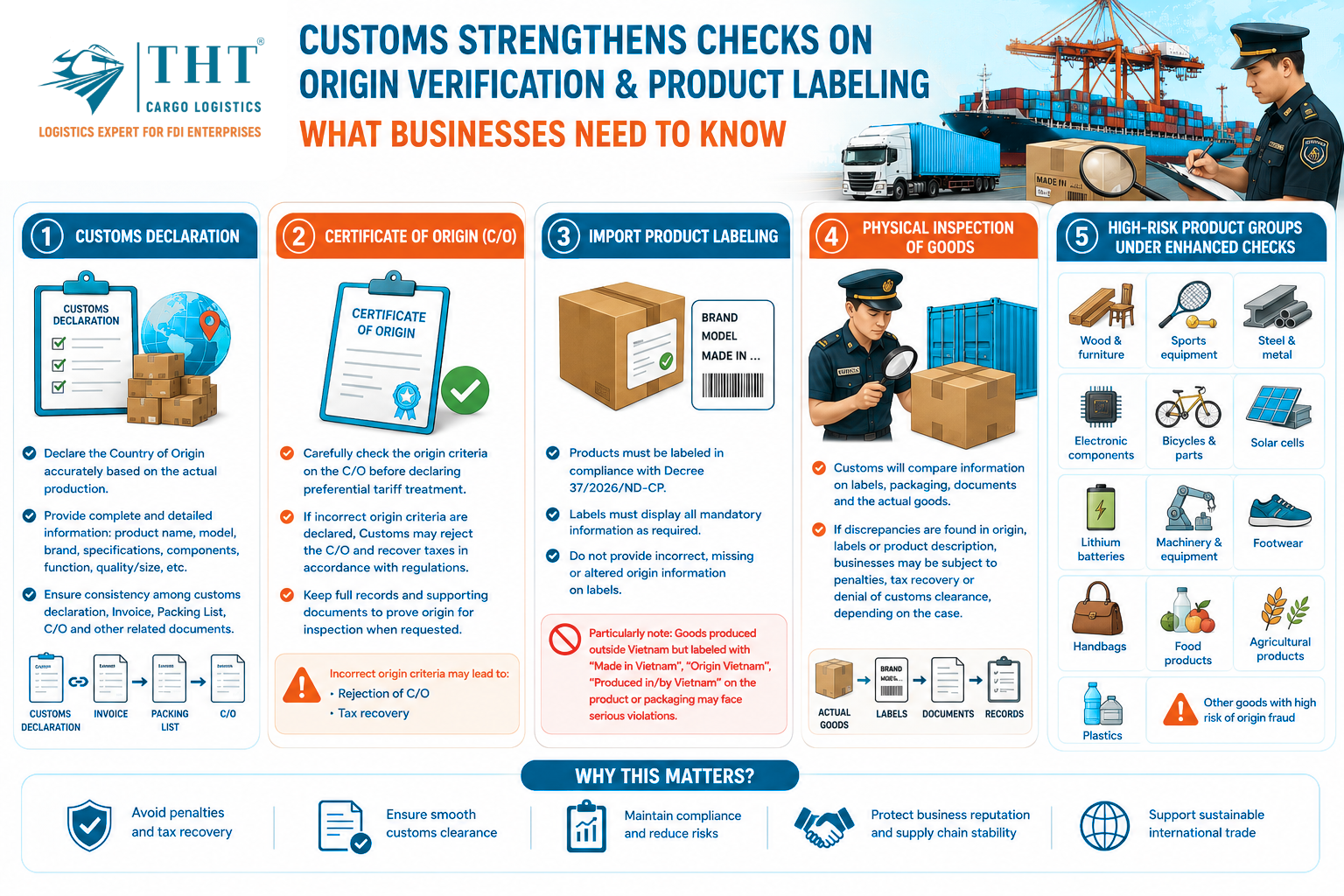
During customs clearance, Customs authorities review not only the customs declaration but also compare information across Certificates of Origin (C/O), commercial documents, product labels, and the actual goods. Any inconsistency among these elements may require additional explanations, supplementary documentation, or lead to regulatory action.
Particular attention is being given to product groups considered at high risk for origin fraud, with stricter inspections aimed at ensuring transparency and compliance in international trade.
1. Customs Declaration Requirements
Businesses should ensure that all information declared accurately reflects the actual characteristics of the goods and remains consistent throughout the supporting documentation.
- Declare the correct Country of Origin based on the actual manufacturing location.
- Provide complete and detailed product information, including product name, model, brand, technical specifications, composition, intended use, and quality specifications.
- Ensure consistency between the customs declaration, Commercial Invoice, Packing List, Certificate of Origin (C/O), and all other supporting documents.
Incomplete declarations or inaccurate product descriptions may result in requests for additional documentation or physical cargo inspections.
2. Carefully Review Certificates of Origin (C/O)
The Certificate of Origin (C/O) is a critical document for obtaining preferential tariff treatment under Free Trade Agreements (FTAs). Businesses should thoroughly verify all information before submitting customs declarations.
| Item to Review | Key Consideration |
|---|---|
| Origin Criteria | Verify compliance with the applicable FTA rules before claiming tariff preferences. |
| Information on the C/O | Ensure consistency with the Commercial Invoice, Packing List, and customs declaration. |
| Supporting Origin Documents | Maintain complete records for submission upon Customs request. |
If incorrect origin criteria are declared, Customs may reject the Certificate of Origin and recover the applicable import duties in accordance with current regulations.
3. Product Labeling Requirements for Imported Goods
Imported products must comply with the labeling requirements stipulated under Decree No. 37/2026/ND-CP.
- Products must be labeled in accordance with applicable regulations.
- Labels must contain all mandatory information required by law.
- Origin information must not be inaccurate, incomplete, or altered.
- Special Notice: Foreign-manufactured goods displaying statements such as “Made in Vietnam”, “Origin Vietnam”, or “Produced in/by Vietnam” on the product or packaging may be considered a serious regulatory violation.
4. Physical Inspection of Goods
During physical inspections, Customs authorities compare multiple sources of information to verify the accuracy of customs declarations.
| Inspection Item | Potential Risk if Inconsistent |
|---|---|
| Product Labels | May result in administrative penalties or requests for clarification. |
| Packaging | Compared against declared customs documentation. |
| Commercial Documents | Reviewed for consistency across all supporting documents. |
| Actual Goods | Discrepancies may lead to penalties, additional duty assessments, or customs clearance refusal. |
5. Product Categories Subject to Enhanced Inspection
Customs authorities are strengthening inspections for product groups considered to have a higher risk of origin fraud, including but not limited to:
- Wood and furniture products
- Sporting goods
- Steel and metal products
- Electronic components
- Bicycles and bicycle parts
- Solar panels
- Lithium batteries
- Machinery and industrial equipment
- Footwear
- Handbags
- Food products
- Agricultural products
- Plastic products and other commodities considered at high risk for origin fraud
Recommendations from THT Cargo Logistics
As Customs authorities continue strengthening inspections related to origin verification and product labeling, businesses should proactively review their documentation before cargo arrives rather than waiting until customs declaration.
Ensuring consistency across customs declarations, commercial documents, Certificates of Origin, product labels, and technical documentation helps minimize the risk of prolonged inspections, additional duty assessments, customs penalties, and unexpected logistics costs.
Need Assistance Reviewing Product Origin, Labeling, or Customs Documentation?
THT Cargo Logistics assists businesses in reviewing product classifications, verifying origin requirements, assessing Certificates of Origin (C/O), checking product labeling compliance, providing HS code consultation, and handling customs procedures to minimize customs clearance delays, additional duty assessments, and compliance risks.
With extensive experience supporting FDI manufacturers and import-export businesses, THT helps standardize customs documentation from the beginning of the logistics process, ensuring shipments comply with regulatory requirements and move through customs efficiently.
Visits: 23