



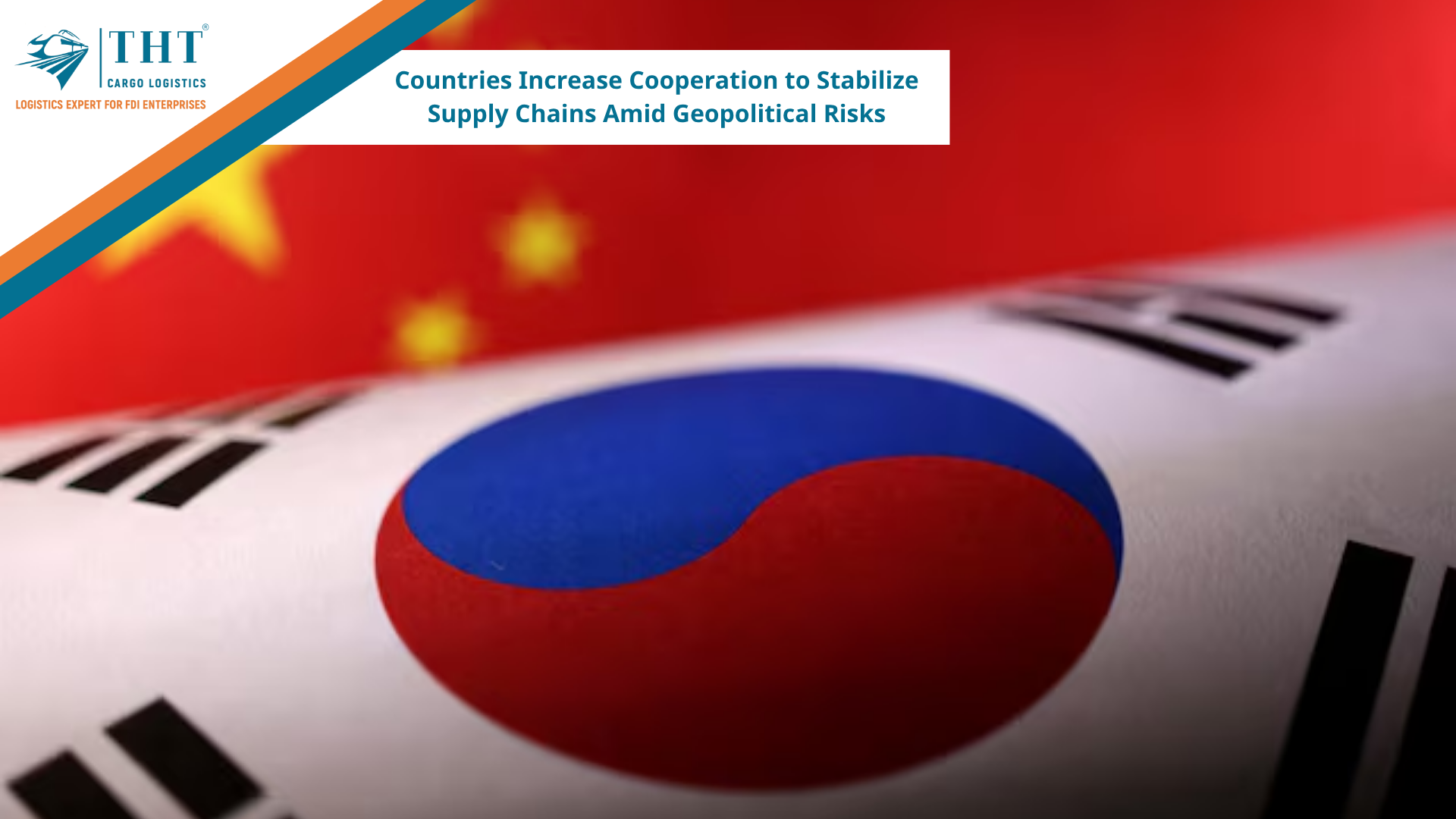
Countries Increase Cooperation to Stabilize Supply Chains Amid Geopolitical Risks
Amid ongoing geopolitical tensions and trade conflicts affecting global trade, many countries are increasing cooperation to ensure supply chains are not disrupted, especially for critical industries such as semiconductors, batteries, and rare materials.
One notable development is the commitment by China and South Korea to strengthen trade cooperation and coordination to maintain regional supply chain stability amid rising geopolitical risks.
China and South Korea Strengthen Cooperation in Strategic Industries
According to official statements following meetings between the trade and industry ministers of the two countries, China and South Korea will increase cooperation in key industrial sectors such as:
- Semiconductors
- Lithium batteries
- Rare earth materials and permanent magnets
- High technology industries
- Industries supporting aging populations
The two countries also agreed to establish coordination mechanisms to respond quickly in case of logistics delays or raw material shortages, while improving forecasting capabilities and stabilizing supply chains for strategic goods.
This development shows that industrial supply chains are no longer just a matter of trade, but also involve national strategy and economic security.
The United States and Allies Promote Regional Supply Chains
At the same time, the United States and its allies are promoting strategies to build supply chains closer to the Asia-Pacific region to reduce dependence on certain countries and minimize risks from trade conflicts or geopolitical tensions.
These trends are commonly referred to as:
- Nearshoring
- Friend-shoring
- Regional supply chain
- China+1 strategy
These strategies are reshaping global supply chain structures as companies and governments seek to diversify suppliers, production locations, and logistics routes.
Supply Chains Are Increasingly Influenced by Geopolitics
Recent developments show that global supply chains are no longer driven solely by production costs or economic efficiency, but are increasingly influenced by geopolitics, national strategies, and economic security.
Major supply chain trends today include:
- Diversifying raw material sources
- Diversifying manufacturing countries
- Building regional distribution hubs
- Developing intra-regional logistics
- Increasing multimodal transportation
- Reducing dependence on a single transport route or a single country
This makes global logistics networks more complex, but also increases demand for international logistics services, particularly multimodal transport, regional distribution hubs, and regional logistics services.
Conclusion
Cooperation efforts between China, South Korea, and major economies indicate that global supply chains are entering a period of significant restructuring. Instead of relying on a single manufacturing hub or a single transport route, future supply chains will be built on multi-center, multi-route, and more flexible models to adapt to geopolitical and trade risks.
TELL US WHAT YOU NEED!
Visits: 18